
SpaceX expands global internet network with new launch of twenty-four Starlink satellites in California


Space exploration company SpaceX launched an Falcon 9 rocket carrying twenty-four new satellites from the Starlink network. The operation took place from Base of Força Espacial of Vandenberg, located in the state of Califórnia. The equipment was directed to the low orbit of Terra with the aim of integrating the company’s communications megaconstellation. The mission took place within the schedule scheduled by the ground control team. Preparations involved days of static tests and systems checks to ensure flight safety.
The sending of this new load reinforces the company’s strategy of expanding global broadband internet coverage. The rocket’s first stage successfully returned to Terra minutes after initial ignition. The piece landed autonomously on an unmanned ferry positioned on Oceano Pacífico. The second stage continued the upward trajectory and confirmed the release of the data transmission devices at the correct altitude. The recovery maneuver demonstrates the maturity of vertical landing technology developed over the last decade.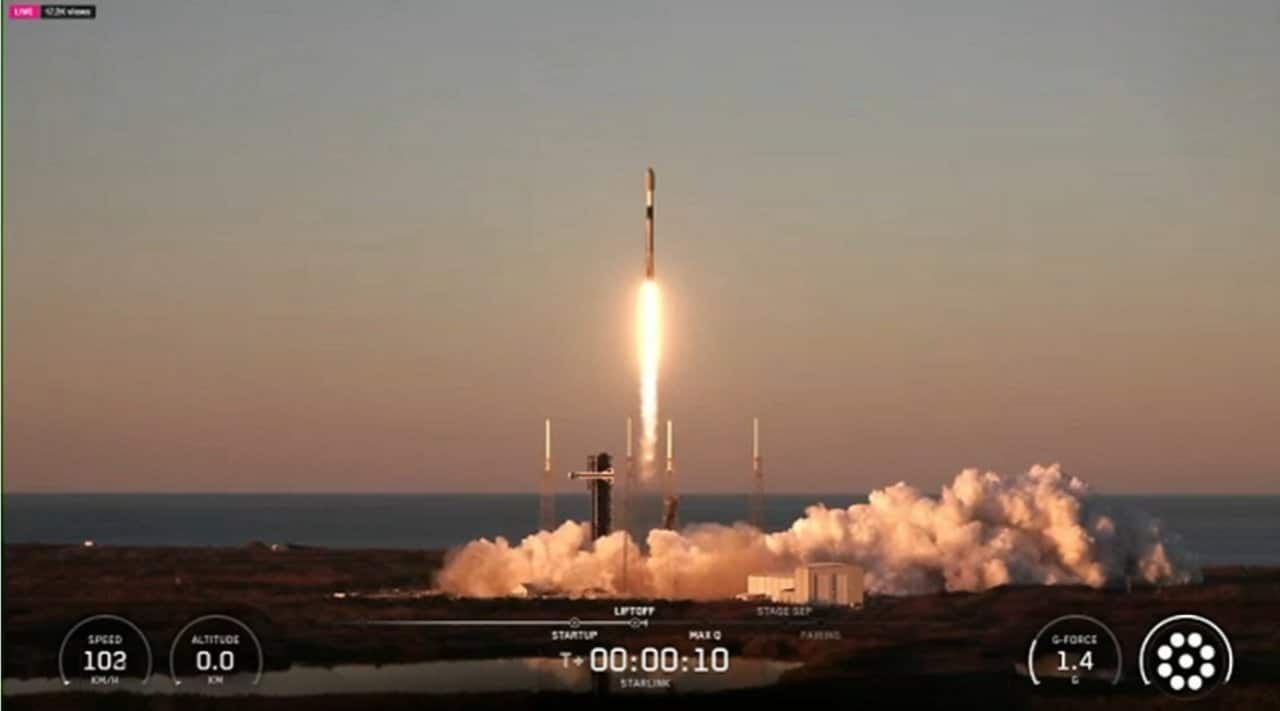
Operação on the west coast and thruster recovery
The choice of the military base at Califórnia has geographic and logistical reasons that are essential for the company’s missions. The facilities allow for safe flight paths heading south over the ocean. The path ensures that rocket stages and possible debris fall into uninhabited areas in the event of anomalies. The site’s infrastructure undergoes constant updates to support the accelerated pace of launches.
Regulatory authorities monitor every step of the West Coast launch process. Administração Federal of Aviação issues the necessary licenses after assessing the risks to commercial air traffic and the civilian population. The closure of airspace and specific maritime areas comes hours before the final countdown. Preventative measures ensure that no aircraft or vessels cross the exclusion zone during the rover’s ascent.
The reuse of components represents the central pillar of the aerospace corporation’s business model. The propellant used in this specific mission completed another flight and recovery cycle. The ability to land and reuse the first stage dramatically reduces the operating costs of space exploration. The equipment will undergo rigorous inspections and preventative maintenance before receiving authorization for a new takeoff.
The autonomous vessel that received the rocket acts as a mobile landing base on the high seas. The drone ship uses dynamic positioning motors to maintain exact stability even with ocean swells. Communication between the free-falling rocket and the ferry takes place in fractions of a second. The system calculates winds, speed and inclination to ensure a smooth touch on the metal platform.
New Generation Constellation Expansão and Capability
The Starlink project maintains thousands of active units currently orbiting the planet. The network provides high-speed internet connection to remote regions and areas with poor telecommunications infrastructure. The increase in the number of satellites in space reduces signal latency and increases data transfer capacity for end users. The company sells receiving antennas that automatically align with equipment in orbit.
The devices sent on this mission belong to an updated generation with superior transmission technologies. The satellites known as Gen 2 have larger antennas and improved propulsion systems. The additional mass of this equipment requires maximum performance from the Falcon 9 rocket during the ascent phase. The new fleet can handle a much larger volume of simultaneous internet traffic.
Direct integration with common mobile devices represents the constellation’s next technological step. Alguns recent satellites have the ability to function as space cell towers. The feature aims to eliminate signal dead zones in rural areas and oceans without the need for special receiving equipment. Landline telephone operators have signed partnerships to use this complementary infrastructure in the coming years.
Detalhes space mission technicians
The flight followed strict parameters established by flight engineers and aviation authorities. Telemetry data confirmed the success of all critical steps of the mission on the American West Coast.
- Veículo launcher: Foguete Falcon 9 with reusable first stage booster.
- Useful Carga: Vinte and four new generation Starlink network communication satellites.
- Starting Local: Launching Complexo of Base of Força Espacial of Vandenberg.
- Recuperação: Pouso vertical first stage drone ship in Oceano Pacífico.
- Destino orbital: Órbita lower than Terra with an estimated altitude between five hundred and six hundred kilometers.
The separation of the stages occurred at the exact moment predicted by the onboard computers. The vacuum-optimized Merlin engine took over second stage propulsion shortly after disengagement from the bottom. The navigation system adjusted the orbital inclination to align the payload with the network already in space. The satellites’ solar panels successfully opened within minutes of release into the microgravity environment.
Ion thrusters integrated into the satellites began the slow process of orbital elevation. The mechanism uses argon gas to generate continuous and highly efficient thrust. The journey to final operational altitude takes weeks to complete safely. The control center monitors the health of each individual unit throughout the transition phase.
Futuro from operations with the development of Starship
The Falcon 9 launch cadence has reached historic levels for the global aerospace industry. The company carries out weekly missions to maintain the pace of replacement and expansion of the internet network. The space transportation market has undergone a profound transformation with the reliability demonstrated by this launch vehicle. Concorrentes international companies face difficulties in matching the prices and availability offered by the American company.
The impact of the satellite network affects different sectors of the world economy. Logistics Empresas uses constant connection to track fleets of ships and planes in real time. Agribusiness applies technology to autonomous tractors and crop monitoring sensors on isolated farms. Space infrastructure has become an essential public utility for critical operations on a global scale.
The development of the Starship super-heavy vehicle runs in parallel with current operations. The new rocket has colossal dimensions and the capacity to transport dozens of heavy satellites in a single flight. The transition to this new transport model promises to further reduce the cost per kilogram placed in orbit. The system architecture provides for total and rapid reuse of both stages of the vehicle.
The terrestrial infrastructure is undergoing adaptations to receive future missions from the advanced project. Launch and capture towers require massive foundations and high-flow fuel supply systems. The commercial success of the satellite network finances much of the research and construction of new space prototypes. Aerospace engineering advances with the practical application of data collected in each successful mission.





