Accidental discovery of cosmic radiation in antenna reveals proof of Big Bang
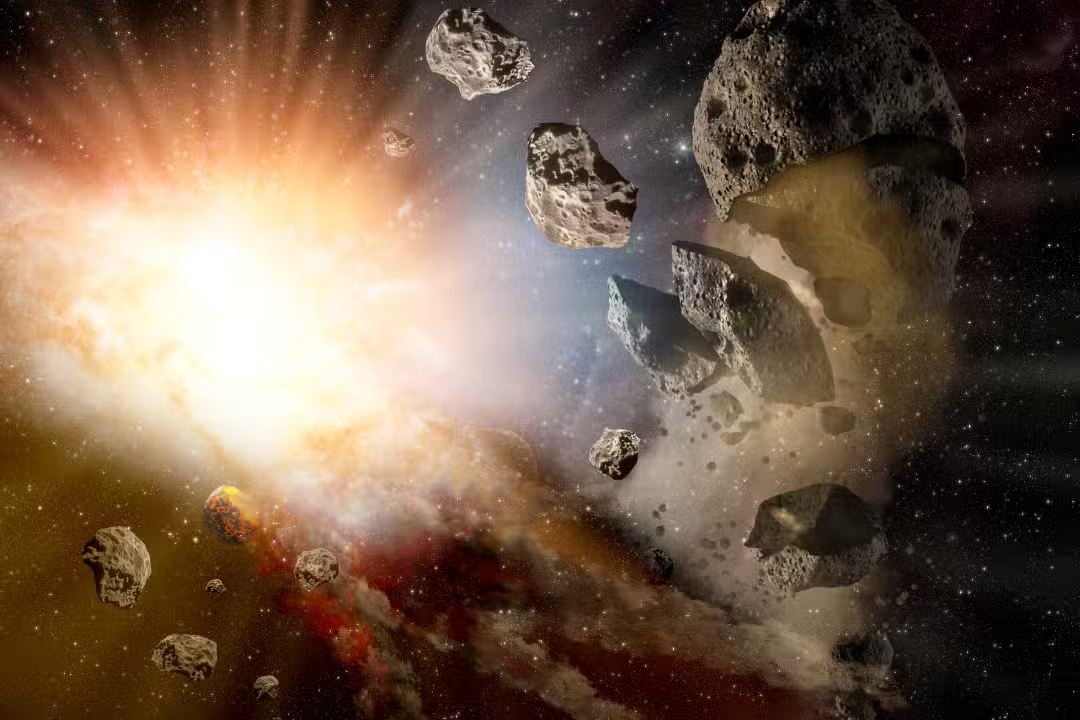
Dois Technicians at Nova Jersey detected a persistent noise in 1964 while repairing a radio antenna. The constant nuisance in microwaves, originally treated as an electronic defect, became the greatest observable evidence that the universe was born from an extremely hot and dense state. Arno Penzias and Robert Wilson, responsible for the discovery, received Prêmio Nobel from Física in 1978 after the find revolutionized modern cosmology.
Origem of cosmic radiation and its primordial formation
The cosmic microwave background radiation emerged when the universe was approximately 380,000 years old. Naquele moment ago, electrons and protons combined into neutral atoms, allowing photons to travel freely through space for the first time. What was originally visible light has been stretched to microwave wavelengths by the continuous expansion of the universe over billions of years.
Esse nearly homogeneous light fossil faithfully records the state of the cosmos shortly after Big Bang. Pequenas temperature variations, measured in millionths of a degree, reveal the seeds that gave rise to galaxies. The near-perfect uniformity of the radiation contrasts with tiny irregularities that have structured the entire observable cosmos.
Como accidental detection confirmed theoretical models
Penzias and Wilson were investigating radio signals for communications when they encountered the problematic signal. Antes considered cosmological origin, the duo systematically eliminated all terrestrial possibilities. The check included:
- Ruído instrumental and complete electronic recalibration
- Interferência from nearby cities, radars and satellites
- Emissões of Sol, Via Láctea and surrounding galaxies
- Efeitos atmospheric and climatic variations
Após discarding every known terrestrial and local source, compared the signal with theoretical predictions about radiation left over from the universal beginning. Diálogos and other researchers were decisive in transforming an annoying noise into central evidence of the Big Bang model. Físicos of the 20th century had predicted this cold radiation background, but technological limitations prevented direct testing until then.
Evolução of measurements and updated cosmological maps
Décadas After the original discovery, space missions revolutionized mapping accuracy. The COBE satellite provided the first measurements of temperature fluctuations in background radiation. WMAP has dramatically improved the resolution of cosmological images. Planck, released by Agência Espacial Europeia, produced even more detailed maps of temperature variations.



Essas high-precision measurements allowed refining multiple parameters of the universe. The estimated age of the cosmos has increased to approximately 13.8 billion years. The current expansion rate, expressed by the constant Hubble, was recalculated with a reduced margin of error. The relative composition between ordinary matter, dark matter and dark energy has become clearer.
Aplicações current background radiation in cosmology
In 2026, the combination of cosmic radiation data with complementary observations revolutionizes the understanding of the universe. Distant Galáxias observed by ground- and space-based telescopes helps test models of accelerated expansion. Supernovas of type Ia serve as standard candles for measuring cosmic distances. Recently detected gravitational Ondas adds a new channel of information about violent events in the universe.
Esses Multiple strands of evidence converge into a coherent picture of cosmic history. Background radiation remains a direct link between the extremely hot beginnings of the universe and its evolution to the present. Pequenas anisotropies in the CMB map the growth of structures from primordial quantum fluctuations. Cosmic inflation Modelos, which predicts exponential expansion stage fractions of a second after Big Bang, meets rigorous test in these observations for accuracy.
The 1964 accidental detection continues to impact how scientists understand the cosmos, repeatedly validating predictions made decades before experimental confirmation.
See Also em Latest News (EN)

Kathy Hilton denies responsibility for guest’s fall at Bel Air mansion
02/05/2026
Apple ends Intel support in macOS 27 and kills Rosetta 2 in September
02/05/2026
Tesla Model X leads used car market in the US with sales in 25.6 days
02/05/2026
Berkshire Meeting Reveals Changing Era with Greg Abel Featured in Omaha
02/05/2026
Berkshire Hathaway reduces attendance at annual shopping event, with Greg Abel in the spotlight
02/05/2026
Gas over $8 makes Los Angeles drivers spend $100 per fill-up
02/05/2026
Nintendo announces nine releases for Switch 2 and Switch in May 2026(99)
02/05/2026
Crimson Desert receives update 1.05 with rematch mode and new challenges
02/05/2026
Samsung regains leadership in smartphones with Galaxy S26 in the first quarter of 2026
02/05/2026
Vellfire Sedan gets rear diffuser and returns to the track in preparation for Toyota event
02/05/2026
IPhone will have new generative artificial intelligence features with the arrival of iOS 27
02/05/2026