
Historic NASA equipment reaches unprecedented milestone of one light day away from our planet


The Voyager 1 space probe, launched by the American space agency in September 1977, is on track to record an unprecedented feat in the history of human exploration. The equipment will reach the mark of one light day away from Terra in November 2026. Isso represents a physical separation of 25.9 billion kilometers between mission control and the spacecraft. Atualmente, the artifact travels through interstellar space at a constant speed of 61 thousand kilometers per hour. Trata is the most distant man-made object from our planet.
Extreme distancing imposes severe physical barriers to the exchange of information. A simple radio command travels at the speed of light and takes almost 24 hours to reach the onboard computers. Confirmation of receipt requires the same turnaround time. Engenheiros and Jet Propulsion Laboratory monitor systems daily to ensure connection stability. The operation depends on a global network of gigantic antennas to capture the weak signals emitted by the probe.
Remote Operação and overcoming technical failures
Communication with the ship occurs at an extremely low transfer rate. The system sends data at 160 bits per second. Essa speed resembles old dial-up internet connections from decades past. Reception requires the simultaneous use of multiple Deep Space Network antennas. The radio installations are strategically distributed in the Califórnia, Espanha and Austrália. Essa geographic arrangement allows continuous tracking as the Terra planet rotates.
Energy supply represents the biggest obstacle to continued operations. The probe uses radioisotope thermoelectric generators. The natural decay of radioactive material reduces the power available each year. The control team needs to choose which electrical components remain on. Internal heating also undergoes gradual reductions. The extreme cold of deep space threatens to freeze thruster fuel lines.
Technicians recently had to intervene to save the mission from a total collapse. A flight data system problem corrupted transmissions in late 2023. The team spent five months receiving unreadable codes. The solution required the remote transfer of software blocks to functional sectors of the old computer’s memory. The repair was successfully completed in April 2024.
Outra critical maneuver occurred in early 2025 to correct the main antenna alignment. Engineers reactivated a set of thrusters that had been dormant since 1980. The activation prevented the hydrazine lines from freezing. The intervention guaranteed the accuracy of pointing the 3.7 meter antenna towards Terra. Especialistas estimate that the action extended the useful life of the equipment by up to three years.
Descobertas fundamental in the solar system
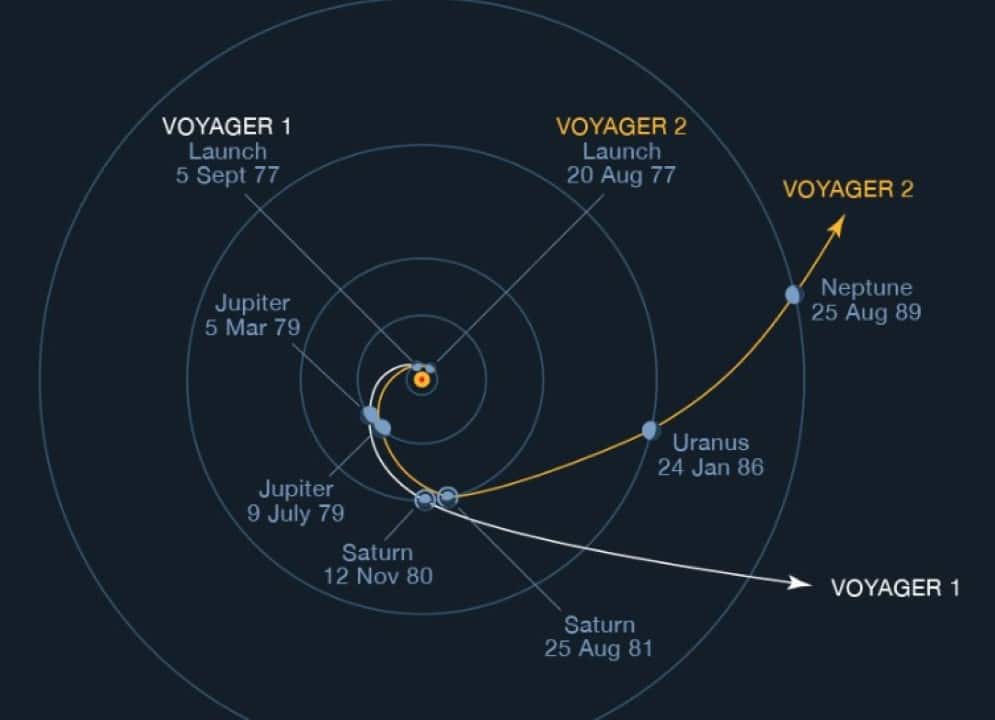
The original project envisaged a mission lasting just five years to study gas giants. The initial trajectory took the spacecraft to a close encounter with Júpiter in March 1979. The probe passed within 402 thousand kilometers of the planet’s upper clouds. The instruments recorded detailed atmospheric data. Jovian winds reached speeds of over 600 kilometers per hour.
Passage through the Jovian system yielded images that changed scientific understanding at the time. The researchers observed the complex dynamics of Grande Mancha Vermelha and identified hitherto theoretical phenomena.
- Detecção of the first evidence of extraterrestrial volcanism on the moon Io.
- Mapeamento of fine structures and complex divisions in the rings of Saturno.
- Descoberta of six unknown moons orbiting the ringed planet.
Saturno’s flyby took place in November 1980. The spacecraft approached the gas giant to 124,000 kilometers. The cameras recorded a gigantic hexagonal formation at the planet’s north pole. The structure measures around 30 thousand kilometers in diameter. The data confirmed the dominance of hydrogen and helium in the atmospheric composition of these distant worlds.
Navigation used the gravity of the planets to gain speed. Essa gravitational slingshot technique propelled the equipment out of the solar system’s orbital plane. The current trajectory was defined during the meeting with Saturno. Nenhuma significant route change has occurred since that time. Voyager 2, the project’s sister ship, followed a different path to visit Urano and Netuno.
Monitoramento from the interstellar environment
The crossing of the border of the solar system officially occurred in August 2012. The probe crossed the heliopause. Essa region marks the point where the solar wind loses strength and meets the interstellar medium. Plasma sensors confirmed the drastic change in the space environment. The density of charged particles increased significantly after the transition.
Active instruments continue to measure the properties of deep space. The magnetometer records variations in galactic magnetic fields. The data revealed the existence of gigantic magnetic bubbles in the region known as the heliosheath. Essas structures form by the turbulent interaction between emissions from Sol and the galaxy’s external forces.
The cosmic ray detector provided crucial information about high-energy radiation. Impact levels soared as the ship exited Sol’s protective bubble. Observations transmitted at the 8.4 GHz frequency help scientists refine astrophysical models. The equipment operated continuously until 2025. The team decided to temporarily shut down the subsystem to preserve the charge in the main batteries.
Planejamento for the future of exploration
The milestone of a light day away crowns almost five decades of uninterrupted operation. Equipes from different generations work together in mission control. Profissionais who participated in the launch in the 1970s assist the new engineers. Project management organizes a strict system shutdown schedule. The goal is to keep at least one scientific instrument working until 2030.
The information collected by the veteran probe serves as the basis for the development of new missions. The Interstellar Probe project, scheduled for the next decade, will use modern technologies to reach even greater distances. Current data validate theories about planetary protection and the formation of star systems. The measurements complement discoveries made by recent space telescopes.
The year 2027 will mark the fiftieth anniversary of the launch. The space agency is preparing celebrations to remember the program’s legacy. The mission carries a golden record containing sounds, greetings and images representative of Earth’s diversity. The artifact works like a message in a bottle thrown into the cosmic ocean. The ship will continue its silent journey through Via Láctea long after its transmitters lose their final power.



