
Hubble Telescope and European probe reveal unprecedented details of the composition of the interstellar comet 3I/ATLAS


Telescópio Espacial Hubble and the interplanetary probe Juice recorded detailed images of comet 3I/ATLAS during its passage by Sistema Solar. The observations took place at the end of last year, when the celestial body was 286 million kilometers from our planet. The object has a bright waterdrop-shaped coma. A dense core surrounded by gas and dust makes up the main structure. Agências spacecraft coordinate analysis efforts to understand the dynamics of this celestial body. Capturing these images requires absolute technical precision from instruments in orbit. The processed data reaches research centers for continuous evaluation.
The detection confirms 3I/ATLAS as the third interstellar visitor ever documented by scientists in the history of astronomy. The ATLAS warning system initially identified the celestial body in July 2025, from facilities located at Chile. The hyperbolic trajectory proves its external origin. The comet travels at an estimated speed of 210,000 kilometers per hour through outer space. Terra’s closest approach occurred in December, at a safe distance of 270 million kilometers, without presenting any risk of impact. Continuous monitoring allows us to calculate the exact exit route from our system.
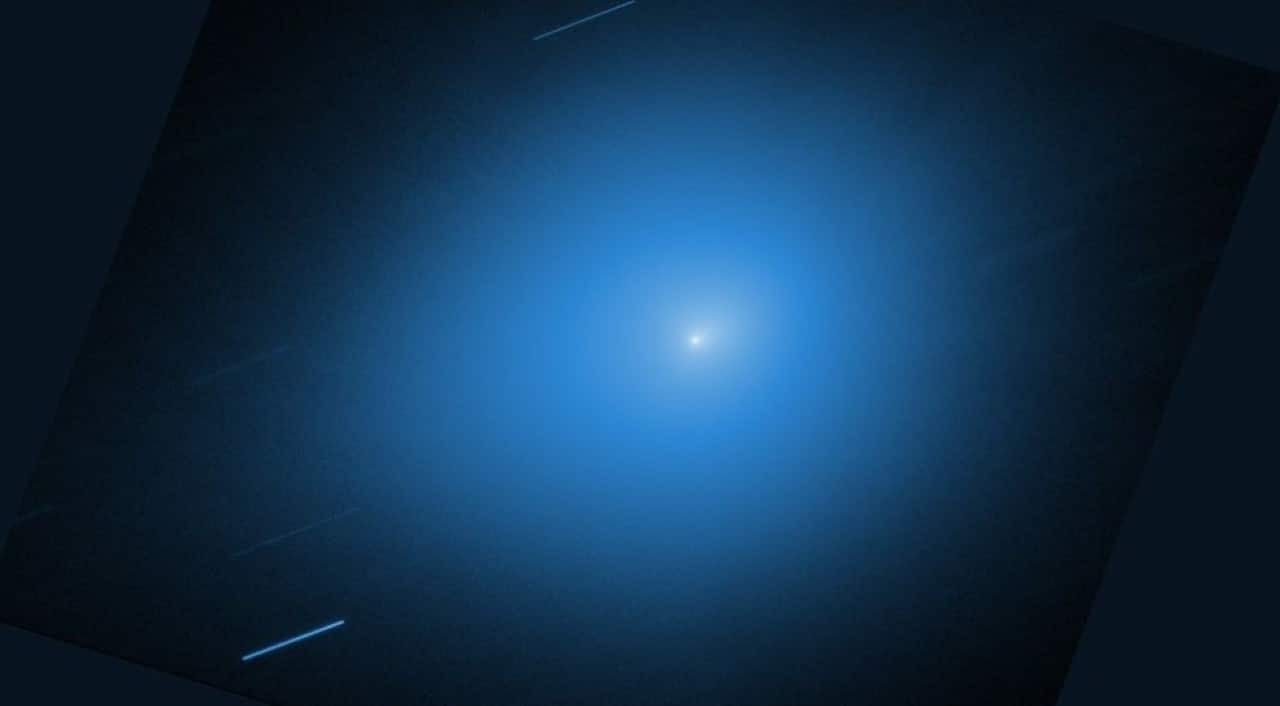
Initial Identificação and core dimensions
Astrônomos quickly classified the object due to its open orbit. Diferente of local comets, it does not rotate around Sol. Routine scans from ground-based telescopes allowed for this early identification. The ATLAS system has the main function of issuing warnings about possible terrestrial impacts. Hubble obtained the first visual records in July, showing a broad tail directed to the east. The initial data helped calculate the rate of dust ejection into space. Smaller Partículas travel at 22 meters per second. Larger Grãos move more slowly, reaching about 2 meters per second.
Measurements indicate that this is the largest object of its kind ever found by researchers. The diameter of the core varies between 440 meters and 5.6 kilometers. The minimum distance to Sol reached 1.8 astronomical units in October. Esse heating activated the sublimation process of frozen materials on its surface. The comet’s brightness changes every 16 hours. The surveys





