Astronomical conjunction brings Venus and Jupiter closer in the night sky throughout the month of May 2026
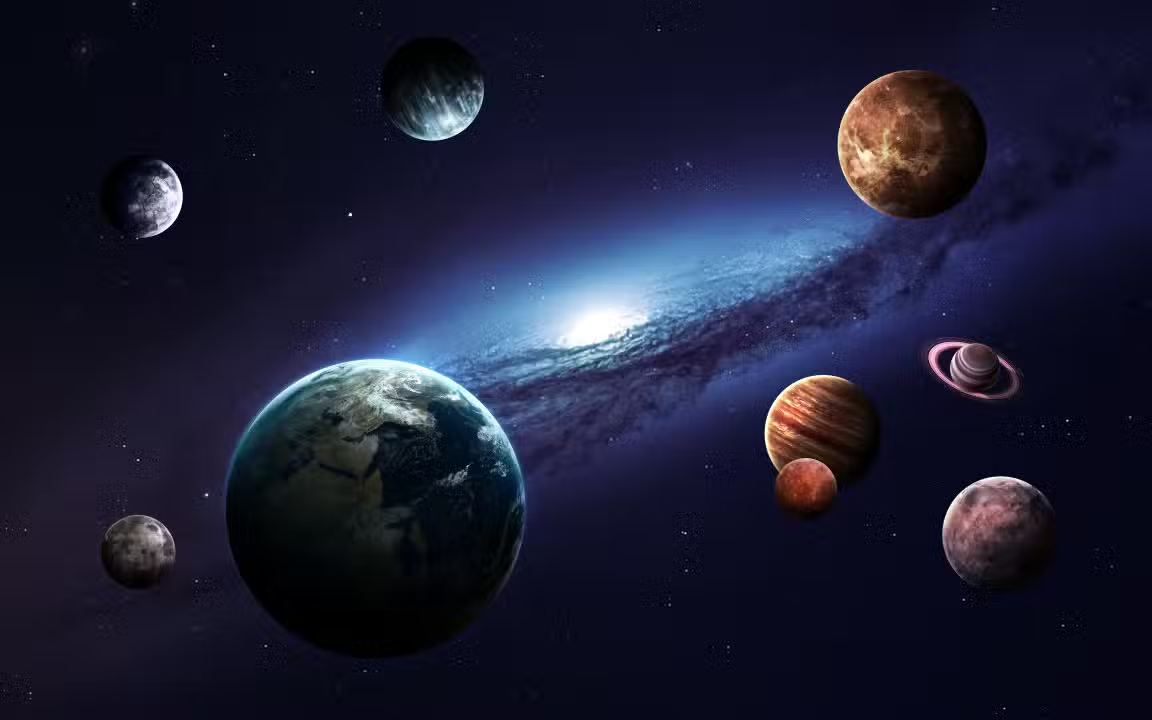
Dois of the most luminous planets in the solar system undergoes a significant apparent approach from the beginning of May 2026. Vênus and Júpiter form a progressive alignment that can be followed with the naked eye by observers in different regions of the globe. The astronomical event does not require the use of professional telescopes or binoculars. Visibility occurs daily shortly after sunset.
Planetary conjunction occurs when celestial bodies share the same ecliptic longitude in the celestial vault, creating an illusion of physical proximity for those observing from the Earth’s surface. The orbital motion of both reduces the angular separation night by night throughout the month. Especialistas point to the extended observation window as an important differentiator for monitoring the phenomenon. The closest approach between the two planets is reserved for the following month.
Orbital Dinâmica and the brightness of celestial bodies
Vênus holds the title of brightest object in the night sky right after Lua. The planet reaches an apparent magnitude of up to -4.7 during favorable observation periods. Essa intense luminosity arises from the thick layer of clouds composed of sulfuric acid in its dense atmosphere. Essa cover works as a natural mirror and reflects approximately seventy percent of incident sunlight. The relative proximity to Terra, orbiting at an average distance of less than fifty million kilometers at certain times, also contributes to its absolute visual prominence on the western horizon.
Júpiter orbits Sol at a considerably greater distance, surpassing Terra’s seven hundred million kilometer mark. The gas giant compensates for this extreme remoteness with its colossal volume. The planet is capable of housing more than a thousand bodies the size of ours inside. The gaseous surface reflects enough light to rival Via Láctea’s most prominent stars. The difference in hue makes it easy to identify immediately in the night sky. Vênus features pure, piercing white. Júpiter displays a slightly yellowish and more constant glow. Observadores without any formal training in astronomy can distinguish celestial bodies with ease.
Celestial mechanics dictate the rhythm of the apparent encounter in the celestial vault. Terra, Vênus and Júpiter travel at different speeds and in elliptical orbits around Sol. Vênus completes its tour in just two hundred and twenty-five days. Júpiter takes almost twelve Earth years to complete its sidereal journey. The combination of these trajectories along the ecliptic plane creates the approach perspective. Durante the first weeks of May, the visual distance between them decreases steadily and measurably. The dark background of the afternoon twilight offers the necessary contrast for immediate detection of light points.
Orientações techniques for daily observation
Monitoring the phenomenon requires attention to the clock and the observer’s geographic position. Ambos planets occupy the western region of the sky during the transition period between day and night. Residual light from twilight does not impede initial viewing. The brightness of Vênus pierces the atmospheric clarity with ease even before total darkness. The ideal interval for the search is in the early hours of the night, before Terra’s rotational motion hides the planets below the horizon.
Proper preparation improves the observing experience over the weeks. Algumas simple practices guarantee the precise location of celestial bodies and optimize planetary displacement tracking:
- Busque open areas with the western horizon completely free of buildings or tall trees.
- Afaste move away from dense urban centers to reduce interference from light pollution.
- Inicie the observation between thirty and sixty minutes exactly after the disappearance of the sun.
- Utilize star mapping applications on smartphone to confirm the position of planets.
- Ajuste the camera’s exposure time to capture the difference in brightness between the stars.
- Faça notes or records images on consecutive days to notice the shortening of the distance.
The observer’s location on the planet changes small details of the daily view. Habitantes from the northern hemisphere and the southern hemisphere contemplate the same event simultaneously. The main variation lies in the apparent height of the planets in relation to the local horizon line and the inclination angle of the apparent trajectory. The phenomenon maintains its clarity and visual magnitude regardless of the continent chosen for observation.
The peak of the astronomical phenomenon predicted for June
The month of May serves as a continual prelude to the moment of greater visual proximity. The angular separation only reaches its minimum point in June 2026. The two planets occupy a tiny area of the sky during the apex of the conjunction. Projeções astronomical measurements indicate that the apparent distance will be equivalent to a single lunar diameter. The optical illusion will make them appear to almost touch each other from Earth’s perspective.

Conjunções such close calls involving the two brightest planets occur with low frequency in the regular astronomical calendar. The event attracts the attention of researchers and deep space observation enthusiasts. The specific orbital configuration required for this exact alignment takes years to repeat with the same clarity and nighttime visibility conditions.
The extension of the visibility period represents a significant meteorological advantage for the public. Eclipses solar or meteor showers last minutes or a few hours. Esses fast events become vulnerable to cold fronts or sudden cloudiness. The lineup of Vênus and Júpiter remains accessible for over thirty consecutive nights. The presence of the full moon on some of these nights does not overshadow the intense brightness of the planetary duo.
Impacto scientific and photographic record of the event
The systematic recording of planetary conjunctions has shaped human understanding of the structure of the solar system. Ancient Astrônomos used these visual approximations to calculate orbits and refine mathematical models of the universe. The accuracy of current predictions demonstrates the solidity of the laws of celestial physics. The 2026 event validates in practice the complex ephemeris calculations generated by international space agencies.
Instituições of teaching and research use the extended period to promote basic scientific dissemination. Planetários and public observatories organize guided viewing sessions for the local community. The ease of observation with the naked eye transforms the event into a highly accessible pedagogical tool. The natural interest in space gains strength during long-term phenomena that do not require expensive equipment.
Capturing alignment images requires specific manual adjustments to photographic equipment. The extreme contrast between the piercing brightness of Vênus and the softer luminosity of Júpiter challenges digital camera sensors. Using tripods ensures the stability needed for slightly longer exposures without blurring the image. Previous Testes with the isolated planets help with calibrating the ISO and aperture of the photographic lens.
Familiarizing yourself with the night sky before May makes it easier to monitor the conjunction on a daily basis. Softwares astronomical simulation allows you to predict the exact position of celestial bodies for any terrestrial coordinate and specific time. Continuous observation reveals the constant dynamics of the solar system in real time. The gradual displacement of the planets against the background of fixed stars materializes orbital mechanics directly before the observer’s eyes.
See Also em Latest News (EN)

Book analyzes 80 variations of the snack and recognizes immigrants as creators of the hamburger in the United States (91)
04/05/2026
NASA releases unprecedented records of Mars in 360 degrees to help future manned missions
04/05/2026
Researchers map how quail and other species accumulate lethal toxins in their feathers against predators
04/05/2026
Experts confirm natural satellite with 97% maximum luminosity this first Sunday in May 2026
04/05/2026
NASA and ESA records reveal accelerated advance of volcanic ash on the surface of Mars
04/05/2026
Loophole on the Xbox platform guarantees definitive license for the game Dragon Ball FighterZ at no cost to players
04/05/2026
Premium smartphone POCO F8 Ultra records price drop on Shopee and reaches R$4,463
04/05/2026
Apple organizes the arrival of the new premium iPhone 18 Pro line on the global market in September
04/05/2026
Smart watches combine affordable prices and high technology in the Brazilian market in 2026
04/05/2026
Bungie’s New Extraction Shooter Challenges Players with Punishing Mechanics and Complex Maps
04/05/2026
Prince William and Kate Middleton introduce their Beagle puppy to the British royal residence
04/05/2026