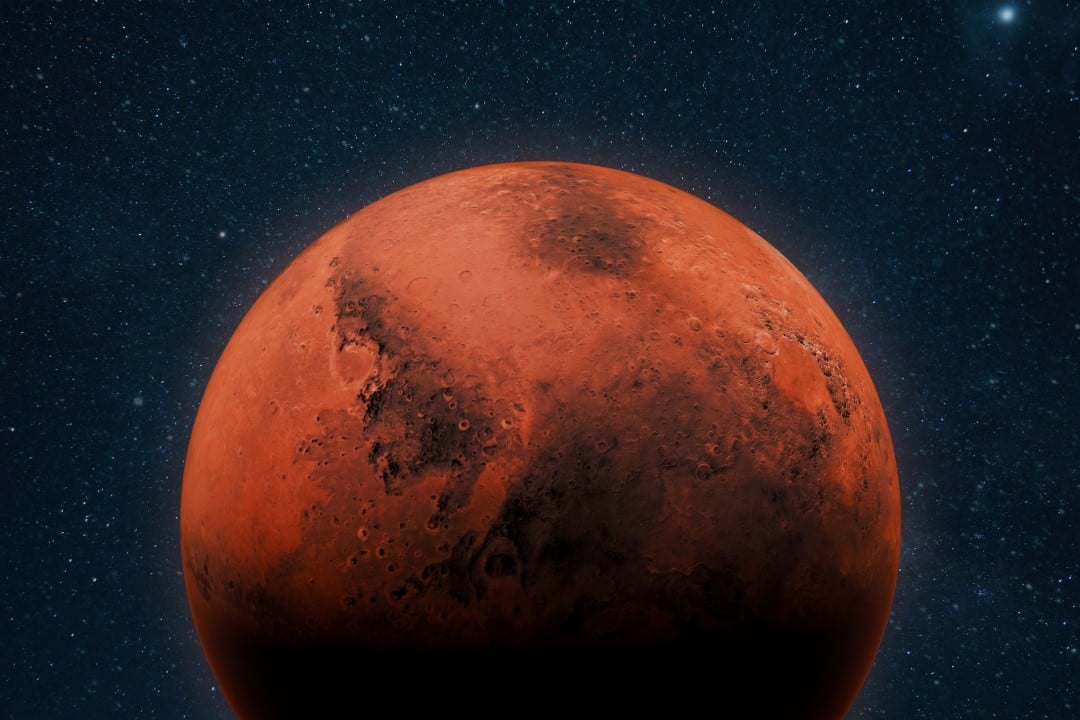
An orbital shortcut discovered in ancient asteroid data allows a round trip to Marte in just 226 days, with the return trip taking 56 days. The route is geometrically valid within the current configuration of the solar system and opens in 2031. Porém, reaching it requires nuclear thermal propulsion, a technology that Europa is already developing and testing with partner agencies.
The extremely fast trajectory was identified by astrophysicist Marcelo of Oliveira Souza, of Universidade Estadual of Norte Fluminense. Ele used preliminary 2015 orbital data from asteroid 2001 CA21 as a reference geometric model, creating an analysis plan to test transfer angles between Terra and Marte that conventional approaches do not capture.
Geometry that defies chemical propulsion
A spacecraft departing Terra on April 20, 2031 would arrive in Martian orbit 56 days later. The crew would remain on the surface for five weeks and return to Terra 135 days after Marte’s launch, totaling a mission of 226 days. Para round-trip trajectory, this timeline is radically shorter than any manned mission design ever conceived.
The demanding chemical propulsion requires seven to nine months just for the outward journey. The speeds required to achieve 56 days of transit destroy any conventional chemical scenario. The excess hyperbolic velocity for this trajectory reaches 16.9 kilometers per second, requiring 15 times more energy than a standard Marte mission.
An alternative called “extreme” further reduces the total time to 153 days, combining 33 days on the way out, 30 days on the surface and 90 on the return. Porém this option requires 40 times the energy of a conventional mission, reaching a takeoff speed of 27.5 kilometers per second, above the theoretical limit of any chemical stage already used. Arrival at Marte would occur at 16.6 kilometers per second and re-entry into the atmosphere of Terra at 15.1 kilometers per second, values that test the limits of thermal protection materials still under development.

Why only nuclear propulsion solves the problem
The study, published in the journal Acta Astronautica, concludes that chemical rockets cannot fill this energy gap. The only technology lever identified is nuclear thermal propulsion, or NTP, which heats liquid hydrogen through a reactor core and expels the gas with roughly twice the efficiency of chemical combustion.
Essa technology does not remain in the theoretical field. French research agency CEA launched a feasibility study called Alumni in 2023, developed in partnership with ArianeGroup and Framatome for Agência Espacial Europeia. The agency’s official announcement details that the objective is to reduce transits to Marte, reducing astronauts’ exposure to cosmic radiation during the prolonged flight.
The CEA also develops a parallel line of research called RocketRoll, focused on nuclear electric propulsion for missions where sunlight is insufficient for solar panels. Ambos projects feed into a European technology roadmap that targets a prototype around 2035, a timeline close enough to the 2031 launch window to be operationally relevant.
European Competência in space nuclear technology
Xavier Averty, program manager at CEA, reported that the organization has been developing nuclear thermal and electrical space propulsion since the 1980s and remains the only European research organization with this capability. The accumulated competence positions Europa as a leader in the only technology capable of enabling fast travel to Marte.
The Alumni and RocketRoll projects are not isolated initiatives. Representam is a strategic integration in which French research, the European aerospace industry and the regulatory framework of the continental space agency converge towards a specific objective: making possible a Marte mission with a duration compatible with astronautical safety and biological viability.
The discovery method through old data
Marcelo of Oliveira Souza did not invoke exotic physics or design new engines. Ele used a methodological approach where old orbital data works as a geometric filter. 2015 data from asteroid 2001 CA21 described an elongated, low-inclination ellipse that intersected the orbits of Terra and Marte. Later Observações refined this orbit, altering its shape, but the initial data offered something rare: a reference plane for testing extreme transfer angles.
The researcher imposed a strict rule: any candidate trajectory needed to remain within five degrees of the asteroid’s orbital plane. Usando a solver for Lambert, a standard astrodynamics tool that calculates possible trajectories between two points in space, it simulated three future windows of Martian opposition. The years 2027 and 2029 failed. The energy demand grew too much or the geometry prevented the return circuit from closing.
The 2031 window behaved differently. Produziu two complete round-trip architectures both departing Terra on the same day in April, differentiated only by transit time and Martian stay options.
Transformar theory into reality
The article published in Acta Astronautica does not address vehicle engineering, mass budgets, intake profiles, or thermal absorption calculations. Oferece, however, numerical evidence that a fast and closed mission geometry for Marte exists within real orbital ephemeris data. The solution remains intact under positional oscillations that reflect observational uncertainty.
The question now is whether other early asteroid solutions encode similar models. Levantamento population remains for future work. For now, the 226-day journey exists only on paper. Transformá in metal and propellant will require an engine that matches the ambition that the geometry describes.