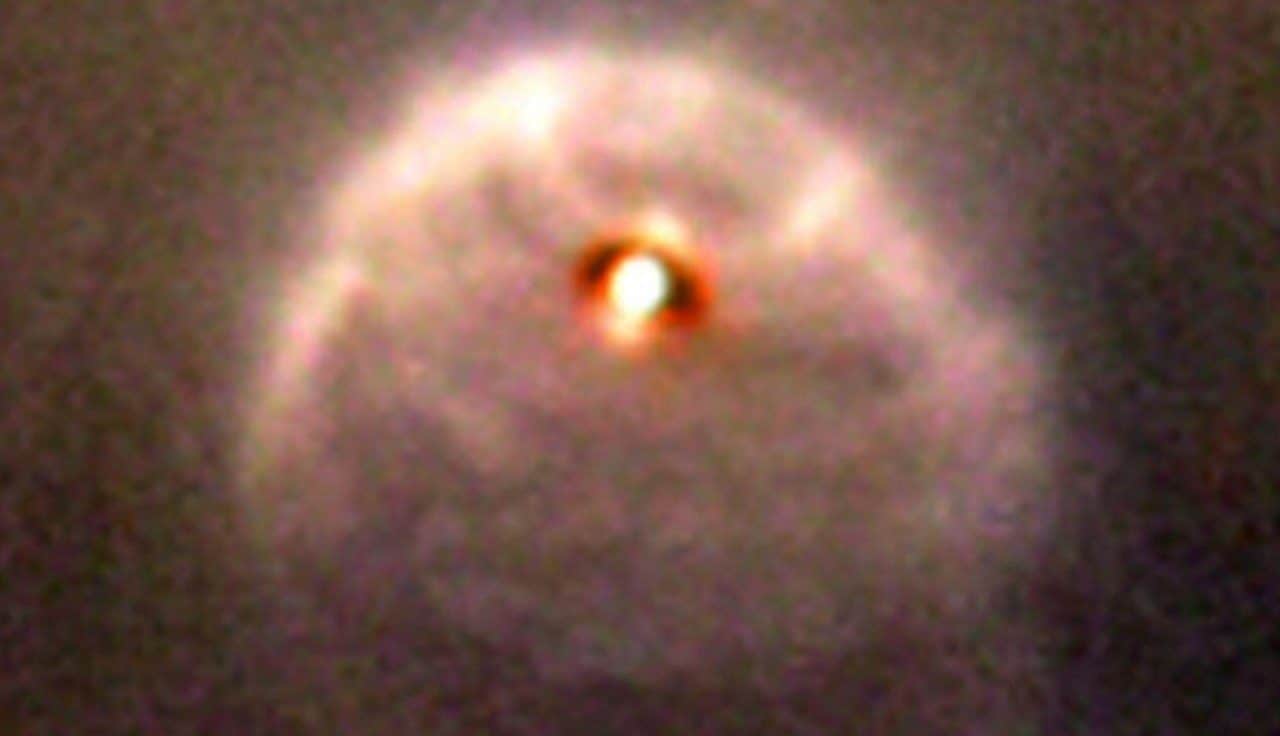
The Hubble space observation equipment recorded detailed images of a unique cosmic formation called proplidium 181-825. The astronomical structure is located in Nebulosa of Órion. The gas and dust complex is approximately 1,500 light years away from the planet Terra. The photographic record provides essential data for understanding the physical mechanisms that govern the birth of new worlds around young stars. Visual capture was made possible by the orbital observatory’s Câmera Avançada to Pesquisas.
The identification of this celestial object is part of the efforts of Programa, Tesouro, and Telescópio Espacial Hubble. Researchers have already cataloged 42 distinct protoplanetary disks in the region. The area functions as a vast natural laboratory. Continuous monitoring of these structures makes it possible to map the initial stages of the consolidation of planetary systems. The images processed by space agencies reveal unprecedented morphological details about the surrounding environment.
Stellar Nursery Structural Dinâmica
A proplidum essentially consists of a rotating disk composed of concentrations of interstellar gas and cosmic dust particles. The material orbits a newborn star at its gravitational center. Este environment acts as the primordial stage for the agglomeration of matter. Microscopic Partículas collide and merge gradually over time. The accretion process takes millions of years to create celestial bodies of significant proportions. Direct observation of these disks in different evolutionary phases provides a comprehensive overview of the transformation of raw matter into rocky planets or gas giants.
The system cataloged as 181-825 exhibits morphological properties that attract the attention of the international scientific community. Its physical configuration presents fundamental elements for the study of fluid dynamics in the space vacuum. Astronomers have identified determining factors that influence the behavior of material in orbit. Continuous monitoring established the following key structure parameters:
- Space geographic Posicionamento in the vicinity of the massive star Theta 1 Orionis C.
- Núcleo composed of a star in the early stages of development surrounded by particulate material.
- Emissão of intense shine resulting from direct exposure to extreme ultraviolet radiation.
- Interação constant with high-speed stellar winds from neighboring stars.
- Nomenclatura technique based on the coordinate system of the region’s astronomical map.
Experts divide the proplidia observed in Nebulosa and Órion into two distinct visual classifications. Os objetos situados nas imediações de fontes intensas de radiação brilham de forma proeminente devido ao aquecimento extremo do gás periférico. Structures located in more distant areas appear only as dark and opaque silhouettes against the luminous background of the ionized gas. Proplydium 181-825 falls into the first classification group. Its intrinsic luminosity facilitates the capture of photons by telescopes’ optical sensors.
Interação with the radiation of Theta 1 Orionis C
The presence of the supergiant star Theta 1 Orionis C dictates the physical rules in the environment. The massive star emits a continuous and violent stream of particles. The stream of matter collides uninterruptedly with the gaseous envelope of the proplidium. The impact generates visible shock waves. The mechanical force exerted by the wind sculpts the external shape of the disc and defines its physical limits in three-dimensional space.
The fluid dynamics generated by this interaction directly affect the planet formation potential of the system. The pressure exerted by external radiation heats the surface layers of the dust disk. The thermal phenomenon causes the gradual evaporation of the lighter material into interstellar space. Simultaneamente, shock waves can compress internal regions of the disc. Localized compression increases the material’s density and accelerates the formation of solid planetary cores before the gas completely dissipates.
Conexões with the evolution of the solar system
Detailed analysis of distant structures provides answers about the geological past of our own cosmic address. Astrophysical models indicate that Sol and its orbiting planets emerged from a similar molecular cloud about 4.6 billion years ago. The study of proplidium 181-825 works as an observation window into the remote past. The researchers use the data captured to understand the environmental conditions that allowed the formation of Terra, Marte and the gas giants in our system.
Evidence collected in Nebulosa from Órion corroborates classical theories about the chronology of planetary formation. Astronomical calculations suggest that the primordial solar disk required tens of millions of years to stabilize the orbits of its main bodies. Comparing features of the mature solar system and newly discovered young disks reveals a remarkable consistency in universal physical processes. The validation of these mathematical models depends entirely on the quality of observational data provided by high-precision equipment.
Spatial mapping and cataloging Tecnologia
The technical performance of Telescópio Espacial Hubble maintains its relevance in frontier astronomical research. The observatory’s location above the Earth’s atmosphere eliminates optical distortions caused by the planet’s air currents. Advanced capture instruments can isolate specific wavelengths emitted by ionized hydrogen and oxygen. The spatial resolution achieved by the equipment’s lenses surpasses the capacity of most observation complexes installed on the Earth’s surface.
The cataloging methodology adopted by scientists guarantees precision in the exchange of information between different research centers. The numerical sequence 181-825 not only identifies the central star, but encompasses the entire system in formation. The identification code is derived from the object’s exact coordinates within the mapping grid established for Nebulosa of Órion. The standardization of nomenclature avoids ambiguities in academic publications and facilitates the crossing of data obtained by different space missions.
Long-term longitudinal monitoring forms the basis of Programa’s Tesouro focused on this region of space. Astrophysics teams compare photographs taken in different decades to measure the physical displacement of gaseous structures. The comparative analysis highlights the dissipation rate of the material and the speed of the stellar wind currents. Image files remain available in public databases for access by the global scientific community. The ongoing compilation of these visual records documents celestial mechanics on a time scale that transcends immediate human observation.