Unpublished images from the space telescope detail the interior of a nebula in the constellation of Hercules

The orbital equipment captured high-definition visual records of the celestial object NGC 6210. The formation is about 6,500 light-years from the planet Terra. The astronomical target is located in the region of the sky known as the constellation Hércules. The scientific satellite’s wide-field planetary camera recorded unprecedented details of the gaseous structure. The material surrounds a bluish central star. The images released by Agência Espacial Europeia transformed the understanding of the internal composition of the cosmic body.
German astronomer Friedrich Strube originally identified the formation in 1825. Terrestrial instruments at the time only showed an opaque disk with no clear definition. The space observatory’s resolving capacity overcame atmospheric limitations. The equipment revealed a complex internal architecture that challenges previous visual models. The analysis work around this gas cloud directly contributes to understanding the final stages of star evolution.
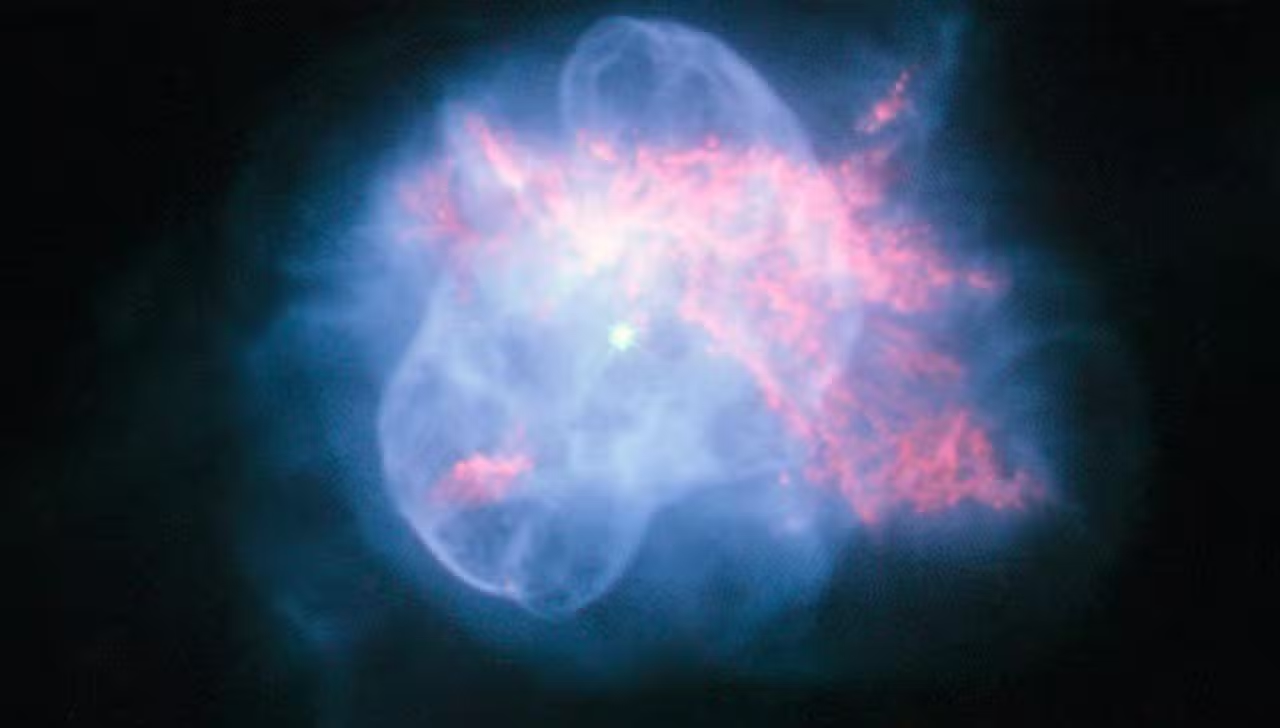
Internal Arquitetura and color variation of space gas
The pale blue glow in the center of the photograph corresponds to a white dwarf. The object represents the remaining core of the original star that formed NGC 6210. A thin, bluish structure expands around the central body. The shape resembles a cosmic bubble in continuous expansion. Delicate, ribbon-like Filamentos appear clearly within this primary region. The definition of the image allows us to observe the interaction between the radiation and the surrounding matter.
A reddish and asymmetrical layer of gas projects in areas furthest from the center. The external region features holes and columnar formations highlighted by the luminous contrast. Scientists believe that this unique appearance results from the overlapping of different layers of material. The star emitted the gas repeatedly at different periods of its evolutionary trajectory. Cada ejection pulse generated a new protective shell around the core. The visual pattern currently observed reflects this sequence of violent events.
The chemical composition of the ejecta varies significantly between different layers of the structure. The difference reflects changes in temperature and gas density in space. Blue filaments indicate the presence of highly ionized material. The intense ultraviolet radiation from the central star causes this energetic reaction. The outer red layer concentrates the regions of lower material density. The efficiency of the ionization process decreases considerably in these peripheral areas of the celestial object.
Dinâmica of stellar remnant formation
Planetary nebulae arise around stars with specific mass characteristics. The phenomenon occurs in stars with up to eight times the mass of Sol. The process marks the final stages in the evolution of these nuclear furnaces. Massive stars end their cycles in violent supernova explosions. Smaller celestial bodies shed their outer layers in a gradual and controlled manner. The star evolves into the red giant phase before ejecting the material into the space vacuum.
The star’s core loses its outer layers over thousands of years. The central structure contracts and turns into a hot, dense white dwarf. The ultraviolet radiation emitted by the remnant reaches extreme levels of intensity. The invisible energy hits the previously released gas and causes an intense glow. The ionization phenomenon transforms the dark cloud into a luminous spectacle visible from great distances. The interaction between light and gas defines the shape of the nebula.
NGC 6210 originated from a star with characteristics very similar to those of our system. The original mass of the star reached about 0.9 times the solar mass. The surface temperature of the exposed core reaches an impressive 65,000 °C today. The extreme heat keeps the gas lit and energized constantly. The continuous heating of the nebular material guarantees the visibility of the structure. Telescopes capture light emission in optical and infrared wavelengths.



Evolutionary Ciclo and ejection of cosmic material
Stars spend billions of years in a state of stable thermodynamic equilibrium. The radiation pressure generated in the core offsets the crushing force of gravity. The scenario changes drastically when nuclear fuel runs out. The remaining hydrogen loses its ability to sustain fusion reactions. The internal structure suffers a brief and violent collapse. The star expands its radius hundreds of times immediately after the initial contraction.
The transition to the red giant phase represents a path of no return for the star. The outer layers are very far from the contracting core. The gravitational force loses its ability to hold peripheral material. The gas slowly begins to break away and travels through interstellar space. Pulsos of matter fly in different directions and create structural asymmetries. Ejection episodes happen at intervals ranging from thousands to tens of thousands of years.
Detailed study of NGC 6210 provides crucial clues about the fate of our own system. Sol will undergo an identical process of expansion and mass loss in the distant future. Terra and the inner planets will suffer the direct consequences of this stellar transformation. Observing planetary nebulae acts as a window into cosmic tomorrow. Astronomers use these natural laboratories to test theories of modern physics. Understanding stellar death helps map the distribution of chemical elements in the universe.
Mapeamento scientific and next observation steps
The data collected by precision instruments allowed rigorous mapping of the spatial region. The researchers measured the density, temperature and chemistry in different parts of the cloud. Spectroscopy revealed the presence of fundamental elements in the composition of the gas. Helium, carbon, nitrogen and oxygen appear in specific abundances. The information feeds theoretical models about mass loss in ancient stars. The precision of the numbers improves the quality of computer simulations.
The scientific community maintains NGC 6210 as a priority target for continued observational studies. The researchers defined specific lines of investigation for the coming years. The work involves different techniques for measuring and analyzing astronomical data. The research fronts seek to unveil the physical mechanisms that operate inside the nebula. Current projects include the following methodological approaches:
- Monitoramento of the variations in brightness emitted by the central white dwarf.
- Análise details the expansion velocities of nebular gas in space.
- Mapeamento of invisible magnetic structures using polarimetry techniques.
- Comparação systematically with other planetary nebulae to refine evolution models.
- Investigação of the dynamic processes that occur in the different gas layers.
The use of next-generation telescopes advances understanding of the physical mechanisms of the universe. The new equipment offers superior observation capabilities compared to the instruments of the past. The improved resolution allows you to see details previously hidden by distance and cosmic dust. NGC 6210 consolidates its position as a fundamental object of study in modern astronomy. Ongoing analysis of the gaseous structure reveals the secrets of the death of stars similar to Sol. Accumulated knowledge prepares science for the discoveries of the coming decades.
See Also em Latest News (EN)

Production of the last chapter of Final Fantasy 7 advances with validation of forty versions of the game
04/05/2026
New version of the Steam Controller hits the market independently and shakes up the gaming community
04/05/2026
Embraer announces record sale of C-390 Millennium to the United Arab Emirates
04/05/2026
Microsoft schedules technical broadcast to detail Project Helix tools to Xbox developers
04/05/2026
Portuguese decree makes nationality stricter with new legal requirements
04/05/2026
Santos lists Neymar and Robinho Jr for a decisive duel against Recoleta in the South American Championship
04/05/2026
Deep-sea creature with giant eyes is recorded on underwater camera
04/05/2026
Imoco Conegliano criticizes the Club World Cup in Brazil and calls the tournament a burden
04/05/2026
Robinho Jr. accuses Neymar of aggression at CT Rei Pelé and sends a notification to Santos
04/05/2026
Generation Z rescues old audio players to avoid digital data tracking
04/05/2026
New OnePlus accessory converts Ace 6 Ultra cell phone into high-precision portable video game console
04/05/2026