

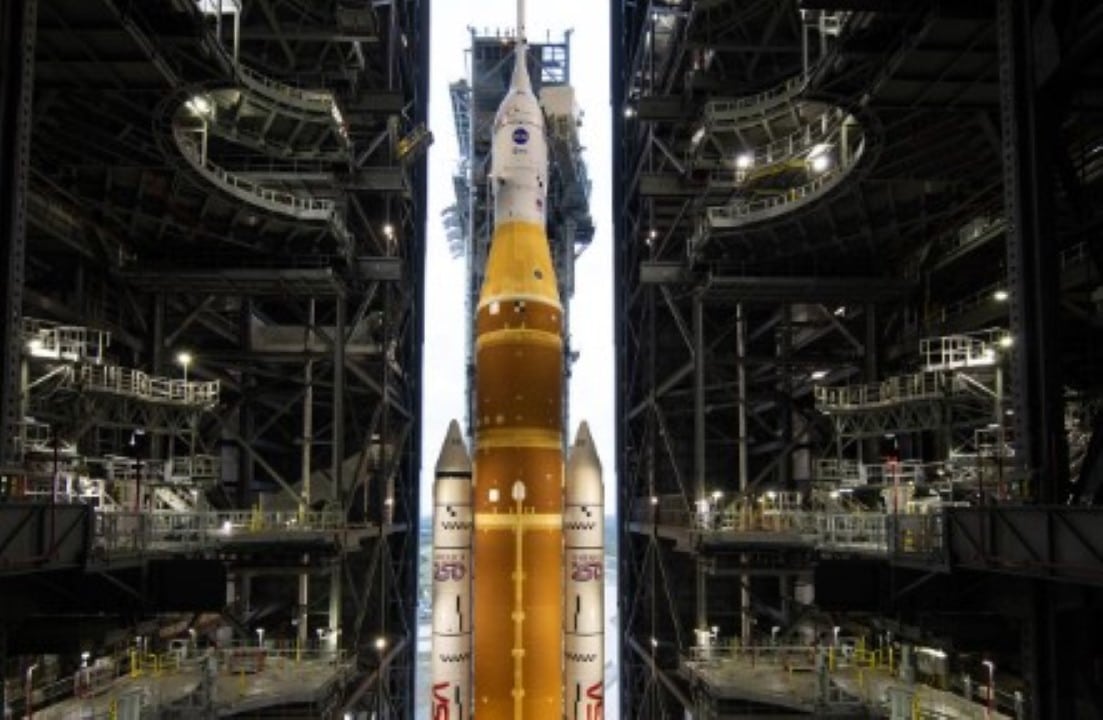
Fotógrafos from the specialized portal team documented celestial events and phenomena between March and May 2026, recording everything from the launch of the Artemis 2 rocket to distant galaxies observed through advanced telescopes. The images show both historic moments of space exploration and the beauty of the night sky captured in precise technical detail.
Lançamento of Artemis 2 documented first hand
Josh Dinner, a spaceflight reporter, was at NASA’s Centro Espacial Kennedy at Flórida on April 1 to photograph the historic launch. The Sistema rocket from Lançamento Lunar (SLS) took off with force, producing noticeable vibrations in the press box. Dinner captured multiple images of the event, varying the exposure depending on the light intensity of the solid propellants.
The launch photography technique required specific camera adjustments. Dinner worked with intentional underexposure to capture details of the flames emerging from the engines, while keeping shutter speeds to a minimum at close distances. The RAW images were initially dark in the rest of the composition, but simple post-processing corrections revealed all the desired details.
An unexpected detail enriched some photographs: small drops of water on the lens, the result of a storm the night before launch. Essas droplets created reflections that added visual uniqueness to the final images.
Galáxia of Bode photographed on Apalaches
Brett Tingley, editor-in-chief, headed to a dark area in the Apalaches mountains on March 28th. The goal was to photograph deep-sky objects using long exposure techniques. Bode’s Nebulosa, also known as Messier 81, was perfectly positioned at dusk, offering ideal conditions for capture.
Messier 81 is actually a spiral galaxy located 11.6 million light-years away in the constellation Ursa Maior. Apesar From its name, the structure is one of the brightest galaxies in the night sky observable from Terra. Tingley used an Celestron Origin Mk II telescope equipped with a specialized nebula filter. The equipment made it possible to capture the spiral shape of the galaxy in great detail, revealing structures that would be invisible to the naked eye.
Equipamento and techniques used
Photographers used advanced technology to document celestial phenomena:
- Telescópio Celestron Origin Mk II with nebula filter for galaxy observation
- Digital Câmeras configured for minimal exposure in rocket launches
- Filtros specialized to capture details of stellar structures
- Editing Softwares for post-processing RAW images
- Night Sky Long Exposure Photography Equipamento
Via Láctea seen by the astronauts of Artemis 2
Além of the photographs taken since Terra, the team also released records captured during the Artemis 2 mission. Astronauts aboard the spacecraft spotted Via Láctea on its trajectory, documenting the galaxy’s luminous streak streaking through space near Lua. The image reveals pinkish nebulae and dark clouds distributed across the galactic plane, with a satellite galaxy visible as a patch of white light.
Contexto of missions and observations
The launch of Artemis 2 marks a significant advance in the American lunar program. The mission takes astronauts on a trajectory around Lua, resuming manned missions after decades. The SLS rocket represents integration of legacy space shuttle technology with modern propulsion systems.
Observations of distant galaxies through telescopes complement manned missions, offering complementary perspectives on space exploration. Equipamentos terrestrial devices allow detailed study of cosmic structures without the need for space travel.
Astrophotography sharing Iniciativa
The publication of the images is part of a monthly editorial initiative to celebrate the passion for space exploration, science fiction and celestial observation. The team invites readers to share their own astrophotographs at spacephotos@space.com. The portal also encourages participation in comment sections to discuss each published article.