
James Webb Telescope detects rare merger of five galaxies just 800 million years after Big Bang


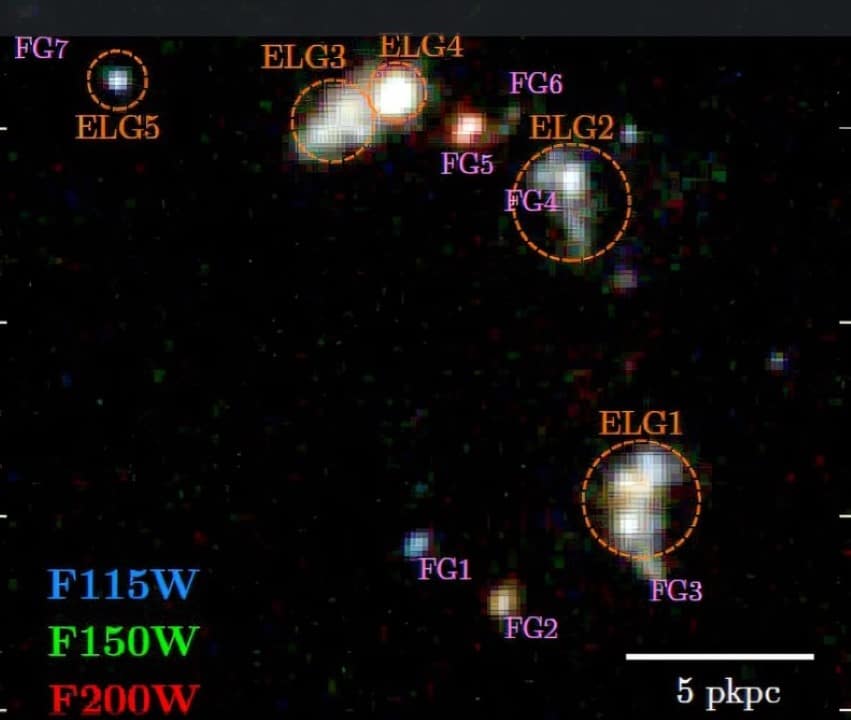
Astrônomos of Universidade Texas A&M have identified an extraordinary system composed of at least five galaxies in the process of simultaneously merging, captured by Telescópio Espacial James Webb. The system, called JWST’s Quintet, exists in a cosmic period corresponding to just 800 million years after Big Bang, at redshift 6.71. The discovery is surprising because such complex galactic interactions occurred much earlier than cosmological models predicted for that time in the universe.
The structure presents notable characteristics: an extensive halo of ionized gas rich in oxygen and hydrogen surrounds all five galaxies, showing redistribution of heavy elements beyond the individual limits of each one. The observations were obtained as part of JWST Advanced Deep Extragalactic Survey, one of the deepest imaging programs undertaken by the telescope to date. The rate of star formation in the group reaches approximately 250 solar masses per year, an extraordinarily high value for that cosmic era.
Características quintet system physics
The identified system consists of five emission-line galaxies, marked as ELG1 to ELG5 in James Webb’s pseudocolor images. Essas structures are immersed in a halo of gas that emits light from ionized oxygen and hydrogen, indicating that the fusion is expelling materials produced inside the stars. The group’s total stellar mass is equivalent to about 10 billion solar masses, an impressive concentration in a small volume that suggests intense gravitational interactions.
The average separation between galaxies ranges from 43,000 to 60,000 light-years, keeping them close enough for continuous gravitational interactions. The five galaxies occupy a compact region of space, forming a system where each component gravitationally influences the others. Essa configuration favors gas transfer between structures, fueling accelerated cycles of star birth.
Enriquecimento early chemist in the early universe
- Detecção of ionized oxygen in extensive halo demonstrates dispersion of heavy elements 800 million years post-Big Bang.
- Heavy Elementos are generated only in stellar cores and released by violent processes such as galactic mergers.
- Interações gravitational forces from fusion drive redistribution of materials more intensely than isolated galactic winds.
Direct evidence shows that multiple collisions contributed to enriching the surrounding space in early times of the universe. Antes of James Webb, such processes were predicted only for more advanced periods, greater than a billion years after Big Bang. Essa discovery reveals that cosmic chemistry evolved much more quickly in the first billion years than theoretical models indicated.
Desafios to existing cosmological models
The existence of such a complex merger at redshift 6.71 requires significant revision of theories on hierarchical galaxy assembly. Previous Modelos indicated that multiple mergers would become common only in later epochs of the universe. Essa discovery reveals that dense clumps quickly formed large, sophisticated structures, contradicting established theoretical predictions.
The system may explain the presence of quiescent massive galaxies observed at slightly later times. Rapid and violent Fusões would deplete available gas reserves, interrupting star formation and generating early inactive objects. Essa connection resolves part of the discrepancies between theoretical predictions and recent observational data obtained by James Webb.
Implicações for early galactic evolution
Sistemas like JWST’s Quintet may evolve into massive galaxies that cease stellar activity between 1 and 1.5 billion years after Big Bang. Observações earlier than James Webb already recorded such quiescent objects in later epochs. Multiple Mergers would accelerate galactic maturation in the young universe, transforming dynamical systems into dormant structures on cosmically short timescales.
Próximas’s James Webb campaigns will analyze movements of gas and stars within the quintet, clarifying orbital dynamics and merger chronology. Pesquisas in deep fields will identify other similar examples, refining understanding of the frequency of complex interactions in the early universe. JWST’s Quintet represents a milestone in observational astronomy, revealing unexpected processes that shaped today’s cosmic structures.



