
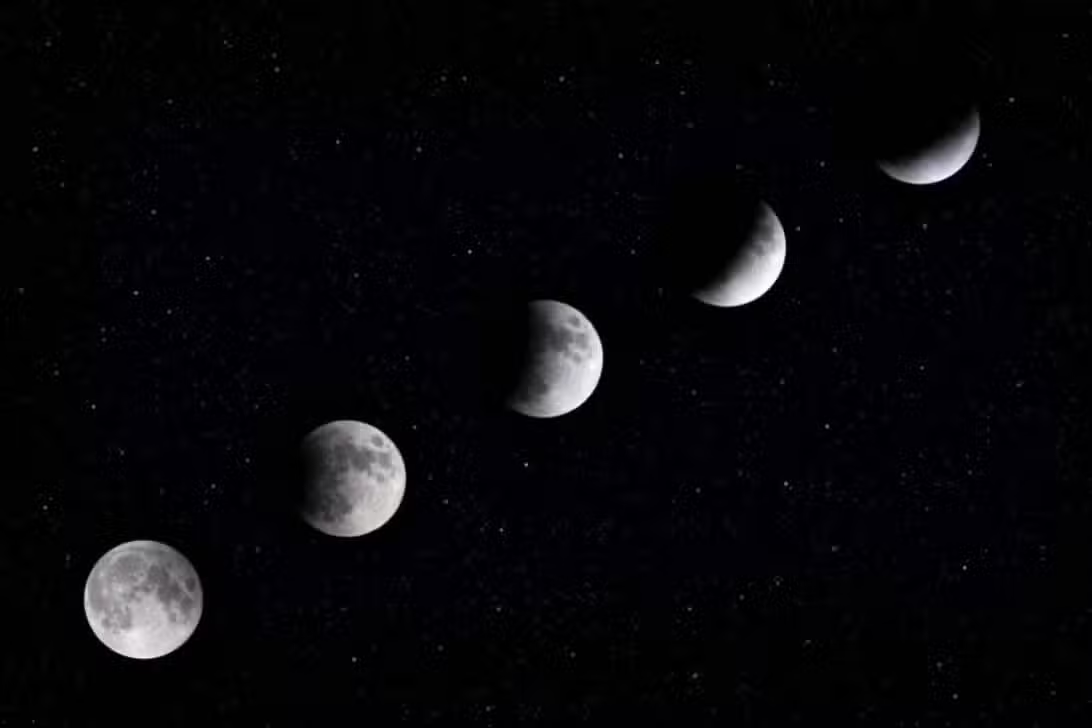
On May 8, 2026, Lua appears in its waning gibbous phase, with 63% of its surface illuminated. The natural satellite is on the 21st day of its lunar cycle of approximately 29.5 days, beginning its transition between fullness and temporary disappearance in the night sky.
Lunar phases follow a predictable pattern throughout each month. Conforme to Lua orbits Terra, the angle of solar illumination gradually changes, creating eight distinct phases that repeat in regular cycles. Esse phenomenon marks the passage of time in the night sky and has influenced astronomical observations for centuries.
Cronograma of lunar changes in May
The month of May features four main milestones in the lunar calendar:
- Lua full on May 1st
- Terceiro quarter (waning) on May 9 at 5:11 pm ET
- Lua new on May 16th
- Primeiro quarter (rising) on May 23
The transition between these phases occurs at approximately seven-day intervals. Cada shift marks a specific point in the lunar orbit where the proportion of sunlight reflected by Lua changes significantly relative to ground-based observation.
Características of the waning phase
Durante the third quarter, only the left half of Lua remains illuminated when viewed from Terra. Tecnicamente, only a quarter of the lunar surface is completely bright at this stage. Lua in this condition normally rises around midnight (local time) and sets around noon, according to NASA data.
The waning period follows immediately after the full Lua. Nessa transition, the satellite gradually goes from a fully round shape to a decreasing crescent. Observadores that track the night sky over several days can notice this gradual change in lunar illumination.

Padrão full 2026
The 2026 astronomical calendar records 13 full moons and 13 new moons distributed over the 12 months. Janeiro starts with a full moon on January 3rd (5:03am EST) and a new moon on January 18th (2:52pm EST). Esse pattern repeats monthly with variations on specific dates and times.
Lua phases in 2026 include events at specific periods. Fevereiro contains a new moon on February 17th and a full moon on February 1st. Março brings a new moon on March 18 (9:23 p.m. EDT) and a full moon on March 3 (6:38 a.m. EST). Abril follows the pattern with a new moon on April 17 (7:52 a.m. EST) and a full moon on April 1 (10:12 p.m. EST).
Ciclo astronomical and observation
Lua, like Terra, is a sphere that is always partially illuminated by Sol. The satellite’s orbital position relative to the planet and star determines what percentage of its surface reflects visible sunlight from Terra. The phases precisely describe this percentage of the illuminated lunar disk.
Observadores of the night sky notice significant visual variations throughout the month. Quando to Lua progresses from the new phase (practically invisible) to the growing phase, it takes on the shape of a thin silver band. Conforme continues to illuminate, turns into a crescent shape (technically called a “crescent”) until it reaches the first quarter. It then takes on an oblong or gibbous shape until reaching full moon.
Após to full Lua, the process is reversed. The waning gibbous gradually reduces, returning to the third quarter and after a few days appearing again as a waning crescent. Finalmente, returns to the new moon phase, completing the cycle of approximately 29.5 days.
Próximas phases for observation
Após the third quarter of May 9, observers will be able to track the new moon on May 16 at 4:01 pm ET. One week later, on May 23, the first quarter takes place at 7:11 a.m. Eastern Daylight Time. Essas dates mark reference points for planning astronomical observations during the month.
The new moon period offers an ideal opportunity for observing deep-sky objects, as the absence of Lua increases the contrast of stars and galaxies. The first quarter, with half of Lua illuminated, offers interesting details in the lunar craters near the terminator (the dividing line between light and shadow).
Diversos equipment enhances lunar observation. Basic Telescópios reveals details of lunar craters, valleys and mountains. More advanced Telescópios allow visualization of smaller structures and shadow changes throughout the cycle. Para Photographing the Lua, cameras equipped with long focal range lenses capture details similar to those observed visually.