

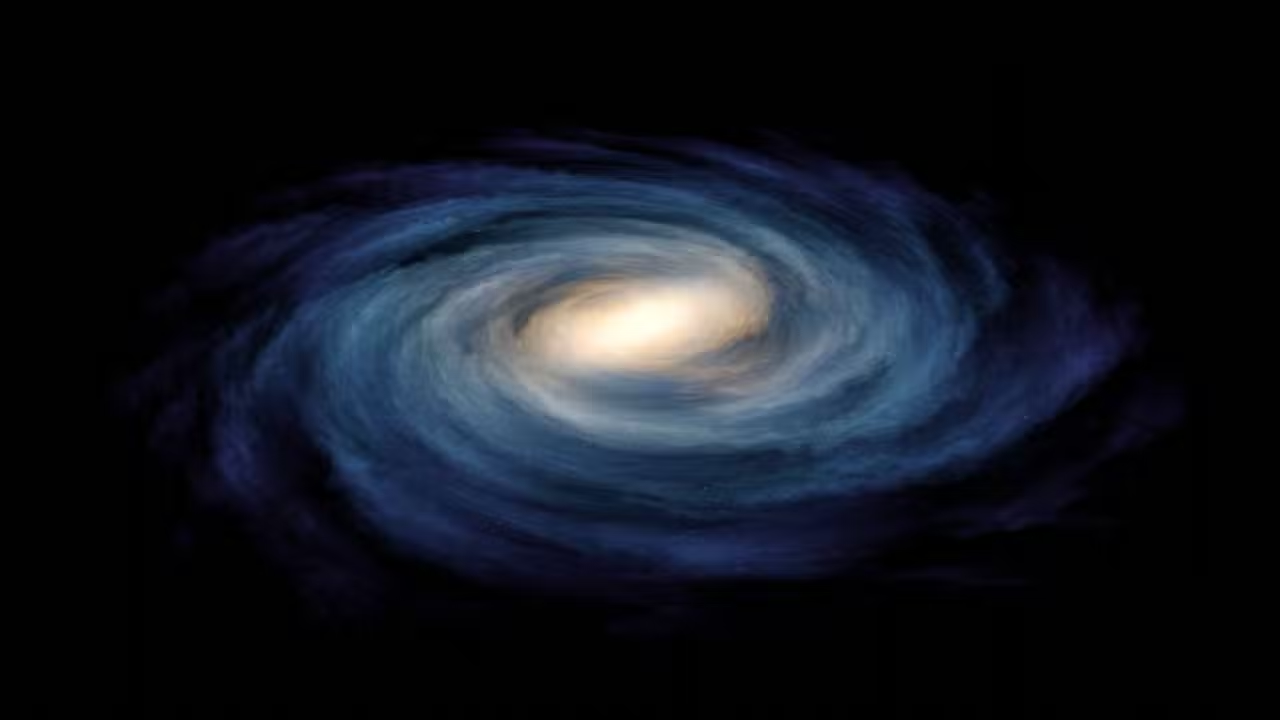
Astrônomos were able to determine exactly where Via Láctea ends. The outer boundary of the galaxy is located 40 thousand light years from its central core. Essa’s precise delimitation ends a decades-long debate in the scientific community. The feat marks a significant advance in understanding the structure and limits of the galactic system that houses Terra and billions of stars.
The research identified where the main galactic disk gives way to the outer halo, a region surrounded by dark matter. State-of-the-art Telescópios tracked stellar movements in distant zones, revealing that the edge is more defined than previously imagined. The data collected resolves uncertainties that have long affected cosmological calculations.

Tecnologia and methods that made discovery possible
Space and ground-based Telescópios worked together to map billions of stars distributed across the galaxy. The researchers analyzed the movement of each star, that is, the speed and direction in which they move through space. Estrelas within Via Láctea exhibit coherent and predictable movement patterns. Objetos located beyond the boundary show completely different speeds and trajectories, facilitating the precise identification of the galactic boundary.
The scientific team used data from observatories operating in multiple wavelengths, including visible light, infrared and other electromagnetic spectrums. The crossing of information from different sources significantly increased the reliability of the measurements carried out. Computadores processed millions of data points to generate a three-dimensional map of unprecedented accuracy. The Gaia space mission provided catalogs containing billions of stars with known positions and velocities, being fundamental to the success of the project.
Estrutura complex revealed by observational data
- Disco main galactic approximately 100 thousand light years in diameter
- Halo spherical dark matter enveloping the entire galactic structure
- Braços spirals where young stars are born and cluster densely
- Bulbo central cluster around supermassive black hole
- Zona of gradual transition between dense disk and dispersed outer halo
The newly identified boundary marks the transition between the dense disk and the scattered halo that surrounds the galaxy. Essa region contains ancient stars, globular clusters and diffuse dark matter distributed in space. Não there is an abrupt and well-defined edge, but rather a transition zone that astronomers are now able to delimit with precision never achieved before. The Via Láctea is not a simple flat disk, but a complex structure with multiple layers and components.
Impacto in cosmological models and astronomical calculations
Conhecer the exact size of Via Láctea significantly refines the cosmological models used by the scientific community. Astrônomos can now estimate the total mass of the galaxy with much greater accuracy than was previously possible. The distribution of normal matter and dark matter follows patterns that help understand how galaxies form and evolve over cosmic time. Esse knowledge is fundamental for research into cosmic evolution and gravitational dynamics on a universal scale.
The discovery also changes calculations about the distance of celestial objects in relation to Terra and the galactic center. If the galactic boundary is different from that previously estimated, the relative position of clusters and cosmic structures changes significantly. Isso directly affects astronomy projects that depend on precise coordinates and reliable measurements for their observations and analysis.
Contexto history and recent technological advances
Durante decades, the size of Via Láctea remained surrounded by uncertainty. Estimativas ranged widely between 80,000 and 120,000 light-years in diameter, reflecting the difficulties in observing the galaxy from within. Terra’s position within the galactic system makes observation more challenging than it would be if we could observe from the outside. Interstellar Poeira blocks vision in many directions, severely limiting what conventional telescopes can see.
Avanços technological technologies of the last 15 years have made it possible to overcome these historical limitations. Infrared Telescópios can pass through interstellar dust that blocks visible light. Detectores of gravitational waves reveal movements in regions previously completely inaccessible to direct observation. Dados space missions have provided unprecedented catalogs of billions of stars with precisely known positions and velocities. Essas combined tools made the current discovery possible.
Aplicações Futures and Relevance for Advanced Searches
Esse’s more accurate mapping of Via Láctea serves as a solid foundation for advanced astronomical studies in the coming years. Pesquisadores can now more accurately model the collision of Via Láctea with the Andrômeda galaxy, an event predicted to occur billions of years in the future. Projetos who study exoplanets and the search for extraterrestrial life also benefit directly from this information. Conhecer the true boundaries of the galaxy significantly improves understanding of where to look and how to interpret data collected in future observations.
Accurate determination of the galactic boundary contributes to more reliable estimates of the total number of stars and planets in Via Láctea. If the size is better defined, stellar density calculations become more accurate and reliable. Isso directly impacts projections about the frequency of planetary systems and the statistical possibility of life in our galaxy, crucial information for astrobiology and programs searching for extraterrestrial intelligence.