
James Webb Observatory finds mysterious red dots at the beginning of the universe’s formation


Telescópio Espacial James Webb recorded the presence of compact and intensely luminous objects at the most distant frontiers of the cosmos. The images captured by the equipment show reddish spots that appeared when the universe was just 600 million years old. The discovery surprised the astronomical community due to the high number of these structures in practically all directions observed in deep space. The phenomenon challenges current cosmological models about the formation of the first galaxies.
Scientists call these formations LRDs, an acronym for small red dots. The light emitted by these celestial bodies traveled billions of years before reaching the observatory’s mirrors. The phenomenon disappears from the cosmic record around 1.5 billion years after Big Bang. Pesquisadores from institutions such as Instituto, Tecnologia, Massachusetts, and Colby College analyze the data to understand the role of these structures in galactic evolution and the distribution of matter.
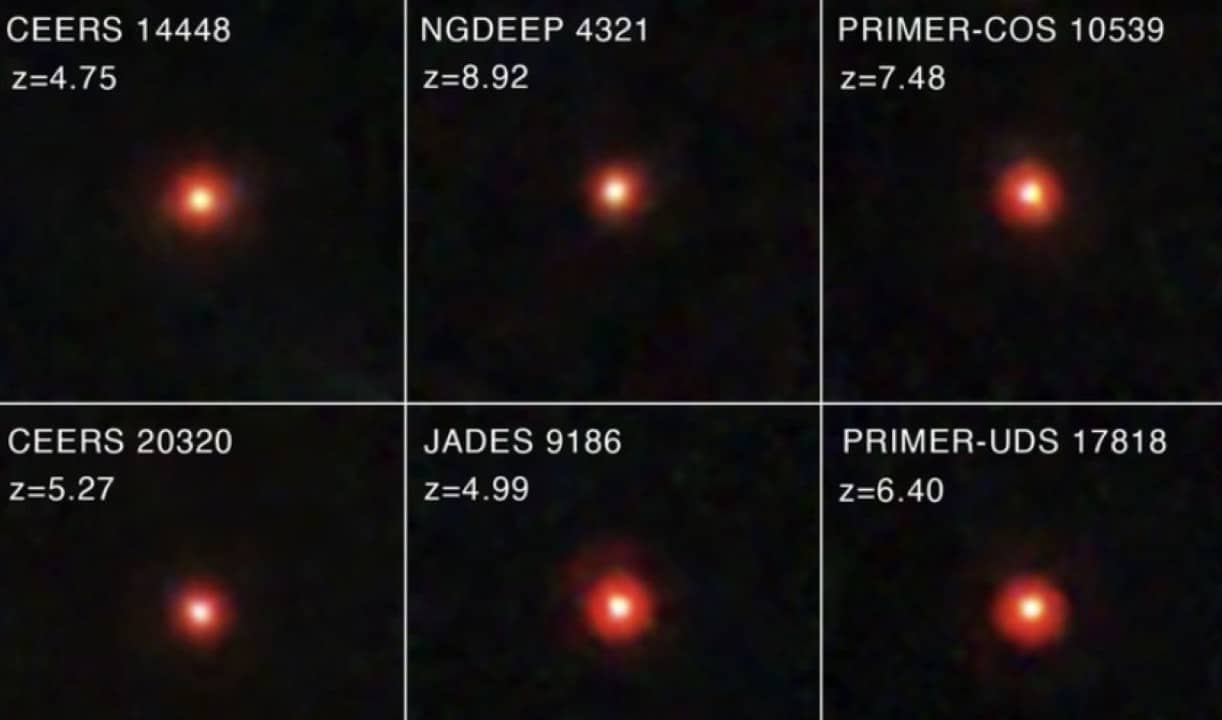
Características visuals and abundance in space images
The space equipment began its full scientific operation in the year 2022. Desde the first deep sky surveys, astronomers noticed the constant repetition of small red dots in the backgrounds of the images. The intense coloring results from the physical phenomenon known as red shift. The continued expansion of the universe stretches light waves as they travel through the vacuum of space. The process alters the visual perception of more distant objects.
A wave that left with high energy reaches current detectors in the infrared range. The James Webb has instruments calibrated specifically to capture this radiation invisible to the human eye. The extreme brightness concentrated in a very small physical space intrigues researchers. The constant presence of these points indicates that they represented a common and fundamental phase in the early cosmos. Frequent detection eliminates the possibility of isolated sensor anomalies.
Preliminary analysis shows that the objects do not behave like mature spiral or elliptical galaxies. The small size prevents the visualization of spiral arms or complex dust disks. Astrophysicists need to use indirect measurement techniques to extract information about the chemical composition and temperature of these light sources. Image processing requires supercomputers to separate the brightness of LRDs from the light emitted by nearby stars.
Hipóteses scientific research on the origin of luminous points
The scientific community formulated three initial proposals to explain the nature of the discoveries. The first suggests that the dots represent dwarf galaxies harboring supermassive black holes undergoing intense feeding activity. The second line of thought proposes the existence of black holes at an intermediate and unknown evolutionary stage. Extreme gravity would attract matter at a rate greater than the theoretical limit established by modern physics.
A third aspect points to galaxies experiencing an extreme burst of new star formation. Esse environment would be full of dense clouds of cosmic dust. The dust would absorb visible and ultraviolet light from young stars and re-emit the energy in the form of heat and infrared radiation. The process would create the visual signature captured by the space telescope.
- Celestial bodies have extremely compact dimensions and high luminosity.
- The reddish hue comes from the stretching of light waves across expanding space.
- Observatory observations reveal a massive amount of these structures.
- Most records point to a period of 600 million years after Big Bang.
- The frequency of objects decreases drastically after the 1.5 billion year mark.
The telescope’s spectrographs provided data on the emission and absorption lines of chemical elements. Nenhuma of the three classic explanations managed to respond to all the variables observed in the graphs. Theoretical debate remains active in astronomy departments around the world. The search for a unified model requires reviewing basic concepts about thermodynamics in deep space.
Modelo theoretical of stars with black holes at the core
A new line of investigation is gaining momentum among the experts who process the images. The researchers are evaluating the possibility that the red dots are quasi-stars. Esse theoretical concept emerged in the astrophysical literature about two decades ago. The structure would consist of a central black hole surrounded by a massive, opaque envelope of hydrogen and helium gas. The radiation pressure would prevent the gas cloud from immediately collapsing.
The gas would function as a dense cocoon that filters and alters the radiation emitted by the active nucleus. Essa configuration would simultaneously justify the reddish color, the high light emission and the punctual format in space photographs. Recent Estudos apply James Webb spectral data to computer simulations to test the physical feasibility of this model. One of the cataloged objects presents chemical signatures that align perfectly with the gas cocoon theory.
If the quasi-star hypothesis is proven, the discovery will change the understanding of the origin of supermassive black holes. Atualmente, science does not clearly explain how objects billions of times the mass of Sol formed so quickly after the beginning of the universe. The red dots could represent the primordial seeds that gave rise to the gravitational giants present at the centers of modern galaxies, including Via Láctea.
Variação of distances and the search for exact mass
Continuous mapping revealed the presence of similar structures in different time frames. Last year, astronomers located three specimens at considerably closer distances. Esses objects lie about 1 billion light years from Sistema Solar. Relative proximity offers brighter targets that are easier to analyze with current instruments. The light from these bodies suffered less interference during the journey to Terra.
Comparing the oldest and most recent points allows us to draw an evolutionary timeline. Scientists are investigating whether physical properties change over the millennia or whether the phenomenon maintains fixed characteristics before disappearing. Detection at multiple distances confirms that the process was not an isolated event in a single region of space. The homogeneous spatial distribution suggests a universal formation mechanism.
The main current hurdle is calculating the precise mass of each red dot. Knowing the total mass will make it possible to definitively rule out some of the proposed theories. Traditional cosmic weighing methods rely on observing the movement of stars around the galactic center. The small size of the new targets makes the direct application of these techniques recognized in observational astronomy unfeasible.
Grupos International research teams work on developing new mathematical approaches to get around the problem. The results of these complex analyzes will undergo peer review before publication in scientific journals throughout 2026. The space observatory continues its deep-sky scanning routine. Cada new dataset expands the catalog of red dots and provides additional pieces for mapping the history of the early universe.





