
Researchers define the exact border of the Milky Way at 40 thousand light years from the central galactic nucleus


Cientistas have established the exact location of the outer edge of Via Láctea. The dividing landmark is positioned 40 thousand light years away from the galactic center. The unprecedented measurement ends decades of academic debate about the real dimensions of our galaxy. Equipamentos advanced observers tracked the motion of stars in deep regions of space to arrive at this result.
The definition of this boundary separates the main disk of stars from the outer halo composed of dark matter. The astronomical data shows a much more abrupt transition than previous theoretical models suggested in their simulations. Three-dimensional mapping changes calculations of the total mass of the star system. Pesquisadores now has a solid basis for projecting cosmic evolution and local gravitational dynamics with reduced margin of error.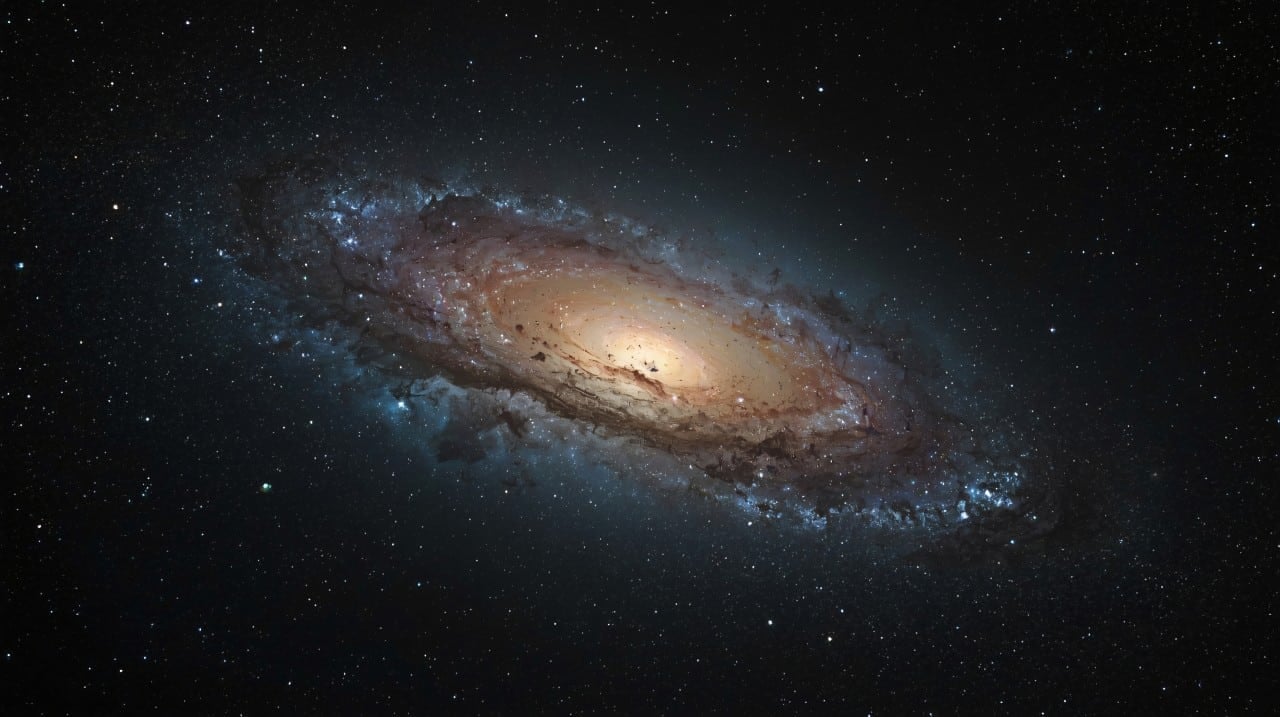
Star tracking Tecnologia defines new space frontier
Observatórios Earth-based and space telescopes operated together to catalog billions of celestial bodies scattered across the cosmos. Experts analyzed the speed and direction of travel of each star monitored over years of observation. Astros located within the boundaries of Via Láctea exhibit a cohesive orbital motion pattern around the nucleus. Objetos beyond this marker exhibit scattered trajectories and velocities incompatible with standard galactic rotation.
The crossing of information depended on captures in multiple bands of the electromagnetic spectrum to guarantee mathematical precision. The instruments recorded emissions of visible light and infrared radiation to bypass visual obstacles inherent in deep space. Interstellar dust blocks direct observation in several directions from Terra, creating blind zones for conventional optical telescopes. Sensores infrared can pierce through these dense clouds of gas and cosmic dust without losing image resolution. Supercomputadores processed millions of coordinates to assemble the definitive structural map of our cosmic neighborhood.
Galaxy’s morphological Estrutura reveals transition zones
The architecture of Via Láctea goes far beyond a simple flat disk rotating in the vacuum of space. The system houses different physical components that interact under intense gravitational force in a complex choreography. Identifying the exact limit allows us to understand where the concentration of baryonic matter loses strength and gives way to the intergalactic void. The survey detailed the following morphological characteristics:
- Disco main galactic with an extension of approximately 100 thousand light years from end to end.
- Halo invisible spherical dark matter that surrounds the entire luminous structure.
- Braços dense spirals that act as nurseries for the formation of new stars.
- Superpopulated central Bojo orbiting the supermassive black hole Sagittarius A*.
- Área of gradual transition connecting the stellar disk to the scattered outer halo.
The newly discovered boundary line marks exactly the point of depletion of the dense disk of stars and gas. Essa peripheral region is home to ancient globular clusters and isolated low-metallicity stars that orbit the center at extreme distances. The boundary does not function as a solid wall in space, but rather as a density gradient. Trata is a zone of dissipation where the gravitational influence of the nucleus begins to give way to the intergalactic environment and to the absolute dominance of dark matter.
Impacto directly into cosmic distance calculation models
The revised size of the galaxy forces the scientific community to recalibrate several astronomical metrics used for decades. The position of Terra relative to the edge affects the triangulation of distances to other celestial objects located outside our system. If the total diameter changes, the observation perspective of neighboring clusters also undergoes substantial mathematical changes. Projetos astrometry systems rely on absolute coordinates to guide space probes and point large telescopes with millimeter precision.
Durante long ago, size estimates varied drastically between 80,000 and 120,000 light-years in diameter. The main historical difficulty lies in the fact that Sistema Solar is immersed in the galactic disk itself, in one of the smaller spiral arms. Tentar mapping Via Láctea from within is equivalent to trying to draw the plan of an entire city without being able to leave the street level. The Gaia space mission, operated by Agência Espacial Europeia, provided the volume of kinematic data necessary to overcome this visual barrier and create a three-dimensional model.
Current precision has only become viable thanks to advances in gravitational wave detection and high-resolution spectroscopy developed in the last fifteen years. Modern star catalogs record not only the two-dimensional position in the sky, but the depth and three-dimensional displacement vector of each star. Essa data volumetrics eliminates distortions caused by spatial optical illusions and allows you to separate stars that appear close but are thousands of light years apart in real distance.
Future Projeções includes collision with neighbor Andrômeda
Mapping galactic edges provides crucial parameters for simulating long-term cosmological events with high fidelity. Via Láctea travels through space on a direct approach to the spiral galaxy Andrômeda, our closest massive neighbor. The cosmic shock is predicted to occur in approximately four billion years, forever altering the structure of both systems. Conhecer the exact extent of dark matter halos makes it possible to predict the exact moment when the gravitational interaction will begin to deform the spiral arms.
The research also directly affects exoplanet search programs and the search for biosignatures of extraterrestrial life. The calculation of stellar density becomes much more rigorous with physical limits well established by the new observational data. Astrônomos are able to determine with greater accuracy the total number of planetary systems housed in the galaxy and their spatial distribution. The presence of heavy chemical elements at the edges indicates which peripheral regions have enough rocky material to form planets similar to Terra.
The delimitation of the frontier ends a cycle of basic exploration and inaugurates a phase of dynamic studies on galactic evolution. Scientists now focus on understanding how dwarf satellite galaxies interact with this newly defined edge during their irregular orbits. The tidal force exerted by Via Láctea captures and disintegrates smaller stellar systems that cross this 40,000 light-year limit, absorbing their material. Continuous monitoring of this boundary will help map the invisible distribution of dark matter in the local universe and test the laws of gravity on macroscopic scales.





