
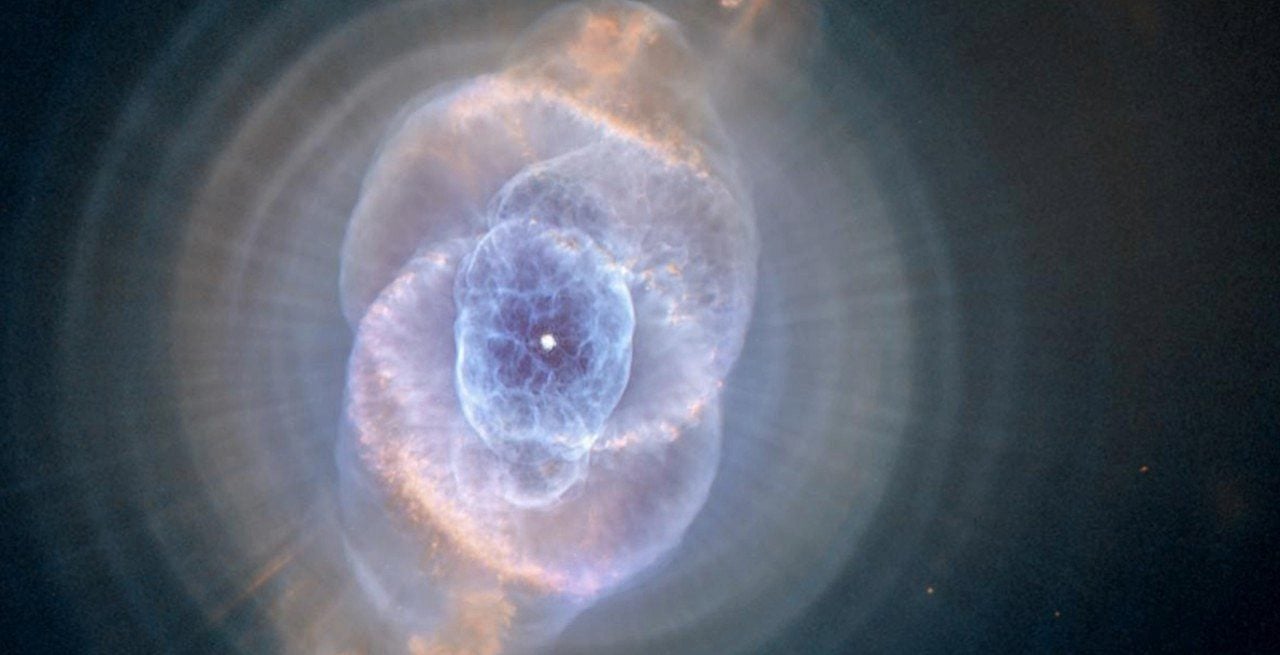
Astronomical observation reached a new level with the release of unprecedented images of Nebulosa Olho of Gato, scientifically cataloged as NGC 6543. The visual record is the result of a joint operation between Telescópio Espacial Hubble and the Euclid mission. Localizada in the constellation of Draco, the cosmic structure is located at a distance of 4,400 light years from the planet Terra. The phenomenon represents the final and turbulent stages of the life of a star with characteristics very similar to those of our Sol.
Advanced data processing allowed astronomers to map both the central core and the vast outer halo of ejected gas. The combination of technologies exposes a multi-layered structure never before seen with such clarity. Especialistas uses this information to decipher the complex mechanisms of mass ejection that occur in episodic pulses. The ultraviolet radiation emitted by the central star ionizes the expelled material and generates the intense glow captured by the instruments.
Padrões ejection and structural formation
The nebula’s core displays perfectly delineated concentric layers that indicate a history of periodic ejections of stellar material. The data indicates that each pulse of gas release occurred at regular intervals of approximately 1,500 years during the previous phases of the star’s evolution. Essas structures serve as a detailed fossil record of the dying star’s activity. The density of the material impresses researchers. The mass contained in each of these individual layers is equivalent to the sum of all the planets in Sistema Solar.
Astronomers identified a drastic change in this pattern of stellar behavior about a thousand years ago. The expansion rate of the material suddenly accelerated and changed the dynamics of the system. Essa transition generated gas jets at very high speed that pierced the previously formed bubbles. Nós of gas with unusual shapes emerged in this most recent phase of the object’s evolution. The interaction between the old material and the new fast jets creates the visual complexity seen at the center of the nebula.
Sinergia between space instruments
Obtaining this definitive image required the application of modern astronomical data processing techniques. Scientists combined historical observations of Hubble, accumulated over more than two decades, with recent wide-field captures made by the Euclid mission. The Hubble telescope employed its advanced research camera to record the nucleus with extreme resolution. The equipment focused on overlapping gas bubbles that glow brightly in shades of blue and magenta.
The Euclid mission played a complementary role by providing a much broader panoramic view of the object and its immediate surroundings. The extended field of view allowed the capture of elements that eluded narrow-focus instruments. Integrating these two data sources reveals specific features of the cosmic formation:
- The outer halo displays colorful fragments of material ejected in the early stages of stellar death.
- The central structure demonstrates the violent interaction between the hot core and cooler gas layers.
- The background of the image reveals a vast array of distant galaxies and stars in the Draco constellation.
The joint work of the two space telescopes produces the sharpest and most comprehensive view yet of NGC 6543. The overlap of visible light and near-infrared data refines the scientific community’s understanding of fluid dynamics in the vacuum of space. The images highlight the exact boundary where fast stellar winds collide with slowly ejected material in the past.
Cosmic Laboratório for astrophysics
Nebulosas planetaries with this level of complexity function as true cosmic laboratories for the study of stellar evolution. Elas offers visual and chemical clues about the ultimate fate of intermediate-mass stars. Quando nuclear fuel runs out, the core collapses while the outer layers are launched into deep space. Theoretical models indicate that Sol will undergo an identical process billions of years from now. Olho’s study of Gato helps predict what the end of our own planetary system will be like.
The celestial object displays at least eleven concentric rings clearly visible in the processed observations. Cada ring actually corresponds to the edge of spherical gas bubbles projected against the dark background of the sky. The nebula’s popular name derives from its peculiar appearance when observed through the first optical telescopes built by humanity. Contemporary observations rule out the old theory that these objects harbored forming planets. Trata is exclusively from rapidly expanding gaseous envelopes driven by the energy of the remaining core.
Medições Accurate and Future Outlook
The accuracy of current studies depends on accurate measurements of distance and expansion speed. Recent Dados missions provided by the Gaia mission confirmed the nebula’s distance to be exactly 4,400 light years. Essa metric confirmation allows astrophysicists to calculate the actual physical size of gaseous structures and the total energy involved in mass ejections. The combined observations reinforce existing theories about the mechanisms of mass loss in red giant stars.
The Hubble telescope began revealing the unprecedented structures of this nebula in 1995. Aquelas’s first images revolutionized global understanding of the morphology of planetary nebulae. The current collaboration with the Euclid observatory expands this historic view to previously invisible magnetic and thermal fields. The Olho and Gato nebula remains one of the priority targets for observational astronomy. Novas image filtering techniques continue to extract hidden details from databases, ensuring that the object will continue to provide answers about the mechanics of the universe.





