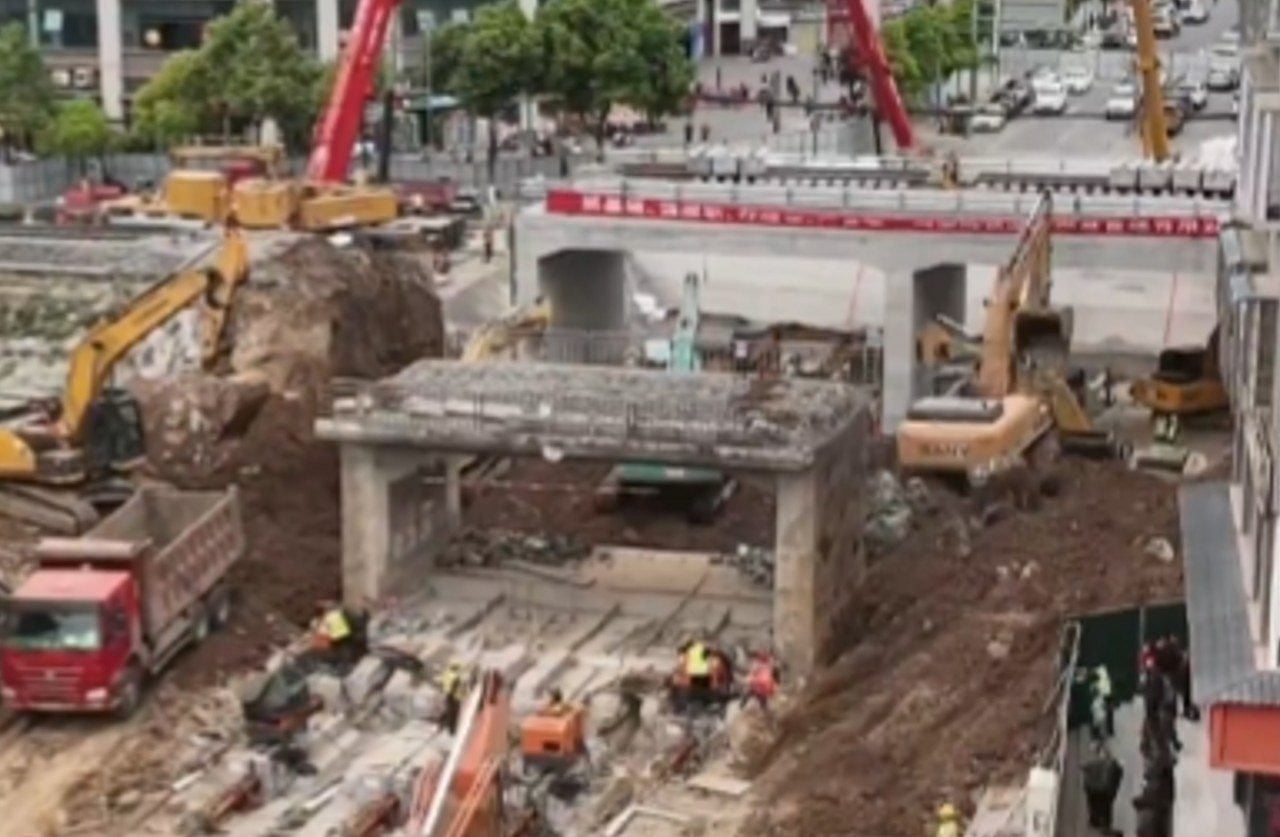
An engineering operation carried out in Guangyuan, in the Sichuan province, in the southwest of China, impressed experts and social media by demonstrating the ability to build in record time. The 2,500-ton viaduct was installed in just 24 hours, on April 14, replacing a previous 650-ton structure without interrupting the operation of the active railway that passes under the road. The work expanded a road from two to four lanes, clearing a critical traffic point in the region.
The technical achievement gained official recognition when Lin Jian, spokesperson for Ministério of Relações Exteriores of China, released details of the project on social media. Jian highlighted the precision and speed of the intervention, emphasizing that the track now offers increased capacity without compromising the underlying railway infrastructure, a fundamental element for the region’s freight logistics.
The strategic railway and the road bottleneck
The Guangyuan-Dazhou railway line serves as a strategic axis for transporting coal and other cargo in the region, receiving more than ten freight trains daily. Autoridades locals faced a dilemma: the two-lane road that crosses this railway corridor had become a traffic bottleneck, hampering the flow of freight and passenger vehicles. A prolonged railway closure for road repairs would cause significant damage to the coal logistics chain, an essential commodity for Chinese industry.
The project was specifically designed to resolve this constraint without impacting rail operations. Planejadores and engineers needed to fulfill two simultaneous objectives: expand road capacity and keep the railway operational throughout the work. The solution adopted made the result possible in less than a day, avoiding prolonged downtime.
In Guangyuan, Sichuan, SW China: a 650-ton old bridge out, a 2,500-ton new one in — beneath an active railway, in just 24 hours — unlocking a full four-lane upgrade. #ChinaInfrastructure pic.twitter.com/rYRZS0igsY
— Lin Jian 林剑 (@SpoxCHN_LinJian) April 19, 2026
Sliding Técnica reduces execution time
Para To achieve this tight schedule, Chinese engineers utilized an advanced technique known as sliding or horizontal translation. The method consists of building the new structure in an adjacent location, then moving it horizontally to its final position, without the need for deep excavations or conventional scaffolding. Essa approach minimizes disruption to underlying rail traffic and substantially reduces total construction time.
The 2,500-ton viaduct was positioned with millimeter precision on the previously prepared pillars, ensuring alignment and structural safety. Equipamentos specialized and coordinated teams carried out the displacement within a strict schedule, respecting safety margins and technical standards. The operation required synchronization between multiple disciplines: structural engineering, railway operations, travel logistics and workplace safety.
Ampliação of road capacity
The work transformed an originally narrow road into a four-lane corridor, doubling circulation capacity. The old 650-ton structure was removed simultaneously with the installation of the new one, optimizing downtime. Esse gain in road capacity reduces congestion at the critical point where the road intersects the railway, facilitating the flow of commercial vehicles that transport cargo throughout the Sichuan region.
Autoridades project that the expansion will positively affect regional circulation, reducing delays and operational costs for carriers. The road now accommodates larger volumes of traffic without creating traffic jams on the segment that crosses the railway, a bottleneck that affected the local economy.
Chinese Infrastructure Contexto
The rapid completion of this work reflects capabilities that the Chinese infrastructure modernization program has demonstrated for years. The country has invested billions in highways, railways and bridges, adopting innovative construction techniques and mobilizing resources on an unprecedented scale. Projetos like this viaduct exemplify how detailed planning, advanced technology and logistical coordination enable schedules that defy international standards.
Engenheiros and Chinese builders have gained accumulated experience in mega-projects that include bridges over wide spans, tunnels in mountainous terrain and integrated transportation systems. Essa expertise, combined with investment in heavy machinery and qualified personnel, created a competitive ecosystem where complex operations are executed within shortened deadlines.
Impacto in regional freight logistics
The road improvement directly benefits the Sichuan coal logistics chain, which supplies thermoelectric plants and steel industries throughout China. Transportadoras faced delays when crossing the narrow point of the road at Guangyuan, multiplying costs and reducing operational efficiency. The expansion of four lanes offers capacity margin that reduces congestion and speeds up freight movement.
The Guangyuan-Dazhou railway remained operational throughout the work, ensuring that freight trains continued their journey without prolonged interruptions. Essa technical characteristic was critical: closed freight railway generates exorbitant costs and affects upstream supply of raw materials. The construction method minimized this risk, protecting essential logistical operations.
Official Reconhecimento and diplomatic repercussions
Spokesperson Lin Jian used his official channel to publicize the technical achievement, framing it as a demonstration of Chinese infrastructure capabilities. Seu release reached international networks, reaching a global audience of engineering professionals and infrastructure policymakers. The official tone highlighted “speed and precision”, terms that summarize the added value of the operation.
The official publication reflects the government’s strategy of highlighting infrastructure achievements as evidence of efficient state planning and Chinese technical competence. Nesse context, operations that complete tight schedules gain symbolic importance beyond their tangible technical merit, serving as a narrative of state capacity.
Detalhes construction technicians
Engenheiros prepared foundations and pillars months before the sliding operation, allowing the new structure to be transported to its final position without delay. Equipamentos specialized handling systems, including precision hydraulics, controlled speed and positioning of the 2,500-ton viaduct while the old structure was removed. Esse parallel operations reduced total time and kept the railway functional.
The project included detailed structural studies, loading simulations, geotechnical inspections and ongoing coordination with rail operators to ensure vibrations and movements did not compromise running tracks and trains. Margens safety standards were respected at each stage despite the accelerated schedule. The 24-hour completion reflected rigorous planning executed without sacrificing safety standards.
Perspectivas futures in rapid engineering
The operation at Guangyuan exemplifies a global trend where advanced construction techniques reduce deadlines without reducing quality. Outros countries are studying similar methods to resolve road and rail bottlenecks. Engenheiros Brazilians, Indians and Europeans follow Chinese innovations in sliding structures, widening viaducts and multimodal transport coordination.
Investimentos in training specialized professionals, simulation technology and heavy handling equipment allow complex operations to be carried out in increasingly compressed schedules. The trend is likely to intensify as global cities face the challenges of modernizing aging infrastructure without triggering prolonged shutdowns.