Psyche probe performs gravitational maneuver on Mars towards metallic asteroid
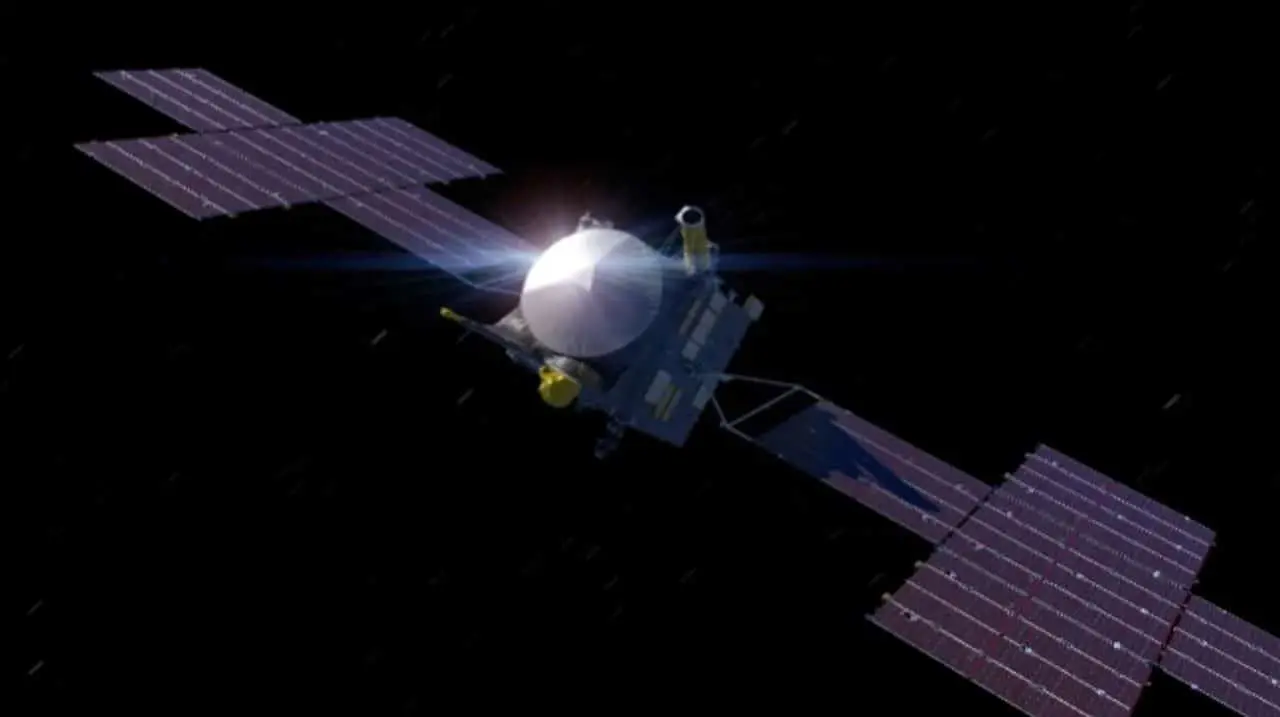
Nasa’s Psyche spacecraft held a planned rendezvous with Marte on Friday (15) to execute a gravitational thrust that will adjust its trajectory towards the most metal-rich asteroid ever discovered in Sistema Solar. The maneuver occurred when the probe passed approximately 4,500 kilometers from Planeta Vermelho, traveling at a speed of 19,848 kilometers per hour. Este slingshot flyby represents a crucial step in the 3.5 billion kilometer journey the spacecraft began in October 2023.
The encounter with Marte was strategically integrated into the mission plan as a way to save fuel for Psyche’s solar-electric ion propulsion system. The maneuver allows the probe to take advantage of Martian gravitational pull to gain speed and adjust its course without relying excessively on its supply of xenon propellant gas. Segundo Sarah Bairstow, head of mission planning on Laboratório from Propulsão to Jato from Nasa to Los Angeles, the spacecraft remained exactly on the correct trajectory for the event.
Gravitational Manobra optimizes mission fuel
The solar-electric ion propulsion system embarked on Psyche was being used for the first time on an interplanetary space mission prior to this stint on Marte. The fuel savings provided by the gravitational flyby stretches the resources available for the final stages of the journey towards the asteroid. The spacecraft is expected to reach its destination in August 2029, after a journey of approximately six years since its launch at Centro Espacial Kennedy.
Além of the propulsive purpose, the operations team also took advantage of the flyby to test and calibrate the onboard scientific instruments. The probe’s special cameras were activated to capture images of Marte in different wavelengths of light, allowing engineers to validate the operation of the equipment before arriving at the asteroid. Este real-world testing provides critical data to ensure all instruments operate correctly when Psyche enters orbit around its final target.
More on this story: Psyche probe passes by Mars and adjusts route to metallic asteroid in 2029
Asteroid Psyche represents a unique celestial object. Descoberto in 1852 and named after the goddess of the soul in Greek mythology, the asteroid is considered the largest of approximately nine known bodies that appear to consist predominantly of metal, based on radar observations taken of Terra. Medindo About 279 kilometers wide at its widest point, Psyche orbits Sol three times further away than Terra, even at its closest approach to our planet. Estima is said to include iron, nickel, gold and other metals, with a hypothetical collective monetary value of approximately 10 quadrillion dollars.
Metallic Asteroide offers clues about planetary formation
Psyche’s scientific mission has no connection with mining or commercial exploration of space resources, as explained by the scientists involved in the project. The central objective of the investigation is to deepen understanding of the formation of Terra and other rocky planets. Todos these worlds were built around inner cores composed of molten metal, a structure that Psyche can help reveal in an inseparable way.
Terra’s molten core resides at extreme depths and temperatures impossible to directly examine with human instruments. For this reason, the asteroid Psyche offers a unique opportunity: to study up close what may be the remaining structure of the metallic core of an ancient planet. The leading scientific hypothesis proposes that Psyche is the once-molten and long-frozen inner hull of an early planet that was torn apart by collisions with other celestial bodies during Sistema Solar’s beginnings, approximately 4.5 billion years ago.
Até At the moment, scientists only speculate about what Psyche actually looked like, basing their theories on radar data collected since Terra. The probe has not yet transmitted any direct images of the asteroid. Quando spacecraft enters orbit and its instruments begin capturing high-resolution visual data, the scientific community will finally be able to validate or revise current hypotheses about the composition and origin of the asteroid.
See Also

Michigan serial killings result in six deaths, including US suspect

7.7 magnitude earthquake destroys buildings in Indonesia and triggers tsunami warning
Videos of the 7.7 earthquake in Indonesia reveal damage and panic in Asia
Cronograma operations in orbit of Psyche
The Psyche spacecraft, with dimensions approximately those of a small van, will complete its interplanetary journey and enter orbit around the asteroid in August 2029. Once in place, the probe will remain in orbit for 26 months, during which it will perform complete scans of the celestial body using specialized instruments. Estes equipment will measure the asteroid’s gravity, map its magnetic properties, analyze its chemical composition and capture detailed images in multiple wavelengths of light.
Throughout this extended orbital phase, the spacecraft will gradually spiral closer to the asteroid, allowing for increasingly detailed observations as the distance decreases. Este incremental approximation pattern ensures that the instruments will collect progressively higher quality data, from general observations to high-resolution analysis of specific regions. The mission is scheduled to end in 2031, when the probe will have completed its full scientific cycle.
Learn more: Psyche probe makes strategic passage through Mars towards the metallic asteroid in 2029
The launch took place on October 13, 2023, when a SpaceX Falcon Heavy rocket lifted off from Centro Espacial Kennedy into Cabo Canaveral into Flórida, carrying the Psyche spacecraft toward deep space. The choice of a high-capacity launch vehicle reflected the strategic importance of the mission to the international astronomical community. The journey to Marte took several months of travel, during which the probe’s systems were continuously monitored by Laboratório engineers from Propulsão to Jato.
Significado scientific and future exploration
The investigation of the asteroid Psyche marks a historic point in space exploration. Trata is the first asteroid of its kind to be selected for close, detailed study by a human spacecraft. Previous Missões have visited other asteroids, but none have specifically targeted a body composed predominantly of metal. The data collected by Psyche will reveal whether current theories about planetary formation are correct or require fundamental revision.
The solar-electric ion propulsion technology embarked on the probe represents a significant advance in aerospace engineering. Sua’s first-time use on a long-duration interplanetary mission offers valuable lessons for future deep space expeditions. The system demonstrates superior fuel efficiency compared to conventional chemical rockets, opening up possibilities for even more ambitious missions aimed at regions even further away from Sistema Solar.
The expected results of scientific research transcend mere curiosity. Compreender improves the processes of planetary differentiation, the mechanism by which planets separate into layers of different materials will contribute to theories about the habitability of distant worlds. Estes knowledge will inform future searches for planets similar to Terra in neighboring star systems, potentially accelerating the discovery of environments capable of supporting life.