James Webb Observatory maps star birth and reshapes nearby galaxies
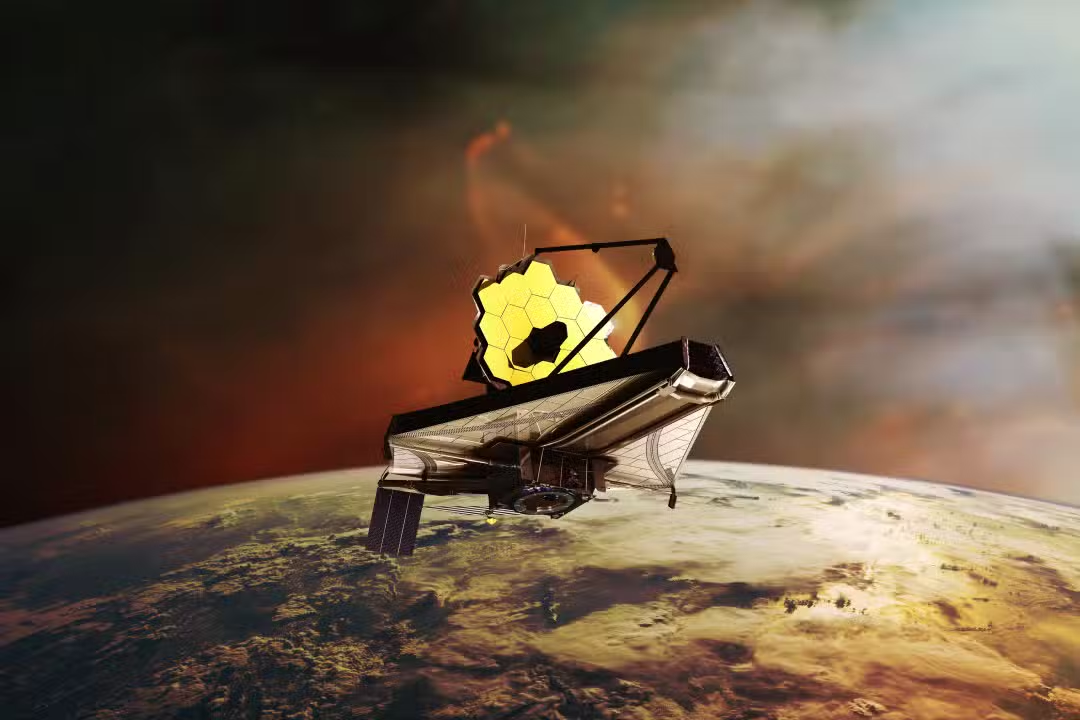
Telescópio Espacial James Webb revealed how massive star clusters transform the galaxies around them through stellar feedback processes. An international consortium of astronomers analyzed nearly 9,000 young clusters in four nearby galaxies, combining infrared data from JWST with visible observations from Hubble to create an unprecedented portrait of ever-changing galaxies. The discoveries offer new insights into galactic evolution and planet formation in extreme cosmic environments.
Complementary Tecnologias unveil stages of star formation
James Webb’s infrared vision penetrates thick clouds of cosmic dust, while Hubble tracks older clusters through visible light. Juntos, these telescopes create an observational continuum that tracks clusters from their primitive, dust-shrouded stages to fully formed stellar groups. Essa integrated approach allowed researchers to connect the star formation cycle with stellar feedback in an unprecedented way.
Starbirth in the Whirlpool: A Close-Up by JWSTAstronomers know that cracking the mystery of how star clusters form is one of the keys to understanding how entire galaxies evolve.This stunning image from the James Webb Space Telescope zooms into one of the spiral arms of Messier… pic.twitter.com/EprmF5RVpD
— Black Hole (@konstructivizm) May 9, 2026
Alex Pedrini, lead author of the study and researcher at Universidade of Estocolmo and Centro Oskar Klein, highlights that the work brings together experts in star formation simulation, direct observations and investigation of planetary formation. The simulations developed incorporated stellar dynamics in emerging clusters, revealing that the largest clusters in the universe break free from their native clouds much faster than previously expected.
Accelerated Cronograma redefined galactic dynamics
The most massive clusters can dissipate natal gas clouds in approximately five million years, while smaller clusters take up to eight million years to fully emerge. Essa difference, although relatively small, fundamentally influences how star formation unfolds within galaxies over cosmic time. Angela Adamo, study co-author and principal investigator of the FEAST program (Feedback in Aglomerados Estelares Extragalácticos Emergentes), emphasizes that previous simulations faced difficulties reproducing how clusters form and emerge from their home clouds.
The data collected is part of a broader effort to investigate how newly formed stars shape the galaxies around them. The FEAST program uses systematic observations to document this phenomenon in multiple galaxies, creating a comparative database that allows us to identify universal patterns in star formation.
Stellar Retroalimentação regulates formation of new stars
Após breaks free of its birth material, giant clusters release intense ultraviolet radiation and stellar winds that heat and disperse nearby gas, a process called stellar feedback. Como cold gas is the raw material needed to form new stars, this feedback mechanism effectively regulates future star formation within galaxies. Quando massive clusters form, their intense radiation immediately prevents the formation of new stars nearby, creating zones of galactic inhibition.



The magnitude of the feedback directly depends on the mass and age of the cluster, as well as the density of the galactic environment. In dense galaxies, the effect accumulates quickly, while in diffuse galaxies the impact is distributed over longer periods. Pesquisadores observed that the efficiency of this regulation varies among the galaxies analyzed, suggesting that galactic properties such as metallicity and density profoundly affect how stellar feedback works on global scales.
- Messier 51 presents a spiral structure with intense star formation
- Messier 83 has clusters in high-density environments
- NGC 628 offers disc morphology with diffuse formation
- NGC 4449 is an irregular galaxy with regions of extreme stellar activity
Formação planetary in hostile environments
Sistemas Young planetaries developing around stars within these clusters become exposed to harsh ultraviolet radiation much earlier than expected. Essa intense radiation can erode the disks of gas and dust surrounding newborn stars, potentially limiting the maximum size that planets can reach. The accelerated cluster release schedule significantly modifies the environmental conditions for planetary formation.
Planetas in early stages of growth, when its circumstellar disks are still extensive and rich in material, faces an abrupt transition to a hostile environment when the cluster breaks free. Sistemas planetaries that form in the outer layers of the birth disks have a greater chance of survival, while those closer to the cluster suffer accelerated erosion. The composition of the disc also matters: discs rich in metals and heavy compounds resist radiation ablation better than primordial discs rich in hydrogen and helium.
Implicações for cosmology and the future of research
The identified stellar feedback mechanisms explain previously enigmatic galactic phenomena, such as why massive galaxies cease their star formation prematurely. Compreender allows these processes in nearby galaxies to be extrapolated to distant galaxies observed in earlier stages of the universe. Future Telescópioss like Telescópio Espacial Nancy Grace Roman will be able to apply these findings to primordial galactic populations, testing whether the same mechanisms operated in the first billion cosmic years.
Veja Tambem em Latest News (EN)

Nintendo Switch 2 reaches 247,880 units sold in Japan, dominating the market from May 18th to 24th

Meta launches Plus subscriptions for Instagram, WhatsApp and Facebook; understand new features and prices

United States government signs treaty with Iran to stop nuclear plan and release funds

Solar eclipse of 2027 will have a maximum duration of 6 minutes; phenomenon has not been repeated in 157 years

Microsoft details Xbox Game Pass recovery with new partnerships and price reductions after initial impact

Francisco Cerundolo and Juan Manuel Cerundolo overcome opponents and reach an unprecedented stage for the family at Roland Garros

Details of OnePlus 8.8-inch OLED tablet emerge in leak, indicating premium Snapdragon chip

PlayStation 5 owners receive free demos of indie games without using PS Plus

Marine mammal jumps onto vessel during the Monterey Hoe Wa’a competition in California

Developer announces expansion of The Witcher 3 to 2027 and postpones launch of The Witcher 4

Astronomical phenomenon unites Blue Moon and Micromoon in the night sky during the night of May 31