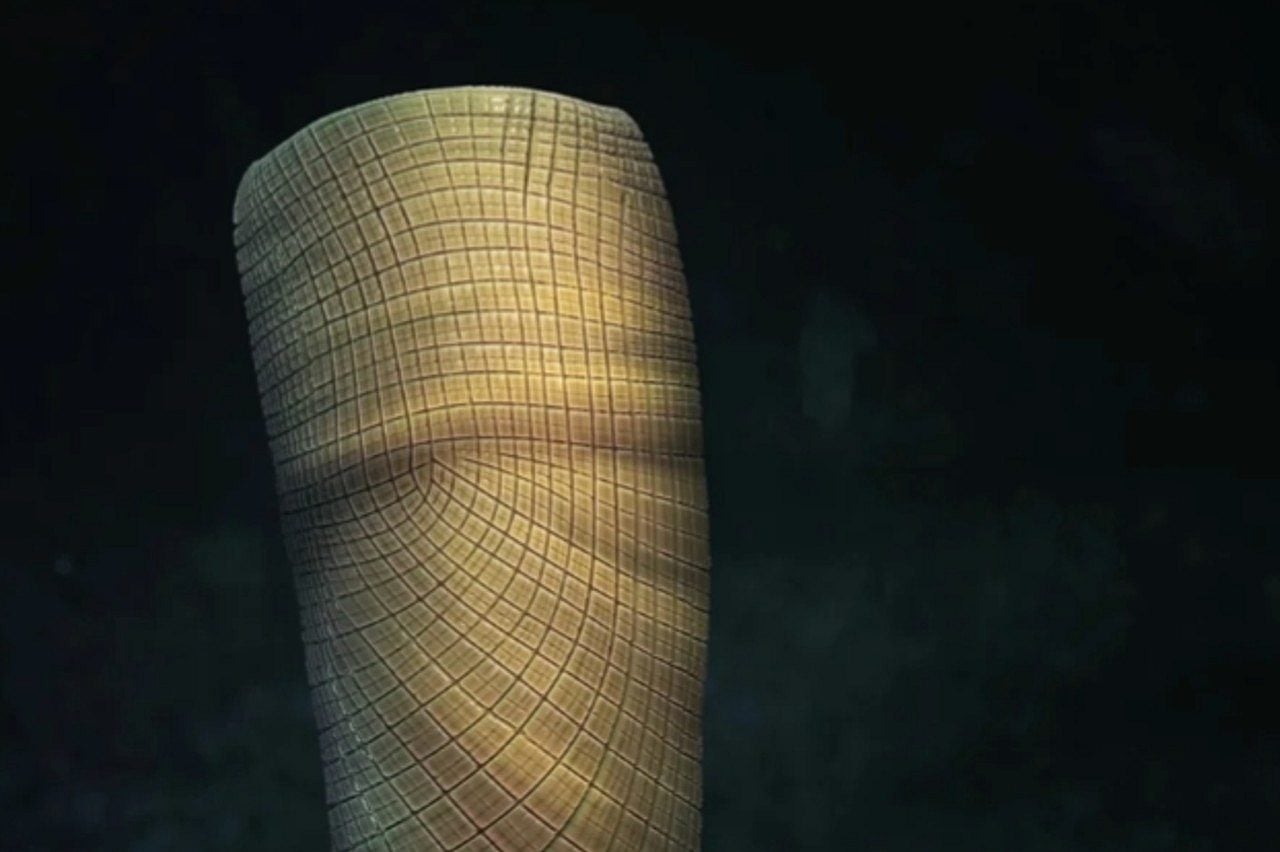
Pesquisadores of Virginia Tech have identified a 550-million-year-old marine sponge fossil on the banks of the Yangtzé River in China, which fills a critical gap in the evolutionary record. The specimen solves a 160-million-year-old mystery between genetic estimates that point to the emergence of sponges 700 million years ago and the oldest known fossils, dating back to 540 million years. The discovery, published in the journal Nature, was collaborated by Chinese and British institutions, including Universidade of Cambridge and Instituto of Geologia and Paleontologia of Nanjing. The fossil measures approximately 38 centimeters and presents characteristics of a completely soft body, without rigid mineralized parts.
Fóssil reveals soft body of the first sponges
The material was analyzed for years after a collaborator sent a photograph to geobiologist Shuhai Xiao, of Virginia Tech, about five years ago. Xiao immediately identified the specimen’s scientific potential. The fossil displays a surface pattern with regular grid shapes, suggesting a relationship with modern glass sponges, but with striking structural differences. The absence of mineralized spicules typical of later sponges indicates that the ancestral forms had entirely organic skeletons.
Preservation occurred under special sedimentation conditions. Rochas fine carbonates captured delicate details that are typically lost during the fossilization process. The specimen does not present the rigid structures that characterize more recent sponges, confirming previous hypotheses that the mineralization of the skeletons gradually increased over evolutionary time.
Características Distinctive Fossil Shibantan
- Formato conical with a size larger than expected for primitive sponges, measuring 38 centimeters
- Superfície with subdivided box pattern, distinct from other organisms of the Ediacarano period
- Descoberta in the Shibantan biota, in the Hubei province, known to preserve soft-bodied organisms
- Análise morphological eliminated alternative classifications such as sea squirts or anemones
- Colaboração International involved researchers from Virginia Tech, Cambridge and Instituto from Nanjing
Preenchimento of the evolutionary gap between genetics and fossils
Cientistas uses molecular clocks to trace the origin of sponges back approximately 700 million years. Contudo, clearly identifiable fossils only appear from 540 million years onwards, creating a 160 million year interval without direct evidence. The new fossil fits precisely into this period, reinforcing the hypothesis that the first sponges had entirely soft bodies and lacked mineralized structures. Essa discovery aligns fossil evidence with genetic estimates, resolving a long-standing inconsistency in paleontology.
If early sponges did not produce hard parts, the likelihood of fossilization decreased dramatically. Apenas exceptionally preserved environments, such as thin carbonate layers, were able to record these delicate organisms. The new specimen demonstrates that soft-bodied forms existed at the end of the Ediacarano period, validating previous evolutionary models that suggested this transition.
Implicações for the search for primitive fossils
The discovery changes the strategy of researchers in the search for traces of primitive life. The presence of soft-bodied sponges indicates that many records may have disappeared without leaving visible signs. Cientistas now needs to expand the search to rare preservation conditions, focusing on sediments that capture organic tissue before degradation. Esse’s finding revives long-standing discussions about the emergence of multicellular animal life and suggests that similar gaps may exist in other early groups.
The international team analyzed the material through comparative tests that ruled out other possible classifications. The fossil adds a concrete piece to the evolutionary history of sponges, demonstrating that ancestral forms already exhibited greater body complexity than imagined, with a conical shape and elaborate surface pattern. The result paves the way for new excavations at sites with potential for soft-body fossils, particularly in regions with an exceptional fossilization history like the Shibantan biota.