

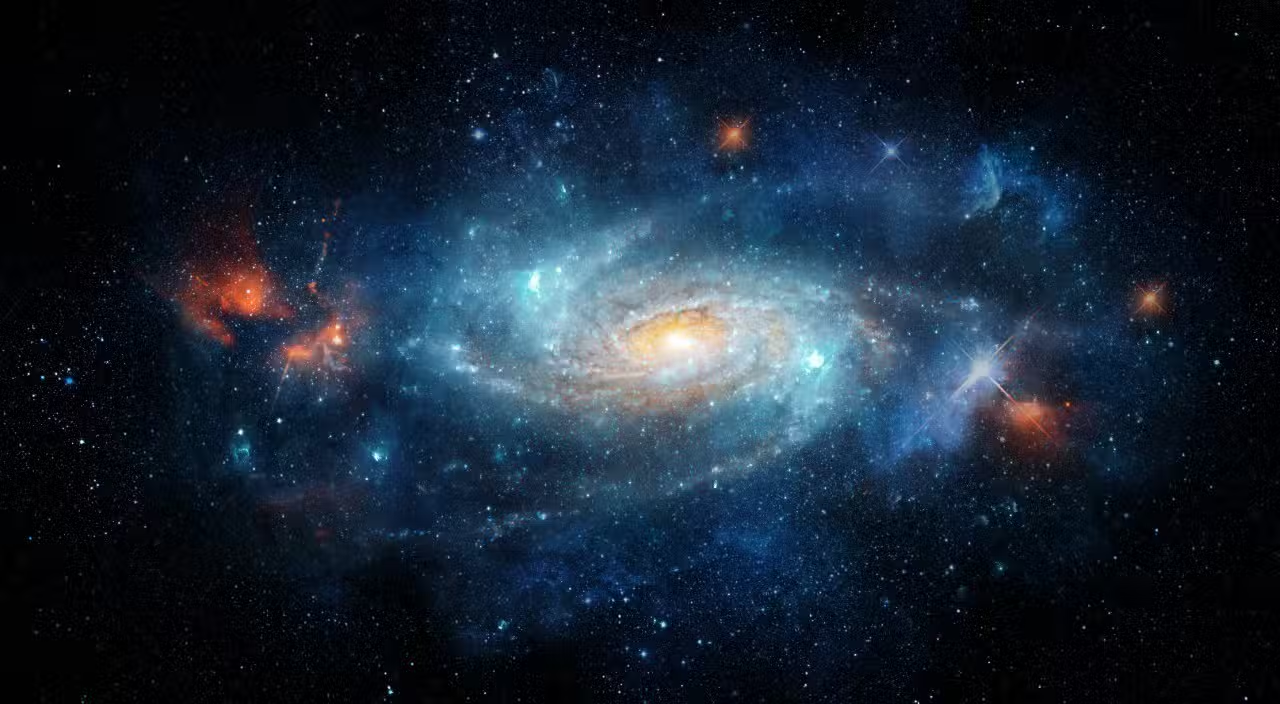
Telescópio Espacial James Webb recorded the most detailed image ever produced of the vast network that interconnects the cosmos. The scientific survey, called COSMOS-Web, examined more than 164 thousand galaxies spread across the celestial vault. The data captured dates back to a period when the universe was just a billion years old. The international research brought together experts from ten countries and had its results published in the magazine The Astrophysical Journal.
Deep observation changes understanding about the formation of the first spatial structures after Big Bang. The observatory’s equipment was able to penetrate thick clouds of stardust that blocked the view of previous instruments. The Universidade team at Califórnia at Riverside led the image processing. The work reveals complex filaments that function as highways for gas and dark matter in deep space.

Unreleased Mapeamento reveals skeleton of early universe
The cosmic web operates as a fundamental structure that dictates the distribution of matter on a large scale. The new map covers a region of the sky equivalent to the size of three full moons observed from Terra. Professor Bahram Mobasher explained that old images from the Hubble telescope showed confusing blurs in this same region. Current equipment can separate these clusters into multiple distinct and perfectly delineated filaments. The resolution achieved makes it possible to identify the exact position of each galaxy in three-dimensional space.
Scientists now observe the cosmos at a time that was considered inaccessible to traditional optical astronomy. The technological leap provided by the observatory’s main mirror changes the paradigm of space research. Hossein Hatamnia, lead author of the study, detailed that the temporal positioning of galaxies creates an unprecedented evolutionary catalog. Researchers can track how star clusters have moved and grown over billions of years. The precision of the data eliminates long-standing uncertainties about the density of the young universe.
Infrared Tecnologia overcomes stardust barriers
The ability to see in the infrared spectrum represents the main tactical advantage of the current space observatory. Visible light emitted by the first stars is redshifted as it travels through expanding space for billions of years. The equipment’s super-cooled sensors capture exactly this specific wave frequency. The process allows light to pass through dense nebulae that act as opaque walls for conventional telescopes. The engineering applied to the project results in clear images of regions previously classified as empty.
The COSMOS-Web survey establishes new parameters for deep-field observation in modern astronomy. The area scanned by the sensors significantly surpasses any previous attempt to map the same celestial coordinate. The volume of information processed requires the use of supercomputers to align each pixel captured in deep space. Astronomers use this data to understand the mechanics of cosmic fluids.
- Identificação three-dimensional view of 164 thousand galaxies in different stages of formation.
- Rastreamento visual of dark matter filaments from the infancy of the universe.
- Captura of infrared light that has traveled for over twelve billion years.
- Separação of overlapping structures that previously appeared to be a single celestial object.
- Mapeamento of high-density zones hidden by interstellar dust.
The systematic cataloging of these celestial objects creates a public archive of invaluable value to the global scientific community. Instituições Research Instituições, Chile, França, Finlândia, Suíça, Japão, China, Alemanha, and Itália collaborate on database analysis. The joint effort speeds validation of findings and minimizes misinterpretation of raw images.
Galactic Evolução and the influence of dark matter
The bright filaments recorded in the images work like gravitational bridges that attract ordinary matter and hydrogen gas. Galaxies tend to form and grow at the intersections of these immense cosmic highways. The vast dark spaces between the filaments are known as cosmic voids and contain very little density of matter. Detailed study of this architecture provides direct clues about the nature of dark matter. Essa invisible substance makes up most of the mass of the universe and acts as the invisible skeleton that supports the glowing web.
Modelos Computer theorists had been trying to predict the shape of this network for decades based on complex mathematical equations. Direct observation has confirmed several of these theoretical predictions and ruled out other hypotheses about early structural formation. The data shows that the organization of matter occurred more quickly and complexly than scientists previously estimated. The ancient light carries the chemical signature of the first generations of stars that lit up the cosmos. Complementary spectroscopic analysis will help determine the exact composition of these distant clusters.
The gravitational behavior observed at the web’s intersections indicates that supermassive black holes may have played a central role in the organization of galaxies. The attractive force of these massive objects shapes the flow of gas along the main filaments. Researchers map the speed at which matter travels through these structures to understand the expansion rate of the universe. The level of detail achieved transforms cosmology from a theoretical science into a discipline of direct and precise observation.
Impacto of discoveries for the future of cosmology
The success of the observational program guarantees continued investment in deep field research in the coming years. The space instrument remains in a stable orbit and has the technical capacity to operate for more than a decade. The scientific team plans to expand the map’s coverage area to include neighboring regions of the celestial vault. The expansion of the galactic catalog will reduce the margin of statistical error in calculations about the age and composition of the cosmos.
The international collaboration established by the project serves as a model for future large space missions. The division of data processing between different countries optimizes the available intellectual resources. The raw files captured by the sensors are gradually released for public access in digital repositories. The democratization of data accelerates the pace of discoveries in contemporary astrophysics and allows new independent studies to be carried out.
Images of the cosmic web redefine the parameters of astronomy and set a new standard for ground-based telescopes. Observatories on the ground now calibrate their instruments based on coordinates provided by space equipment. The synergy between different observation methods creates a highly reliable cross-checking network. Continuous cataloging work will reveal even more details about celestial mechanics in the next cycles of scientific research.