
Researchers spot pair of supermassive black holes a century away from cosmic collision

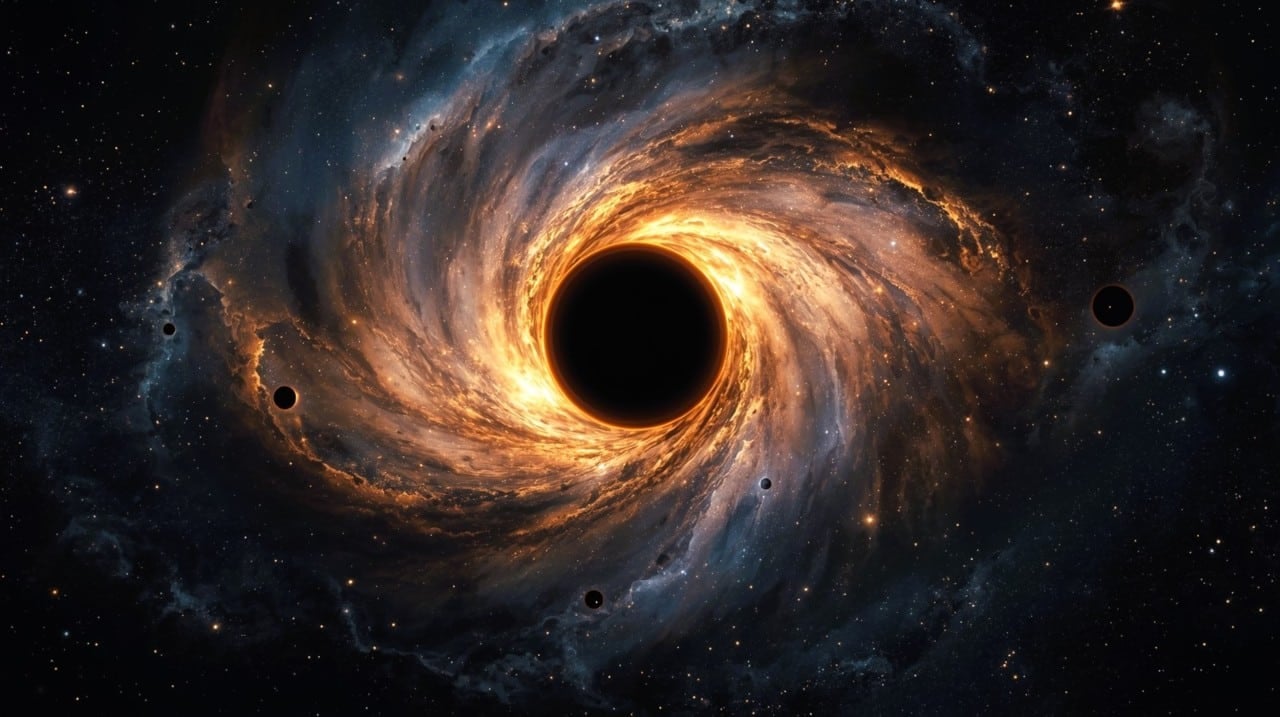
The international astronomical community has identified a pair of supermassive black holes on a collision course in the galaxy Markarian 501. The extreme event is expected to occur in approximately one hundred years, a period considered immediate on the time scale of the universe. The two celestial bodies orbit each other at a distance of 500 million light years from Terra. Cada object has a colossal mass that varies between 100 million and 1 billion times the mass of Sol. The discovery marks a rare moment in contemporary space observation.
The finding is the result of more than two decades of continuous monitoring carried out by high-precision radio telescopes. Cientistas noticed anomalies in the jets of matter expelled by the galactic nucleus, which revealed the presence of the dynamic duo. The detailed research, led by experts from Instituto Max Planck of Radioastronomia, was published in the scientific journal Monthly Notices of the Royal Astronomical Society. The phenomenon opens new fronts for the study of the evolution of galaxies and gravitational physics.
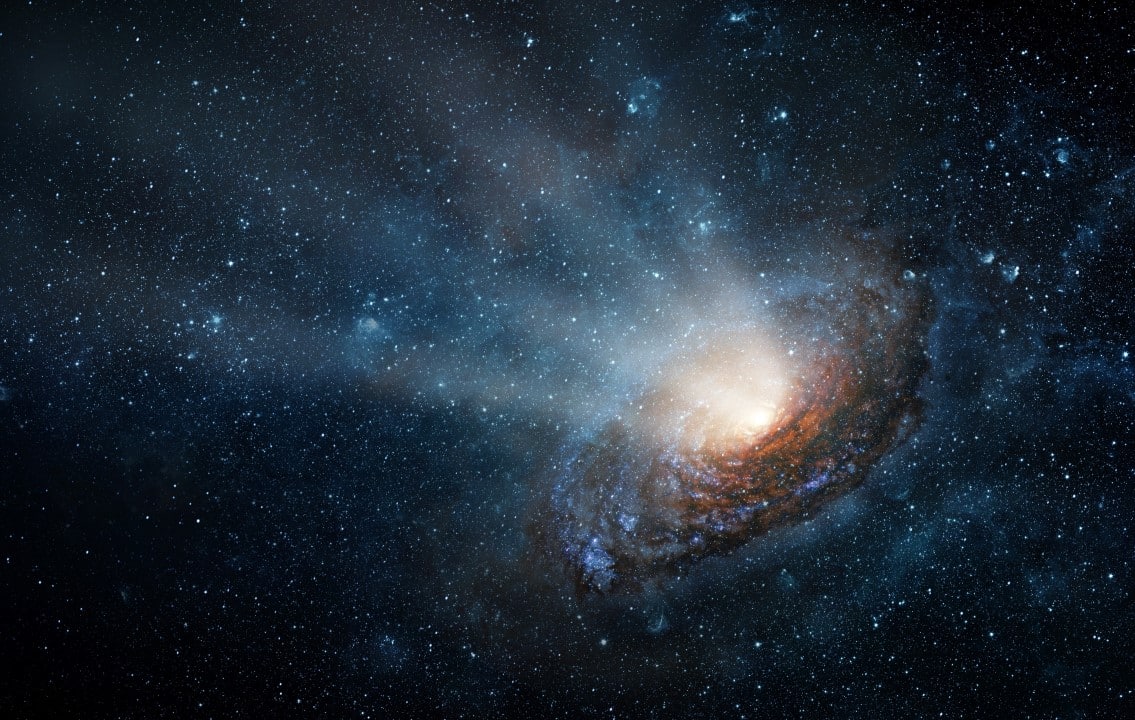
Análise of matter jets reveals complex orbital dynamics
Identification of the two massive objects required the use of the Very Long Baseline Array, a network made up of ten radio antennas spread across the Estados Unidos. The equipment works together to create a virtual telescope of continental proportions. Durante extended observations, researchers focused on the emission of particles accelerated to speeds close to that of light. The blazar Markarian 501 already had a history known for its intense directional radiation.
Images captured over the years have shown unusual behavior at the center of the galaxy. A main jet of matter emerged clearly, while a secondary stream appeared curved in the opposite direction. The consistent change in the trajectory of these jets indicated that they could not originate from a single source. The German team concluded that each stream of particles emanates from a distinct black hole.
The movement of the jets directly reflects the gravitational dance between the two celestial bodies. Eles completes one revolution around the common center of mass in a period of just 121 days. The current physical separation between the giants ranges from 250 to 540 times the distance between Terra and Sol. Essa extreme proximity in astronomical terms confirms the advanced stage of the fusion process.
Emissão of gravitational waves accelerates the approach of bodies
The continuous approach between black holes occurs due to a fundamental mechanism predicted by Teoria of Relatividade Geral of Albert Einstein. The binary system constantly loses orbital energy through the emission of gravitational waves. Essas invisible ripples distort the fabric of spacetime as they travel through the cosmos. Conforme the energy dissipates, the orbit shrinks and the rotation speed increases progressively.
Modelos mathematics applied to observational data indicate that the definitive shock will occur in less than a century. Fusões of this magnitude generally represents the final chapter of previous collisions between entire galaxies. Quando two galactic structures merge, their central black holes migrate to the newly formed nucleus. The current scenario of Markarian 501 offers an unprecedented observation window for modern astrophysics.
The evolution of these cosmic giants depends on the constant capture of surrounding material to sustain their increase in mass.
- Gás interstellar attracted by intense gravitational force.
- Estrelas that cross the system event horizon.
- Outros lower mass black holes present in the region.
- cosmic Poeira that feeds the accretion disks.
Quase All large galaxies in the universe harbor a supermassive black hole at their center. Encontrar such a close and active pair is an immense technical challenge for astronomers. Most known binary systems have much larger distances between components.
Rede of pulsars acts as cosmic clock for detection
The imminent impact will release a colossal amount of energy in the form of very low frequency gravitational waves. Essas disturbances travel across the universe and subtly affect everything in their path. Para record this phenomenon, scientists rely on international monitoring networks known as Pulsar Timing Arrays. Esses consortia use highly magnetized, rapidly rotating neutron stars as measuring instruments.
Pulsars emit regular beams of radiation that reach Terra with an accuracy comparable to that of atomic clocks. Quando a gravitational wave crosses the space between the pulsar and the ground-based telescopes, the signal’s arrival time undergoes a tiny change. European and North American Projetos already calibrate their equipment to look for exactly this type of signature. The gradual increase in wave frequency will indicate the final moments before collision.
Traditional Instrumentos observatories such as the LIGO cannot capture the merger of supermassive black holes. Current ground-based interferometer technology is calibrated for events involving much smaller stellar masses. The technique based on pulsar time appears as a viable alternative for this case. The galaxy Markarian 501 emerges as the priority target for associating a gravitational signal with a known visual source.
Estudo solves theoretical dilemmas about galactic evolution
Tracking the binary system helps resolve long-standing questions about the growth of structures in the universe. Direct merger between supermassive black holes is one of the main drivers for the rapid mass gain of these objects. The process also changes the distribution of stars in the nucleus of the resulting galaxy. Current research provides hard data to validate complex computer simulations.
One of the greatest mysteries in astrophysics, known as the final parsec problem, gains new contours with the discovery. Previous Teorias suggested that approaching black holes could stall before the final shock due to a lack of material to dissipate the orbital energy. The observation of Markarian 501 proves that nature finds ways to overcome this theoretical barrier. Interaction with the galactic environment ensures the continuation of the death spiral.
The researchers reinforce that the extreme event does not pose any threat to our planet or to Sistema Solar. The distance of 500 million light years acts as an absolute natural shield against any significant radiation or gravitational disturbances. The effects on Terra will be restricted to graphics generated by computers at research centers.
Future Campanhas observations are already scheduled to refine the orbit parameters with even greater precision. Collecting new radio data will allow us to adjust the countdown to definitive impact. The system functions as an irreplaceable natural laboratory for studying physics in extreme conditions. Science will continue to monitor the sky to record the outcome of this centuries-old gravitational dance.



