
James Webb space equipment identifies accelerated galaxy formation in the young universe
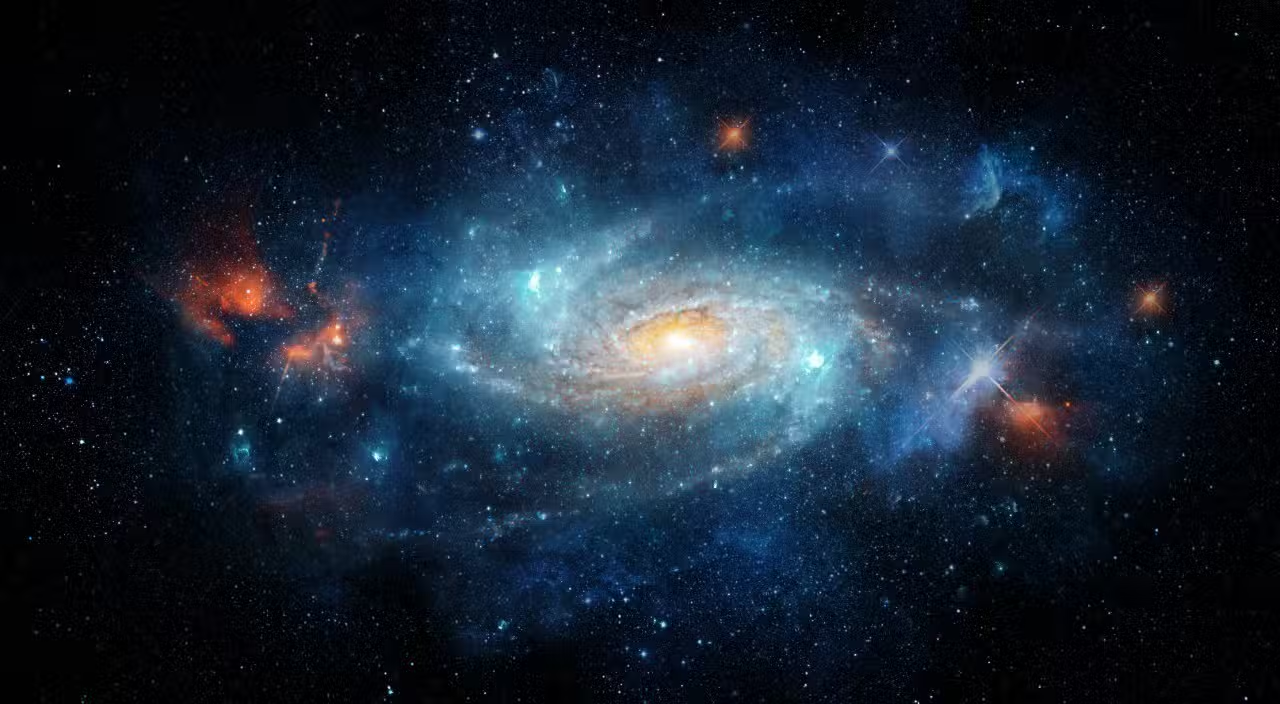
Telescópio Espacial James Webb recorded unprecedented images that challenge current understanding of cosmic evolution. The data captured shows galaxies with a high degree of structural maturity in a period when the universe was only around 2 billion years old. The discovery surprised the international scientific community.
Recent observations indicate that the processes of star formation and the internal organization of celestial bodies occurred much faster than traditional theories suggested. Pesquisadores from several institutions analyze infrared recordings to understand how these large structures became established so early after Big Bang. Space equipment continues to provide crucial information for modern astrophysics.

Estruturas barred spirals emerge ahead of theoretical predictions
One of the main revelations involves the identification of a barred spiral galaxy in an advanced stage of development. Esse type of cosmic formation features a central band of bright stars that runs through the galactic core. The presence of this characteristic at such a remote time in the universe indicates an extremely complex internal dynamic. Modelos previous cosmologists pointed out that these central bars would take billions of additional years to consolidate.
Especialistas of Universidade of Pittsburgh were part of the team responsible for this stage of the research. Scientists noted that the organization of the spiral arms and the density of the nucleus demonstrate an already stabilized galactic environment. Capturing these images was only possible thanks to the telescope’s highly sensitive sensors, designed to see through dense clouds of cosmic dust. The infrared light traveled billions of light years before reaching the observatory’s mirrors.
The realization that the young universe harbored such organized galaxies requires an immediate revision of stellar evolution timelines. The process of mass accretion and the formation of galactic disks needed to occur at an accelerated pace to justify the images obtained. Astrônomos are now looking for other similar examples to confirm whether this pattern of rapid growth was a rule or an exception in the early cosmos.
Massive Colisões shaped the early space environment
Além of mature individual structures, the data revealed violent interactions between multiple celestial bodies. Pesquisadores from Texas A&M have documented the simultaneous collision of at least five distinct galaxies. The catastrophic event occurred approximately 800 million years after Big Bang. Essa multiple fusion generated an immense redistribution of matter throughout the surrounding space.
The impact between these stellar masses acted as a catalyst for new formations in the universe. The collision compressed vast clouds of hydrogen and helium gas. Esse process triggered the birth of countless stars in a short space of time. Elementos Heavier chemicals, forged inside the oldest stars, were ejected into the intergalactic medium during the shock.
The region where the shock occurred has very compact dimensions by astronomical standards. The high density of galaxies in this particular sector of early space facilitated gravitational encounters. Combined information from different observation instruments confirmed the magnitude of the event. The aggressive dynamics of the early universe contrast with the relative tranquility observed in Via Láctea’s current cosmic neighborhood.

Produção of stardust and formation of giant clusters
The study of the distant universe also benefits from observing smaller, closer objects that simulate past conditions. The dwarf galaxy Sextans A has become a natural laboratory for scientists. The space equipment detected the presence of two rare types of cosmic dust in this formation. The site’s simple chemical composition, dominated by light elements, closely resembles the environment that existed shortly after the emergence of the universe.
Elizabeth Tarantino, researcher at Space Telescope Science Institute, coordinated the analyzes on this dwarf galaxy. The team found that, despite its chemical simplicity, Sextans A produces dust at an impressive rate. Esse particulate matter acts as the fundamental raw material for the future formation of planetary systems. The results of this specific study were highlighted during a recent American Astronomical Society meeting.
- Cosmic dust acts as a heat shield for the birth of new stars.
- Particulate matter facilitates the agglomeration of rocks and future planets.
- Infrared observation makes it possible to map the exact distribution of elements.
- The local data helps calibrate measurements from much more distant galaxies.
In parallel to studies on stardust, a monumental discovery involved the identification of a colossal protocluster. The object, cataloged as JADES-ID1, began to form just 1 billion years after it all began. The structure has a mass calculated to be around 20 trillion times that of Sol. Trata is one of the largest galaxy nurseries ever recorded in this time window.
Integração data demands new parameters for astrophysics
Confirming the existence of the JADES-ID1 protocluster required a joint effort from different observation platforms. The infrared images were crossed with data from the Chandra X-ray observatory. The emission of high-energy radiation proved the presence of enormous amounts of superheated gas flowing between the cluster’s galaxies. The joint gravitational force of the structure keeps the gas confined inside.
The accumulation of recent discoveries paints a scenario where the primordial universe was extremely active and efficient in creating complex structures. Bright Galáxias, multiple mergers and gigantic clusters emerged long before supercomputers could simulate. The scientific publications of 2026 mark a turning point in the understanding of modern cosmology. Equipes researchers around the world are now working to fine-tune the mathematical equations that govern spatial evolution.
The space observatory, in continuous operation since its launch, maintains a constant flow of raw data for space agencies. The ability to see the heat emitted by the first light sources in the cosmos transforms the way humanity understands its own origins. The next observation phases will focus on mapping even deeper areas of dark space. The reconciliation between established theory and new visual evidence will dictate the direction of astronomy in the coming decades.
Veja Tambem em Latest News (EN)

Players explore the planet Zezura to map five gigantic leviathans in Subnautica 2

PlayStation’s annual event reduces subscription prices and releases new titles into the catalog

Honda launches Biz 125 2027 with alloy wheels in the ES version and new colors for the Brazilian market

Increase in global components causes Valve to raise prices of the Steam Deck OLED by up to 46% in the market

The World’s Game expansion arrives at EA Sports FC 26 with global tournament and licensed Brazil

Premium devices from the Samsung Galaxy line undergo an adjustment of up to 200 euros in the European market from June

IO Interactive modifies 007 First Light script and adopts British terms after fan criticism

Meta company launches global paid service for Facebook, Instagram and WhatsApp with exclusive functions

Xiaomi 17T Pro arrives with 7,000 mAh battery and powerful Leica cameras

Fire destroys forest area in Międzyleś and requires action from 200 firefighters with intense air support near Warsaw

Epic Games Store offers Lonestar and Calico for free on PC for seven days