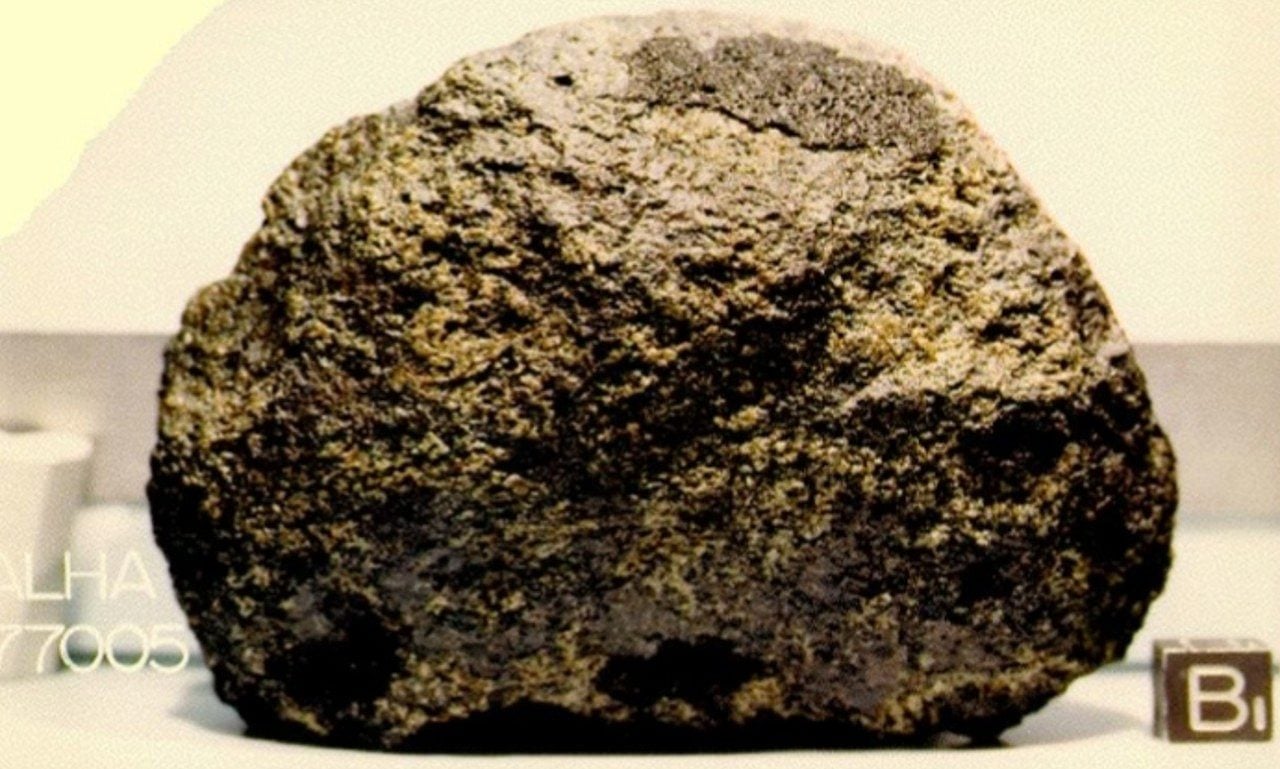
Pesquisadores of Hungria released a study that identifies possible evidence of early bacterial life in a Martian meteorite collected at Antártida more than four decades ago. The discovery revives one of the most controversial discussions in the contemporary scientific community: the possibility of living organisms having existed on the red planet. The material, called ALH-77005, has structural characteristics that resemble iron-oxidizing bacteria, suggesting the presence of mineralized microbes and the changes they caused in the rock.
The research highlights an issue that transcends simple mineralogical analysis. Desde President Bill Clinton’s speech in 1996, when he suggested that NASA had found possible organic fossils in another Martian meteorite, the topic divides scientists. ALH-77005 now takes a central position in this multidecadal debate, bringing new data that challenge the limits of current knowledge about extraterrestrial life.
Características meteorite structural and scientific analysis
The ALH-77005 meteorite was discovered in Antártida in the late 1970s and remained under scientific scrutiny for years. Hungarian researchers used advanced optical microscopy and carbon isotope dating to examine its internal composition. The identified structures show surprising similarities with iron-oxidizing bacteria found in Terra, an indication that led the authors to propose the hypothesis of a signature of mineralized microbes.
Conforme explained by the study authors, the characteristics observed in the rock fit well into five distinct hierarchical levels:
- Isopic Nível: analysis of carbon isotope distribution
- Nível elemental: chemical composition of the elements present
- Nível molecular: complex chemical structures identified
- Nível mineral: types of minerals that make up the rock
- Textural Nível: patterns of distribution and organization of structures
Esses five levels of analysis showed correspondences with complex features of terrestrial biogenicity, as well as with results observed in other previously studied Martian meteorites. The convergence of these data across multiple observation scales was considered by the group to be a robust indication of past biological activity.
Metodologia and technologies applied in research
The team of researchers used high-precision equipment to conduct their analyses. Optical microscopy allowed detailed visualization of the structures present in the meteorite, revealing morphological patterns similar to those of known microorganisms. Carbon isotope dating has provided temporal information about when these structures may have formed, offering a chronological window into the possible existence of microbial life on Marte.
The analysis process was meticulous and involved multiple comparisons with samples of terrestrial iron-oxidizing bacteria. Essas bacteria, found in specific environments in Terra, have the ability to metabolize iron and leave characteristic signatures in the rocks where they live. The researchers looked for these same signatures in ALH-77005, comparing mineral distribution patterns, chemical characteristics and fossilized structures.
Contexto history and the previous discussion about life in Marte
The question of life in Marte is not new on the scientific scene. In 1996, during a press conference at NASA, the then president of Estados Unidos Bill Clinton announced that the agency had identified a meteorite that could contain organic fossils. Esse announcement generated intense controversy and heated discussions between scientists from different specialties. The meteorite in question on that occasion was also of Martian origin, and its analysis had suggested possible signs of biological structures.
The then-president’s disclosure amplified the public visibility of the issue, but also exposed the limitations and controversies inherent in the search for extraterrestrial life. The scientific community was divided: some researchers argued that the evidence was convincing and deserved further investigation, while others maintained a skeptical position, pointing out that structures similar to bacteria could have a non-biological origin.
Três decades after this episode, ALH-77005 emerges as a new protagonist in this scientific narrative. Diferentemente of the meteorite discussed by Clinton, the new material displays characteristics that the Hungarian researchers describe as even more in line with known biogenicity patterns. Isso does not end the discussion, but repositions it to a level where new analysis technologies allow for deeper investigations.
Posicionamento from NASA and the scientific community
Agência Espacial Americana continues its studies on Marte’s ability to support microbial life in ancestral periods. The agency recognizes the importance of Martian meteorites as direct messengers of the red planet’s geological history and biological potential. However, NASA did not comment in depth on the discovery of ALH-77005, maintaining a cautious stance in light of the Hungarian group’s statements.
Essa caution reflects a fundamental scientific reality: identifying extraterrestrial life, even in its most primitive and fossilized form, is an extraordinarily complex task. The challenge lies not only in finding structures that look like bacteria, but in proving that these structures originated from biological processes and not from purely chemical and mineralogical mechanisms.
The international scientific community remains divided on the issue. Muitos researchers warn that the simple presence of bacteria-shaped structures is insufficient to prove definitive biological origin. Outros argue that the convergence of multiple levels of analysis, as presented in the Hungarian study, constitutes significant evidence that deserves in-depth investigation and replication of results.
Desafios in proving extraterrestrial life
The biggest obstacle to proving life in Marte lies in the practical impossibility, with current technology, of unequivocally demonstrating that a fossilized structure is of biological origin and does not result from abiotic processes. Processos Natural chemicals can generate morphological patterns that mimic biological characteristics, creating interpretative ambiguity that is extremely difficult to resolve.
Estruturas minerals can crystallize into forms that superficially resemble bacteria. Reações Complex chemistries involving iron, carbon and other elements present in Marte could, in theory, generate residues in rocks that mimic biological signatures. Distinguir among these scenarios is a task that goes beyond the current capabilities of terrestrial laboratories, even if equipped with the most advanced technologies.
Essa methodological limitation is particularly frustrating for the scientific community. A meteorite may contain potentially transformative evidence about extraterrestrial life, but its interpretation may remain ambiguous indefinitely, depending on future technological advances that allow for even more precise and discriminatory analyses.
Implicações for the search for extraterrestrial life
The study of ALH-77005 represents an important chapter in the long human journey of investigating life beyond Terra. Independentemente Whether their final conclusions are accepted or challenged, the Hungarian researchers’ work exemplifies scientific dedication to exploring fundamental questions about the origin and distribution of life in the universe.
If the evidence presented is confirmed by independent studies and replication analyses, the implications would be profound. Proving that bacteria lived on Marte would indicate that life emerges more easily than previously imagined, suggesting that microbial organisms could be common on multiple celestial bodies. On the other hand, if the identified structures are explained by non-biological chemical processes, the study would still contribute valuably to the understanding of Martian geochemical processes.
The methodology used in the study, combining five hierarchical levels of analysis, establishes a standard for future investigations of Martian meteorites. Essa multifaceted approach reduces the likelihood of misinterpretations caused by isolated structural coincidences. Quando multiple levels of analysis converge to the same conclusion, the probability of an incorrect interpretation decreases significantly.
Perspectivas Future and Continued Investigations
The international scientific community continues to closely watch developments in Martian astrobiology. Futuras Marte exploration missions, both orbital and landing, will collect new samples that could complement the knowledge acquired through meteorites. Essas samples, analyzed by instruments even more advanced than those available today, may offer more definitive answers to the question of early life in Marte.
Laboratórios specialized in astrobiology on different continents continuously develop new analysis protocols for Martian meteorites. Emerging Técnicas, such as high-resolution mass spectrometry and advanced molecular analysis, promote prospects for deeper investigation. Essas future tools will be able to differentiate more clearly between genuine biological signatures and chemical mimics.
The debate reignited by ALH-77005 transcends purely scientific issues. Ele touches on fundamental philosophical aspects about humanity’s place in the universe and the laws that govern the emergence of life. The possibility that Martian bacteria lived billions of years ago challenges anthropocentric perceptions and suggests that life is a potentially ubiquitous phenomenon in the cosmos.
Pesquisadores from all over the world increase their dedication to the study of Martian meteorites with increasingly sophisticated technologies. Universidades and research institutions establish international collaborations to expand investigative capacity. Conferências scientists dedicate entire sessions to the topic, reflecting the growing recognition of its strategic importance for understanding the inhabited universe.
The scientific journey around ALH-77005 and similar questions will likely continue for decades, attracting new investigators and innovative technologies. Cada discovery, even one that rules out the hypothesis of primitive Martian life, contributes to the refinement of knowledge. The balance is always positive for general scientific advancement, progressively consolidating human understanding of the possibility and nature of extraterrestrial life.