

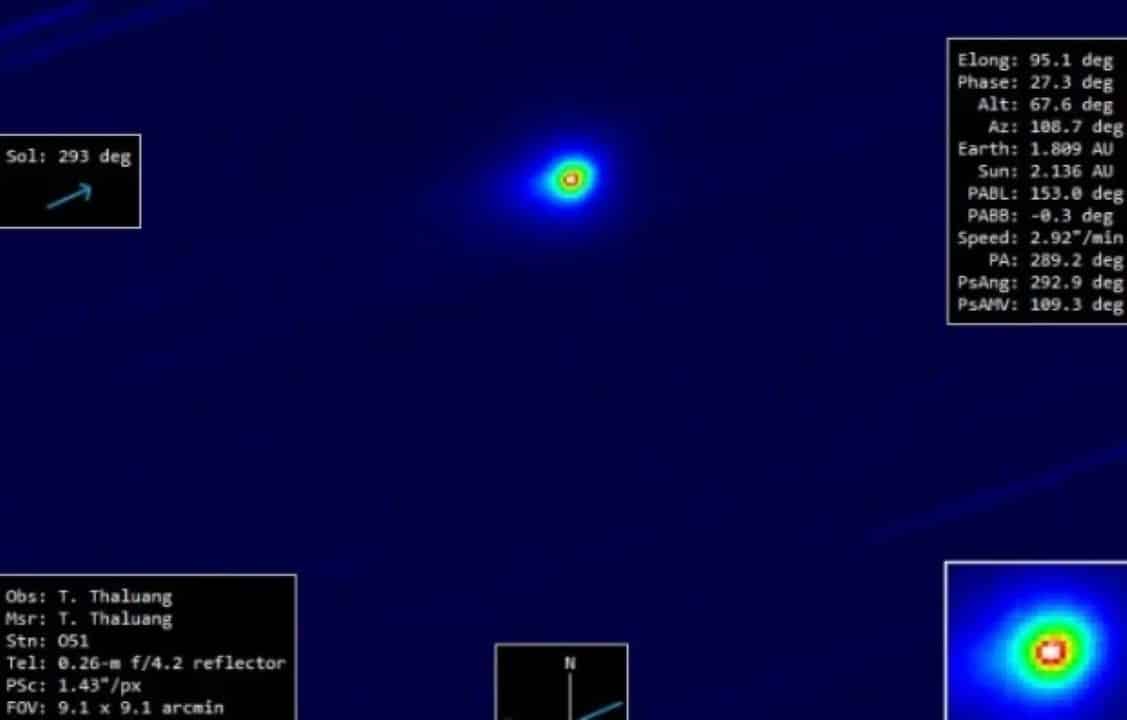
The JUICE space probe recorded an intense release of water vapor from the interstellar comet 3I/ATLAS. The volume detected by Agência Espacial Europeia’s instruments reaches two tons of ejected material per second. Essa daily quantity corresponds to the volume needed to fill around 70 Olympic swimming pools. The celestial body reached its closest approach with Sol in November 2025.
The information captured in deep space only reached the control centers at Terra in February 2026. The object originating outside Sistema Solar was already being monitored by other terrestrial and space telescopes. The cosmic visitor’s passage offered a rare opportunity for scientists to analyze the composition of materials formed in other star systems, providing unprecedented data on the dynamics of icy bodies subjected to solar heating.

Instrumentos from the European mission maps the structure of the celestial body
The spacecraft’s main mission heads towards the planet Júpiter. The agency’s operators needed to adjust onboard equipment within very restricted time windows to be able to observe the unexpected target. The thermal environment of space required strict safety protocols to protect supercooled cameras during image capture. The maneuver represented a practical test of the flight control team’s ability to respond quickly.
The spectrometer known as MAJIS was able to record emissions in the infrared range. The data revealed the abundant presence of water vapor and also carbon dioxide in the object’s structure. The images processed by the JANUS camera showed an extensive coma around the solid core. Photographic records showed complex filaments and jets of material being expelled at high speed into the vacuum of space.
The NavCam navigation system operated in a complementary manner to track the exact trajectory of the celestial body. The spacecraft’s privileged position allowed observation from angles that would be impossible to reach using only the infrastructure installed on the Earth’s surface. Scientists calculated operational risks before authorizing the temporary refocusing of the original mission, ensuring that the main route towards the gas giant would not suffer harmful changes.
Ancient Origem and chemical characteristics surprise researchers
Astronomical estimates indicate that 3I/ATLAS went through its formation process more than 10 billion years ago. The advanced age classifies the object as a true chemical relic from a distant star system. Analysis of the proportion between light and semi-heavy water molecules provided clues about the original formation environment. The data point to an extremely cold place of origin and subject to intense levels of ultraviolet radiation during the initial phases of matter agglomeration.
Observatório Neil Gehrels Swift, managed by NASA, had already detected the presence of hydroxyl in the comet region in October 2025. The celestial body released approximately 40 kilograms of water per second when it was still at a distance equivalent to three times the space between Terra and Sol. The flow of ejected material experienced an exponential increase as the orbit approached perihelion, demonstrating thermal reactivity higher than the average observed in local bodies.
The researchers noted that the water did not emanate exclusively from the central rocky core. A significant portion of the material evaporated from a dense cloud composed of icy dust grains that orbited the main structure. The fragility of this peripheral formation helps explain the atypical intensity of gas emission. The sublimation phenomenon occurred at a much earlier stage than what is normally observed in comets native to our own planetary system.
Detalhes visuals reveal gas and dust dynamics in space
The JANUS high-resolution camera documented the visitor’s passage from a distance of tens of millions of kilometers. The photographs captured display a bright coma with greenish tones, a direct result of the interaction of sunlight with the newly expelled gases. The tails formed by the trail of debris extended millions of kilometers into dark space, creating an extensive and detailed visual signature for the probe’s sensors.
- The combination of red, green and blue channels highlighted the compact center of the structure.
- Specific Filtros isolated the diffuse formations that make up the periphery of the gas halo.
- The ultraviolet spectrograph tracked chemical elements spread up to 5 million kilometers away from the nucleus.
- The measurements recorded differences in the behavior of the material on the side directly illuminated by the Sol.
- The raw data allowed us to accurately estimate the continuous outflow of volatile material.
Continuous monitoring of these emissions provides essential data for understanding changes in the trajectory of celestial bodies. Small variations in the rate of dust and gas release have a direct influence on the path taken by the object through space, functioning as small natural propellants. The information collected feeds databases used in planetary defense calculations and in predicting long-term orbital paths.
Scientific Contribuição for studying planetary formation
The mass loss rate of 3I/ATLAS exceeded the scientific community’s initial expectations. Regular Sistema Solar comets also lose material as they approach the central star, but the interstellar visitor had very high rates for its physical dimensions. The confirmation of water in a body from outside reinforces the thesis that the building blocks of organic chemistry are widely distributed throughout other systems in the galaxy.
The behavior of the object was compared by experts to a hydrant operating at maximum flow capacity. The early awakening of activity suggests the existence of pockets of volatile ices that remained buried beneath the surface crust during billions of years of interstellar cold. The gradual heating caused by the solar approach caused the rupture of these protective layers and the consequent violent release of the material trapped inside.
3I/ATLAS enters the history of astronomy as the third interstellar object to have confirmed passage through our cosmic neighborhood. Previous records involved 1I/ʻOumuamua and 2I/Borisov, which also showed unique chemical characteristics during their respective crossings. The JUICE probe resumed its programmed route to reach the moons of Júpiter in the year 2031. Scientists continue to process the massive volume of raw data received, while the comet maintains its hyperbolic trajectory towards deep space, definitively leaving the area of Sol’s gravitational influence.





