
Scientists decipher the mystery of the rare behavior of humpback whales with their mouths open


Pesquisadores uses photographs and videos captured by tourists on social media to investigate unusual behavior of humpback whales. The phenomenon, in which these cetaceans keep their mouths open while remaining still in the water, has intrigued scientists for years. Images shared on digital platforms have become valuable tools for unraveling the mystery that challenged the international scientific community.
Access to amateur visual recordings has revolutionized the way researchers investigate rare behaviors in wildlife. Onde Before there were information gaps, now there are thousands of visual documents available. Essa democratization of scientific knowledge allows experts to analyze patterns that would be impossible to study in the laboratory.
Fotos of tourists transform marine research
The proliferation of smartphones and wearable cameras has created an unprecedented database of animal behaviors in the wild. Turistas visiting humpback whale migration regions manages to record moments that dedicated researchers took decades to document. Data collected through social media complements decades of traditional scientific observations.
Cientistas now systematically analyzes thousands of images and videos posted on platforms such as Instagram, TikTok and YouTube. The amount of material available makes it possible to identify behavioral patterns with unprecedented precision. Fotografias taken in different geographic locations and times of year reveal consistencies that defied previous explanations.
The peculiar behavior of whales with their mouths open
Baleias-humpbacks remain motionless at the surface of the water with their mouths completely open for periods that can last several minutes. The behavior does not correspond to any known feeding or breathing activity. Pesquisadores observe that the phenomenon occurs in specific contexts, suggesting a distinct adaptive function.
The images reveal that multiple individuals often exhibit the same behavior simultaneously in one area. The social pattern of behavior suggests communication or coordinated response to common environmental stimuli. The regular repetition of the phenomenon indicates that it is an instinctive behavior and not an isolated accident.
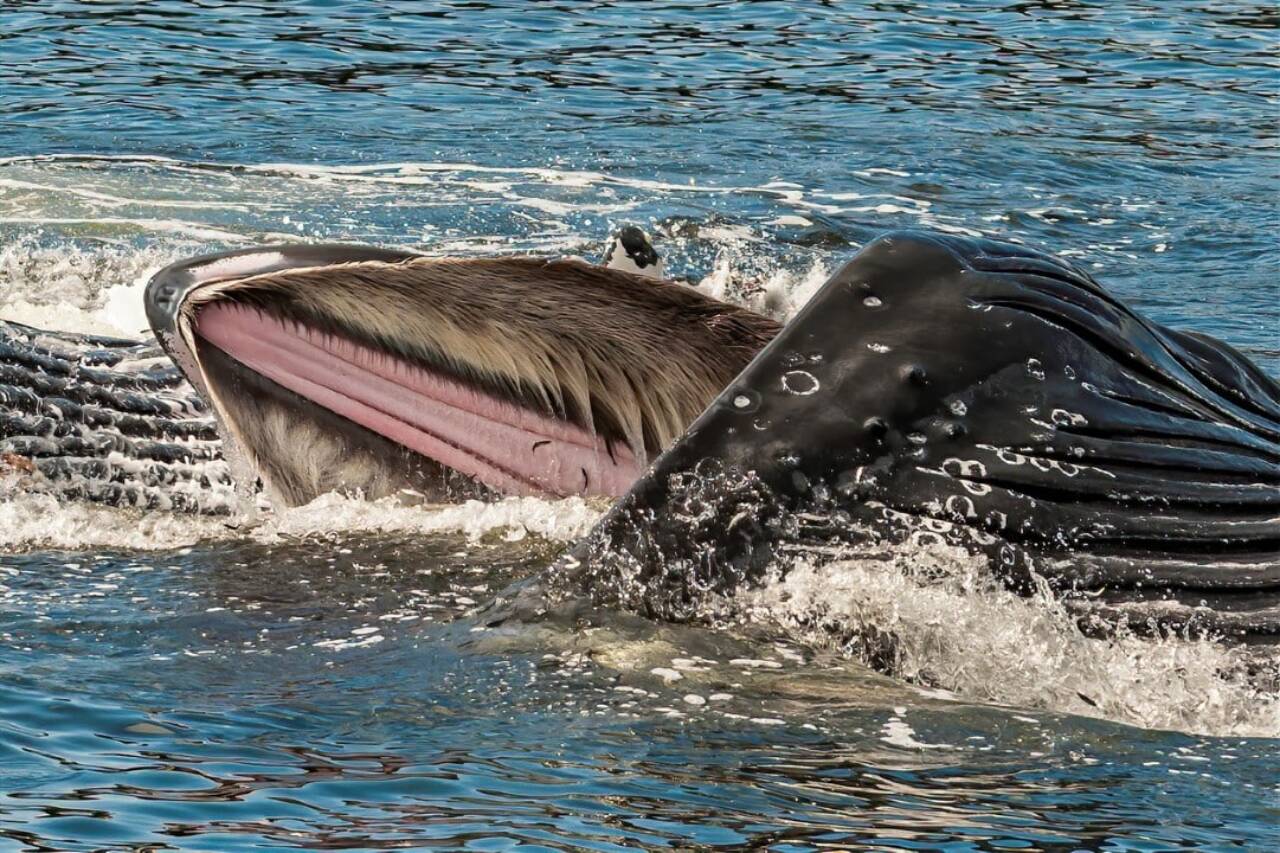
Especialistas formulate hypotheses about the possible functions of this behavior:
- Termorregulação: exposure of the oral cavity could facilitate heat loss
- Comunicação acoustics: production of sounds detectable by other cetaceans
- Parasitic Limpeza: removal of organisms embedded in oral structures
- Reproductive Comportamento: signaling related to mating
- Descanso cognitive: partial rest state during migration
Citizen Science Contribuições for Marine Zoology
The involvement of tourists and amateurs in collecting scientific data transforms understanding of marine life. Instituições Search now explicitly encourages sharing of records on social networks with specific hashtags. Essa scientific crowdsourcing strategy reduces operational costs of field research.
Colaboradores civilians provided georeferenced information that allows mapping the geographic distribution of behavior. Registros temporal snapshots of photos and videos help identify seasonality and correlations with migration cycles. Continuous documentation through social media creates time series that are impossible to achieve with traditional expeditions.
Pesquisadores develop methodologies to validate data collected in an uncontrolled manner. Low quality Fotografias are discarded while images with adequate resolution undergo detailed analysis. Rigorous Critérios ensures that scientific conclusions are based only on reliable and reproducible evidence.
Desafios on Diverse Source Data Analysis
Informações visuals collected by amateurs vary significantly in quality, angle, and context. Cientistas must account for limitations inherent to material not obtained in standardized protocols. Validação cross-references between multiple images and perspectives compensates for deficiencies of isolated individual records.
Incomplete Metadados represent a common challenge in analyzing social media files. Datas Precise, exact locations and environmental conditions are often missing from tourists’ descriptions. Pesquisadores create protocols to reconstruct missing context through analysis of landscape, light patterns and associated fauna.
Individual Diferenças among humpback whales can be tracked through natural markings visible in photographs. Cicatrizes, coloration patterns and deformities allow us to identify specific individuals across multiple records. Essa non-invasive technique provides longitudinal data on behavior of individually identified animals over multiple sightings.
Perspectivas Futures of Collaborative Research
Specialized online Plataformas allow researchers to request specific information about rare behaviors directly from tourist communities. Mobile Aplicativos facilitates data submission with structured metadata during wildlife observation trips. Sistemas gamification encourages continuous participation of civilian employees in long-term projects.
Artificial Inteligência assists in the automated analysis of massive volumes of images captured by amateurs. Computer vision Algoritmos identifies humpback whales in photographs and classifies observed behaviors. Aprendizado machine reduces time needed to manually review millions of images.
Colaboração between international research institutions allows consolidation of data from multiple geographic regions. Shared data Bancos allows researchers in different countries to access the same set of visual evidence. Open science Iniciativas democratizes access to information collected by global communities of observers.





