

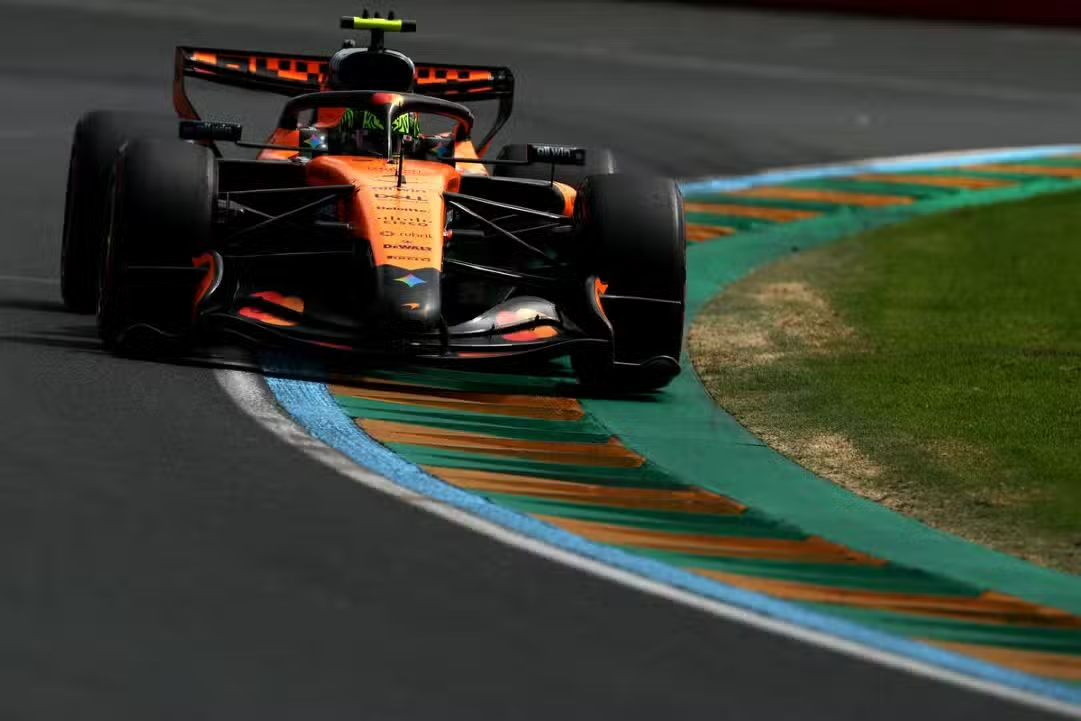
Mercedes, McLaren and Audi have revealed their main technical evolutions for the Gilles-Villeneuve circuit. The FIA released an official document listing all the aerodynamic modifications that the teams introduced in Montreal. Ferrari and Aston Martin remain unchanged since Miami.
Mercedes marks return to development with eight changes
Mercedes presents its first major update package since the start of the season. Diferente from rivals that bet on massive modifications to Miami, the German team focused its efforts on the Canadá. Oito changes were confirmed by the FIA, focusing mainly on optimizing aerodynamic flow. The front wing received revisions at several strategic points.
The front wing elements were extended to the strut plate with the addition of fins. Essa more robust flow structure significantly improves the flow at the rear of the car. The main objective is to gain downforce and improve stability at different speeds. The team worked on the geometry of these parts to maximize aerodynamic load generation.
Modificações also occurred on the flat floor. The front corners now feature reduced curvature from the upper edge of the monocoque. The rear part underwent changes to the elements, repositioning of the fins and addition of strategic grooves. Todas these changes aim to improve airflow quality and increase local load.
The diffuser received special attention with a redesign of the profile of the side and upper walls. Essa revision improves surface flow quality across the entire operating package. The local load generated becomes more significant compared to the previous project.
McLaren finalizes its “all-new” F1 in Montreal
McLaren has realized its ambition to introduce a completely revamped MCL40 between Miami and Canadá. Sete different evolutions were confirmed in the FIA document. The team implemented a new front wing, new engine cover, small halo fin and revised rear wing side plates.
The rear suspension fairings have been completely redesigned. Elementos of the bottom edge of the floor received detailed rework. The modifications aim to improve airflow over the entire structure of the car. Load distribution becomes more balanced during the different phases of the race.
The engine cover now offers additional cooling options. Em Montreal, this thermal flexibility represents a considerable competitive advantage. Ambient temperature and circuit conditions require efficient cooling systems. McLaren’s package seeks to maintain ideal temperatures even under racing pressure.
Red Bull optimizes reliability with a focus on performance
Red Bull introduces four technical innovations in its RB20. Duas modifications were classified as “reliability” evolutions, including revision of the front brakes. The engine cover has also been changed to add more efficient cooling options.
The front wing flaps were revised to improve aerodynamic balance considering future circuits. The front part of the flat bottom received strategic retouching. The bib (central divider) underwent a specific cut while the front devices had slightly increased camber.
Essas changes result in increased local load while maintaining fuel efficiency and tire consumption. Red Bull invests in incremental solutions that consolidate its competitive position.
Audi, Haas, Williams and other teams bring their own evolutions
The Audi of Gabriel Bortoleto and Nico Hulkenberg features changes to the front and rear brake duct. Essas changes seek better cooling specific to Montreal conditions. Aletas on the diffuser were added along with changes to the sidepods.
The purpose of the Audi is to increase the aerodynamic load on the Circuito Gilles Villeneuve. Haas, Williams, Cadillac, Racing Bulls and Alpine also brought minor changes to the cars. Essas evolutions vary in scope depending on each team’s strategic priorities and their technological resources.
Ferrari maintains Miami’s package while Aston Martin remains unchanged
Ferrari is the only one among the top four teams that does not introduce any new aerodynamic features in Canadá. The choice reflects a different strategy focused on optimizing existing configurations. The team may have identified a margin of gain through adjustments to parts already in use since Miami.
Aston Martin also remains without technical updates. Ambas teams focus on alternative development, whether through fine-tuning of current components or deeper analysis of telemetry data. Será It is interesting to observe the performance of these teams compared to rivals who introduced more aggressive changes.
The FIA documents detail each modification in a technical and transparent way. Esse process ensures that all teams follow the same homologation protocol. Montreal marks a turning point in the development of 2026 with different strategies competing side by side.