
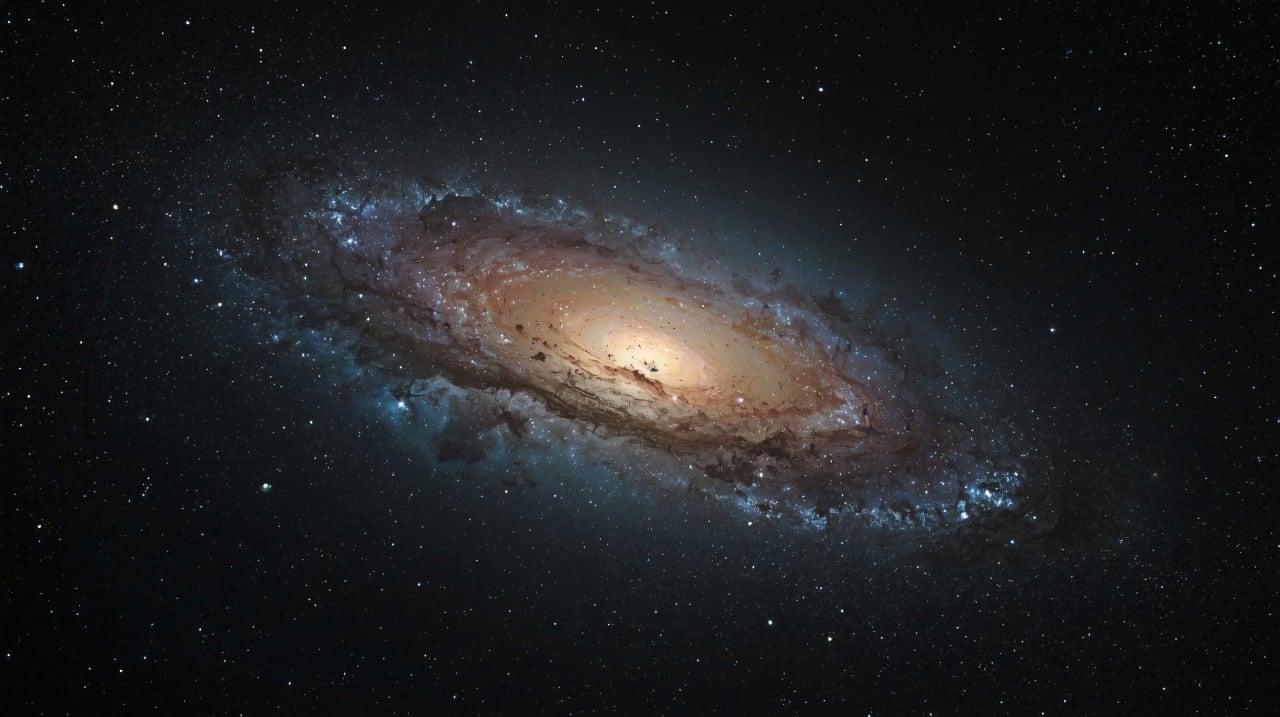
A study published in January 2026 presents evidence that Via Láctea rests on a gigantic, flat structure of dark matter, tens of millions of light years long. The discovery reshapes scientific understanding of the organization of the invisible mass surrounding Grupo Local, our immediate galactic neighborhood.
The research challenges previous models that treated mass distribution as approximately spherical. Current data indicate a much more planar and asymmetrical arrangement, with significant concentration of mass in an extensive plane and considerably less dense regions above and below this layer.
Grupo Local has surprise galactic geometry
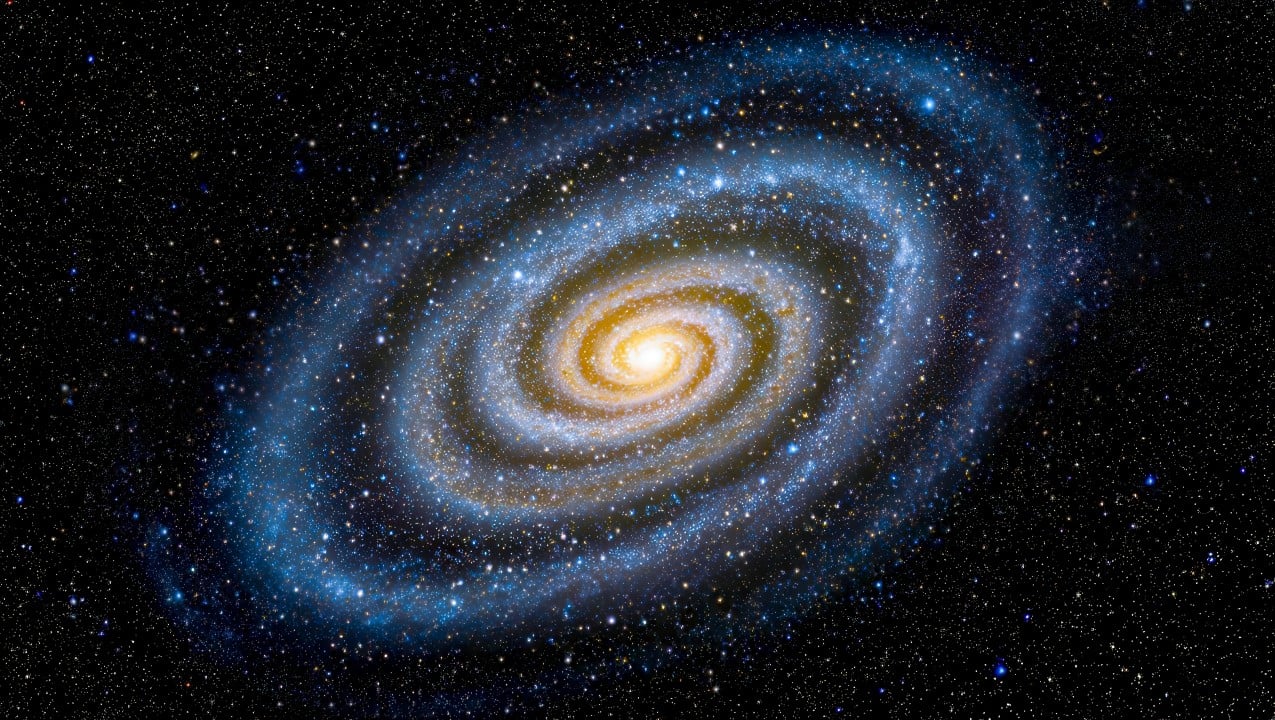
Grupo Local, formed mainly by Via Láctea and the Andrômeda galaxy, has always been the subject of intensive investigation. Durante decades, scientists assumed that the mass distribution around it worked like a roughly spherical bubble. Esse model proved to be insufficient given the new observational data.
The discovered configuration explains phenomena that intrigued astronomers. Most nearby galaxies move away smoothly and predictably, even when close to large galactic structures with intense gravitational influence. Essa predictability finds reason in the flat geometry of the dark matter distribution that surrounds them.
Implicações of planar structure for galactic dynamics
The flattened nature of this structure offers a new framework for understanding galactic movements. Quando the invisible mass is distributed in a plane, instead of a sphere, it produces distinct gravitational effects on neighboring galaxies.
Essa planar configuration exerts different influence depending on the relative position of each galaxy. Objetos lying in the ground plane face robust gravitational attraction. Aqueles positioned above or below this plane experience much less intense forces. Essa asymmetry explains movement patterns that spherical models could not adequately describe.
Matéria dark in focus: the invisible that shapes the universe
Dark matter makes up approximately 85% of all matter in the universe. Sua nature remains partially unknown, but its gravitational effects are measurable and determining. Via Láctea and neighboring galaxies do not float freely in the void—they move within gravitational fields produced by this invisible matter.
The new model suggests that this dark matter is not randomly distributed. Ela forms coherent structures, with the lamina surrounding Grupo Local being a notable example of this organization. Compreender this structure paves the way to better interpret how galaxies form, evolve and interact over billions of years.
Consequências for galaxy formation models
The findings directly impact numerical simulations that try to reproduce how galaxies are concentrated in the universe. Modelos of galaxy formation depends heavily on how programmers input the distribution of dark matter. A more accurate map of this distribution refines these simulations and makes their predictions more robust.
The planar structure also offers insights into the dynamic future of Grupo Local. Preliminary Simulações suggests that this geometry influences the expected collision trajectory between Via Láctea and Andrômeda, predicted to occur in approximately 4.5 billion years. The sheet of dark matter would function as a gravitational “guide” that shapes this inevitable galactic encounter.
Métodos observational reveals hidden structure
Scientists do not observe dark matter directly. Instead, they map its presence and distribution through the effects it produces on visible galaxies. Medições of radial velocities, analysis of the proper motion of galaxies and studies of the dynamics of galactic clusters provide data that allow us to reconstruct the architecture of dark matter.
The study combined observations from multiple observatories and astronomical databases. The researchers used:
- High Precision Galactic Distances Catálogos
- Medições of radial velocities of hundreds of nearby galaxies
- N-Body Dynamics Simulações for Testing Models
- Análise of visible filamentary structures of galaxies
- Dados of modern astronomical surveys
Próximos steps in the cartography of the invisible universe
The astronomical community recognizes that this research represents a significant step, but not the end of the journey. Next-generation Observatórios, like Telescópio Espacial James Webb and future missions, will collect even more precise data on distant galaxies and their motion.
Esses refined data will allow us to map dark matter structures in greater detail on even larger scales. Compreender, how dark matter is organized in different regions of the universe, offers crucial clues about its fundamental nature and the conditions that prevailed in the first moments after Big Bang.
The discovery also highlights the importance of multidisciplinary approaches in cosmology. Colaborações between observers and theorists, between different research institutes, and between countries produce results that no single group could achieve. Mapping the invisible universe continues to slowly reveal the true architecture of the cosmos we inhabit.





