
Harvard scientist evaluates whether interstellar comet 3I/Atlas uses artificial engine in its trajectory

The interstellar comet 3I/Atlas attracts the attention of researchers around the world due to anomalies in its physical structure and trajectory by Sistema Solar. Descoberto in July 2025, the celestial body features an unusual formation of dust and gas that extends hundreds of thousands of kilometers toward Sol. Astrophysicist Avi Loeb, researcher at Universidade Harvard, has published recent calculations to determine the exact nature of this phenomenon. The main objective of the study is to verify the possibility of the object using some type of artificial propulsion.
The analyzes gained strength after the celestial body’s perihelion, recorded in October 2025. Imagens captured in the following months revealed an extremely long and collimated anti-tail. The scientific community uses ground-based and space-based telescopes to map the distribution of materials around the nucleus. The data collected during the object’s passage through the vicinity of Terra provides a solid basis for testing hypotheses about its origin and chemical composition.
Anomalous Estrutura and the behavior of gases
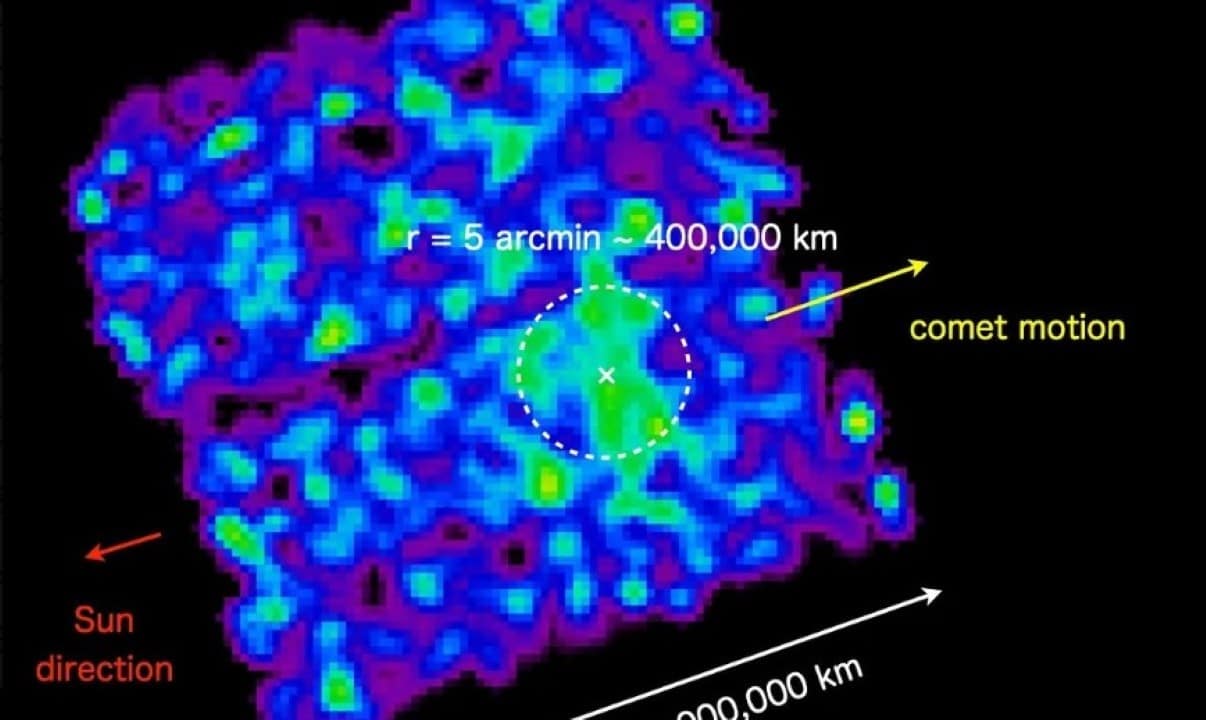
The 3I/Atlas anti-tail was clearly documented in photographic records from December 2025. Essa structure points directly towards Sol and challenges traditional models of cometary formation. Partículas of dust about 10 micrometers in diameter is entrained by the gas near the core. Elas reach speeds sufficient to form a wake visible at great distances. The behavior of natural gas, however, presents severe physical limitations.
According to calculations presented by Avi Loeb, the flow of gas in a comet of natural origin should stop approximately 5 thousand kilometers from the nucleus. Essa barrier occurs due to the pressure exerted by the solar wind, which balances the expansion of volatile compounds. At distances greater than this mark, the anti-tail structure should contain exclusively heavy dust particles. Detection of specific molecules beyond this limit would indicate an unnatural process of matter emission.
The Universidade Harvard researcher established clear parameters to identify possible space locomotion technologies. The difference in range is brutal. If the object uses chemical propulsion, the gases could reach up to 25 thousand kilometers away from the nucleus. Motores ions would have the capacity to propel the material an impressive 100,000 kilometers. The presence of compounds such as carbon dioxide in these extreme regions of the anti-tail would serve as a strong indication of artificial activity.
- The anti-tail is predominantly formed by higher density dust particles.
- The solar wind acts as a physical barrier to the natural expansion of cometary gases.
- Telescópios like Hubble confirm the vast extension of the structure toward Sol.
Para confirm these hypotheses, astronomers rely on high-precision spectroscopic analysis. Advanced Instrumentos telescopes such as the Keck, VLT, ALMA and the James Webb space observatory have the technical capacity necessary to perform this mapping. The data collected at the end of 2025 continues to be processed by international astrophysics teams.
Monitoramento radio frequency and technological searches
The possibility of 3I/Atlas being a technological artifact motivated direct investigations into communication signals. On December 18, 2025, Telescópio Green Bank aimed its antennas at the interstellar object. The operation was part of the Breakthrough Listen program, a global initiative dedicated to the search for extraterrestrial intelligence. The equipment scanned frequencies between 1 and 12 GHz during hours of continuous observation.
The sensitivity of the instruments used would make it possible to identify very low power transmitters operating on the surface of the object. The results of the scans pointed to the complete absence of narrow radio emissions. The threshold power detected by the sensors was lower than the energy emitted by a common cell phone. Scientists’ Equipes based on Sul’s África and Suécia independently reviewed the data packages.
The joint reports concluded that there is no evidence of isotropic transmitters operating above the 0.1 W mark on the celestial body. Current scientific consensus reaffirms the natural origin of the visitor, classifying it as a comet ejected from another planetary system. Apesar’s lack of radio signals, groups of independent researchers maintain active debate about alternative explanations for the anti-tail’s structural anomaly.



Trajetória hyperbolic and chemical composition
The orbital dynamics of 3I/Atlas proves its origin external to Sistema Solar. The object travels in an open hyperbolic trajectory. Isso means it is not tied to the gravity of Sol. Perihelion occurred at a distance of 1.4 astronomical units from the central star of our system. The closest approach to Terra occurred on December 19, 2025, when the comet passed approximately 269 million kilometers from the planet.
Spectroscopic observations revealed important details about the physical makeup of the nucleus and gas coma. The reddish color of the structure suggests a high concentration of dust rich in organic compounds. Essa’s visual signature is very similar to that found on 2I/Borisov, the interstellar comet discovered years earlier. The sensors also detected the presence of cyanide and nickel vapor, elements often found in local comets.
The size of the dust particles in the anti-tail partially explains the material’s resistance to solar radiation. Fragmentos with 10 micrometers suffer less slowdown when exposed to photons emitted by Sol. Essa physical characteristic allows the debris wake to maintain its collimated shape for hundreds of thousands of kilometers. The interaction between these heavy grains and the solar magnetic field remains under rigorous investigation.
Próximos steps of astronomical exploration
The 3I/Atlas observation schedule will extend into the first months of 2026. The celestial body is currently heading towards the orbit of Júpiter, with a distant approach scheduled for the month of March. Após crosses this planetary boundary, the comet will quickly lose brightness due to the distance from the solar heat source. Large terrestrial Telescópios will maintain tracking until mid-year, when the object will become visually indistinguishable against the dark background of space.
The monitoring campaigns rely on the logistical coordination of the UN’s Rede, Alerta, and Asteroides. International collaboration has allowed the collection of an unprecedented volume of data on the composition of materials from other stars. The information extracted from the 3I/Atlas passage will be used to calibrate instruments for future space missions. Detailed study of the distribution of gas and dust in the anti-tail will help refine mathematical models about the formation of planetary systems.
The passage of interstellar objects through Sistema Solar offers a rare opportunity to study the chemistry of the distant universe without the need to send space probes. The calculations proposed by Avi Loeb, regardless of confirmation of artificial propulsion, establish a new analysis protocol for future cosmic visitors. Modern astronomy consolidates increasingly precise methods for differentiating natural phenomena from potential technological signatures in deep space.
Veja Tambem em Latest News (EN)

OnePlus develops portable video game with Android system focused on competitive shooters

New BYD Seal 6 DM-i Touring hybrid station wagon debuts in Europe with ample interior space and super-efficient engine

Costco reaches historic volume in gasoline sales in the United States with prices below market

June PlayStation Plus Catalog Brings Grounded and Warhammer 40,000 Darktide to Subscribers

Disney+ brings Avatar Fire and Ash finale to The Bear and new Pixar animation in June

Netflix updates June catalog with new season of Avatar and classic cinema sagas

Geely Xingyuan electric compact gains 47 kWh battery and autonomous driving system in China

Episode 1156 of One Piece marks arrival at Elbaf with decisive actions by Shanks and Blackbeard

2026 Jeep Renegade global update introduces new 1.2 turbo engine and six-speed manual transmission

June cinema and streaming releases include new Toy Story and return of Steven Spielberg

Streaming catalog receives new film from the Avatar franchise and closure of The Bear in June
