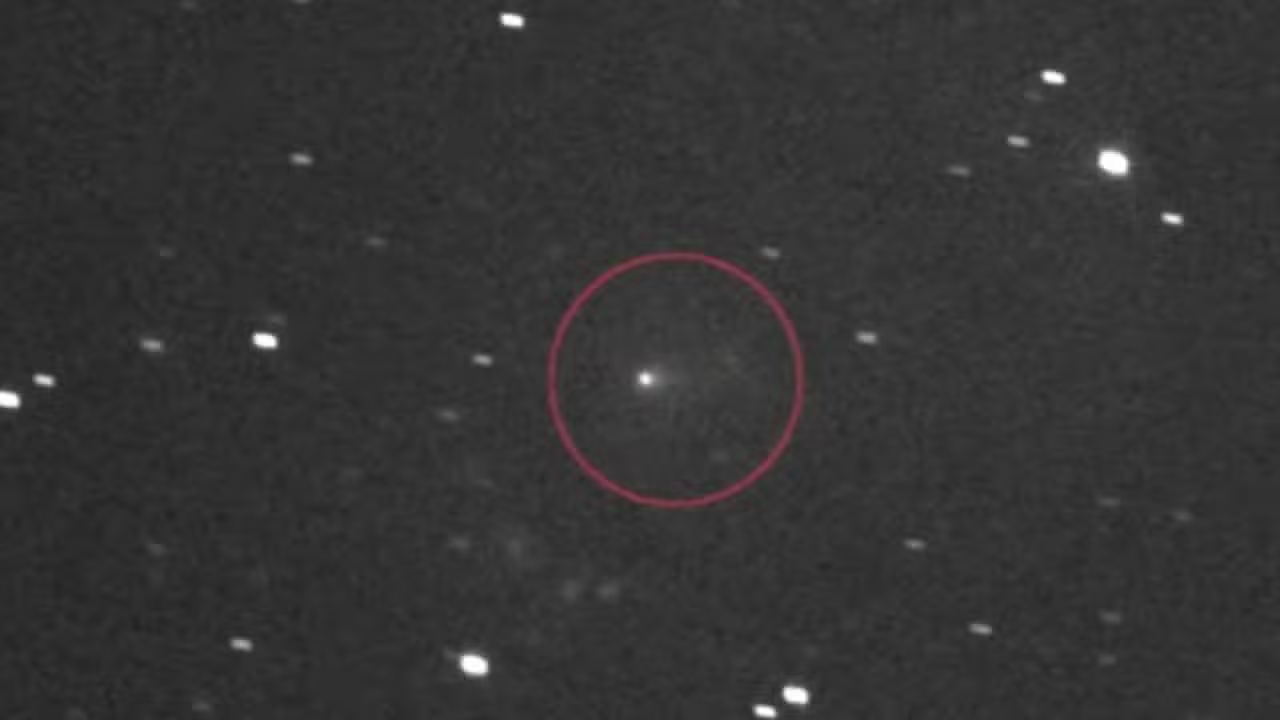
Asteroid 2024JH2 will reach its closest point to Terra this Monday, May 18, around 7 pm Brasília time. The celestial body is approximately 35 meters long, a dimension that scientists often compare to the size of a commercial bus or an adult blue whale. The space object will pass at a distance of 91 thousand kilometers from the planet’s surface. Essa measured is equivalent to about a quarter of the total path between Terra and Lua. Especialistas confirm that there is no risk of impact with the Earth’s soil during the astronomical event.
The rocky body was identified less than two weeks ago, demonstrating the agility of planetary defense systems. Astrônomos of Observatório Mount Lemmon, located in the city of Tucson, in the state of Arizona, recorded the object on May 10 after analyzing deep space monitoring data. Orbital calculations indicate that 2024JH2 completes one full revolution around Sol every 3.7 years. The asteroid’s elliptical trajectory extends to the vicinity of the planet Júpiter before returning to the inner region of the solar system.
Hoy, 18 de mayo, el asteroide #2026JH2, de unos 15~35 m de diámetro, pasará a tan solo ¼ de distancia Tierra – Luna (85210 ± 240 km) sobre Sudáfrica 🇿🇦
🟢 Sin riesgos
🔭Descubierto el 10 de mayo de 2026
📍Más temprano, el asteroide 2026JN4, de 1 m de diámetro, explotó sobre Papúa pic.twitter.com/tKPSt6UUTW— ASISMET (@Asismet_IF) May 18, 2026
Space rock’s Distância ensures safety of satellites in orbit
The approach of 91 thousand kilometers is considered quite short when evaluated from the perspective of traditional astronomical scales. However, this safety margin keeps the asteroid positioned far above the vast majority of artificial satellites currently orbiting Terra. Equipamentos communications, navigation and weather monitoring systems operate at considerably lower altitude ranges. The transit of the celestial body will occur without causing any type of electromagnetic interference or risk of physical collision with human space infrastructure.
A practical example of this separation of routes involves Satélite from Pesquisa from Exoplanetas into Trânsito, known by the acronym TESS. The scientific equipment orbits the planet at an altitude lower than the asteroid’s trajectory and will continue its search operations for new worlds without interruption. International space agencies constantly monitor these passages to ensure the integrity of billions of dollars in technological investments. The global surveillance network tracks thousands of objects simultaneously to avoid surprises in the orbital environment.
The transit of 2024JH2 follows regular patterns of celestial movement that research institutions rigorously document. Eventos of this nature receive close approximation classification, but mainly serve to feed scientific databases. Accurate cataloging of routes allows astronomers to model the dynamic behavior of the solar system. Planetary security directly depends on this ability to predict where each space rock will be in the coming decades.
Dimensões of the object refers to the historical impact that occurred on Rússia
The estimated size of the asteroid attracts the attention of researchers because it presents proportions very similar to those of the famous Chelyabinsk meteor. Aquele celestial body penetrated the Earth’s atmosphere in 2013 and caused great international repercussion. Naquela occasion, the space rock could not resist atmospheric friction and exploded in the sky of Rússia. The episode marked the largest entry of an object of this magnitude into the atmosphere of Terra in a period of almost one hundred and twenty years.
The explosion over Russian territory released a massive amount of energy and generated a shock wave that broke windows and damaged structures in several cities in the region. Redes seismic monitoring stations spread across the globe detected the disturbance generated by air displacement. Apesar similarity in physical size, 2024JH2 has a completely different and safe trajectory. The approach angle and speed of the current asteroid ensure that it will remain in the vacuum of space.
Scientists use the data collected during the Chelyabinsk event as a practical reference to measure the energy potential of 35-meter objects. Understanding these past impacts helps calibrate modern early warning systems. Pesquisadores from different nationalities work together to refine mathematical models of atmospheric input. The central objective is to understand exactly how different rock or metallic compositions react when encountering the layer of gases that protects Terra.
Early detection Tecnologias and work on Arizona
The rapid discovery of 2024JH2 perfectly illustrates the level of technological sophistication achieved by programs tracking objects close to Terra. The Observatório Mount Lemmon operates with highly sensitive equipment designed to continuously scan the night sky. Telescopes use high-resolution digital imaging cameras that capture vast portions of the firmament in short intervals of time. Algoritmos advanced artificial intelligence processes these images to detect moving points of light against the static background of stars.
The early identification capability gives scientists the time needed to calculate routes with extreme precision. The interval of a few days between the first detection and the closest approach required a concentrated effort from the astrometry teams. The experts were able to quickly confirm the absence of danger and pass on the coordinates to other research centers. Essa collaborative network allows smaller observatories to also point their lenses at the target before it moves away again.
Studying the physical properties of the asteroid during its rapid passage generates valuable information about the formation of the solar system. Light from Sol reflected off the rock’s surface reveals details about its chemical composition and rotation rate. Astrônomos take advantage of these short observation windows to test new sensors and spectral analysis methodologies. Cada new cataloged object adds an important piece to the puzzle of planetary evolution.
Alternativas virtual equipment and equipment to monitor the phenomenon
The passing of asteroid 2024JH2 offers an excellent observation opportunity for astronomy enthusiasts equipped with small telescopes. The moment of greater proximity will allow optical instruments of moderate quality to follow the rapid movement of the luminous point between the constellations. The apparent speed of the object in the sky will require attention and the use of motorized mounts for efficient tracking. The phenomenon attracts the attention of amateur astronomy clubs that organize joint viewing sessions.
The general public who does not have access to optical magnification equipment has several technological options to avoid missing the space event. Instituições of scientific dissemination prepare dedicated structures to take images from space directly to computer and cell phone screens. Available options include:
- Transmissão live on the Virtual Telescope project website, starting at 4:45 pm Brasília time.
- Cobertura continuous monitoring of professional observatories that carry out public monitoring of important astronomical events.
- Plataformas citizen science systems that provide real-time tracking data and interactive orbit graphics.
- Aplicativos of astronomical charts for mobile devices that indicate the exact position of the asteroid in the night sky.
- Canais of scientific education on video networks that offer expert analysis during the moment of passage.
Democratizing access to astronomical events strengthens public interest in space sciences and helps combat misinformation. Real-time monitoring demystifies the passage of asteroids and demonstrates the agencies’ competence in monitoring space. The transmission of images captured by robotic telescopes transforms a distant event into a visual experience accessible to anyone connected to the internet. The engagement of civil society in monitoring these space rocks reinforces the importance of continued investments in research and planetary defense.