
Approach of the interstellar object 3I/ATLAS increases records of meteors in Earth’s atmosphere


Terra reached the minimum distance from the trajectory of the interstellar object 3I/ATLAS during the second half of March 2026. The planet was 54.6 million kilometers from the trail of debris left by the celestial body. Cientistas evaluate the direct relationship between this passage and the sudden increase in the fall of small meteorites in several parts of the world. The space visitor crosses Sistema Solar and is currently moving away toward deep space. The orbital proximity raised the alarm among astronomers about the interaction of the Earth’s atmosphere with the ejected material.
Dados from the SPHEREx space observatory, captured in August 2025, revealed an extensive plume of carbon dioxide surrounding the object. The gaseous cloud stretched for thousands of kilometers in a vacuum. The presence of this gas indicates the continuous ejection of solid particles from the rock surface. Cálculos orbitals show that the fragments released in the past intercepted the Earth’s route exactly at the beginning of this semester. The temporal coincidence reinforces the hypothesis of a bombardment of external cosmic dust.
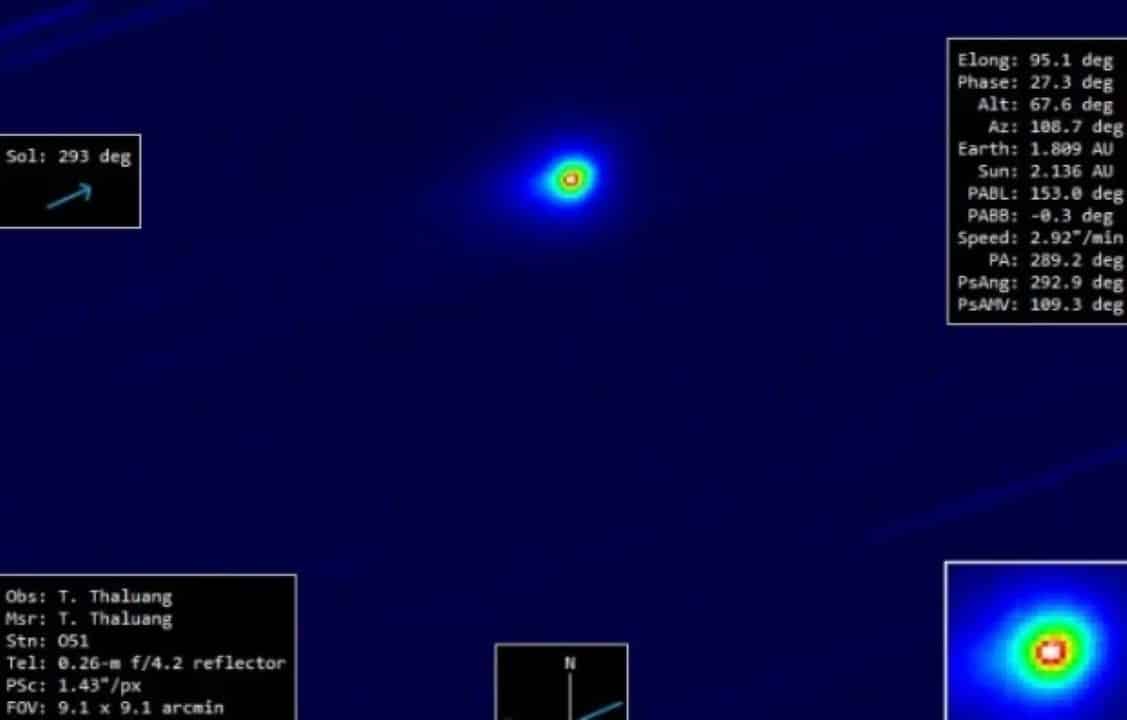
Dinâmica orbital and particle ejection in deep space
The displacement speed of the fragments between the 3I/ATLAS orbit and Terra remains low by astronomical relative speed standards. The release of material took place about a decade ago. The celestial body was still far from Sol during that ejection period. The particle detachment force resembles the thermal agitation of gas molecules in the space environment. Esse physical scenario enables the collision of interstellar debris with the planet’s atmosphere at the current moment of maximum approach.
Pesquisadores calculate that the object’s main structure houses about a billion metric tons of mass. The fragmentation of a minimum portion of this total generates trillions of pieces approximately one centimeter in diameter. The material travels through space and crosses the path of the inner planets. Modelos statistics point to the entry of up to 34,000 of these particles into the Earth’s atmosphere in just the last few weeks. High-speed friction results in the formation of small fireballs.
The luminous phenomena occurred on different continents and caught the attention of local residents. The burning of material in the mesosphere produces a short-lived bright trail. The color of the emitted light depends on the chemical composition of the fragment and the speed of entry. Partículas rich in magnesium or iron generate specific tones during disintegration. Observing these details helps astronomers classify the invasive material.
Características of light events recorded in March
Observations documented in the first quarter of 2026 establish a clear pattern for the ongoing astronomical phenomenon. Sociedade Americana of Meteoros compiled data from recent occurrences and identified anomalies in the records. The volume of information received by space agencies exceeded the average of known annual meteor showers. The preliminary analysis points to specific characteristics of this atmospheric interaction:
- The volume of light events observed by large population groups grew significantly in March.
- The average number of reports per incident reached 142.7 witnesses in different regions.
- The incoming trajectory of smaller meteors serves as the primary basis for identifying interstellar origin.
- Pesquisadores organize ground expeditions to recover physical remains of meteorites in the ground.
Quase half of the events cataloged in March 2026 recorded the direct observation of at least 50 people per fall. Civil engagement demonstrates the actual frequency of penetration of objects into the upper layers of the atmosphere. Systematic analysis of direction and speed separates ordinary space junk from possible interstellar fragments. Cross-referencing data from security cameras and meteorological sensors refines the calculation of the exact point of disintegration.
Análise of large magnitude explosions in Estados Unidos
High visual impact Eventos has undergone kinetic energy analysis in recent days. A large explosion occurred over the city of Houston. Outro sonic boom hit Lago Erie’s region. Both cases caught the attention of planetary defense experts due to the intensity of the shock wave. The release of energy into the atmosphere triggered seismographs and infrasound detectors installed in American territory.
A one-ton meteoroid exploded at Texas on March 21, 2026. The clock read 4:40 pm local time during the detonation. The impact force reached the equivalent of 26 tons of TNT. The flash eclipsed the sunlight for a split second. A seven-ton space rock entered the atmosphere of Ohio on March 17, 2026. The explosion occurred at 08:57 local time and generated vibrations in windows of nearby homes.
Astrônomos rule out the direct relationship of these massive rocks with 3I/ATLAS. The interstellar object lacks the mass to eject fragments larger than one meter in diameter. The large fireballs originate from Sistema Solar’s local asteroid belt. The coincidence of dates generates initial confusion, but orbital physics separates the events. The increase in small meteors remains the only strong candidate for interstellar origin.
Busca for physical samples and scientific validation on the ground
The trajectory of 3I/ATLAS has received continuous monitoring since its initial discovery by ground-based telescopes. The celestial body surpassed the mark of five times the distance between Terra and Sol. The dust trail continues to influence the space environment near our planet. Fluid dynamics and solar radiation pressure push the smaller particles into Earth’s orbit. The solar wind acts as an invisible engine that directs the debris.
Search Equipes scans fall regions mapped by weather radars in remote areas. Identification of missing isotopes in Sistema Solar will prove the connection to the distant visitor. Most ten-gram particles undergo total disintegration during re-entry. Slightly larger Fragmentos leaves metal or rock debris in desert or ice areas. The absence of dense vegetation makes it easier to visually locate the dark stones on the light terrain.
The study of materials external to Sistema Solar transforms the understanding of the exchange of matter between stars in the galaxy. The orbital proximity window remains open and allows new luminous events to occur in the coming weeks. Civilian and military Satélites cross-reference data to triangulate the exact impact points on the surface. Science processes the speed trajectories to definitively confirm the bombardment of cosmic dust on the planet.





