
NASA researchers detail the origin of the interstellar comet 3I/Atlas after analyzing fragments

Pesquisadores of Nasa and global partner institutions continue to extract unprecedented insights from data collected during the passage of Comet 3I/Atlas. The object crossed intergalactic space and crossed our cosmic neighborhood in a short-lived event. Analyzes carried out in 2026 detail the chemical composition and physical structure of the celestial body. The journey provided enough material for decades of astrophysical studies focused on the formation of the universe.
The visitor was the first of demonstrably external origin to be identified by terrestrial telescopes. The unexpected breakup of its core during Sol’s closest approach generated a rare opportunity for direct observation of the inner layers. Cientistas uses advanced computational models to map the behavior of primordial materials in extreme stellar environments. The results of the research change established concepts about the evolution of nomadic celestial bodies and their interaction with gravity.
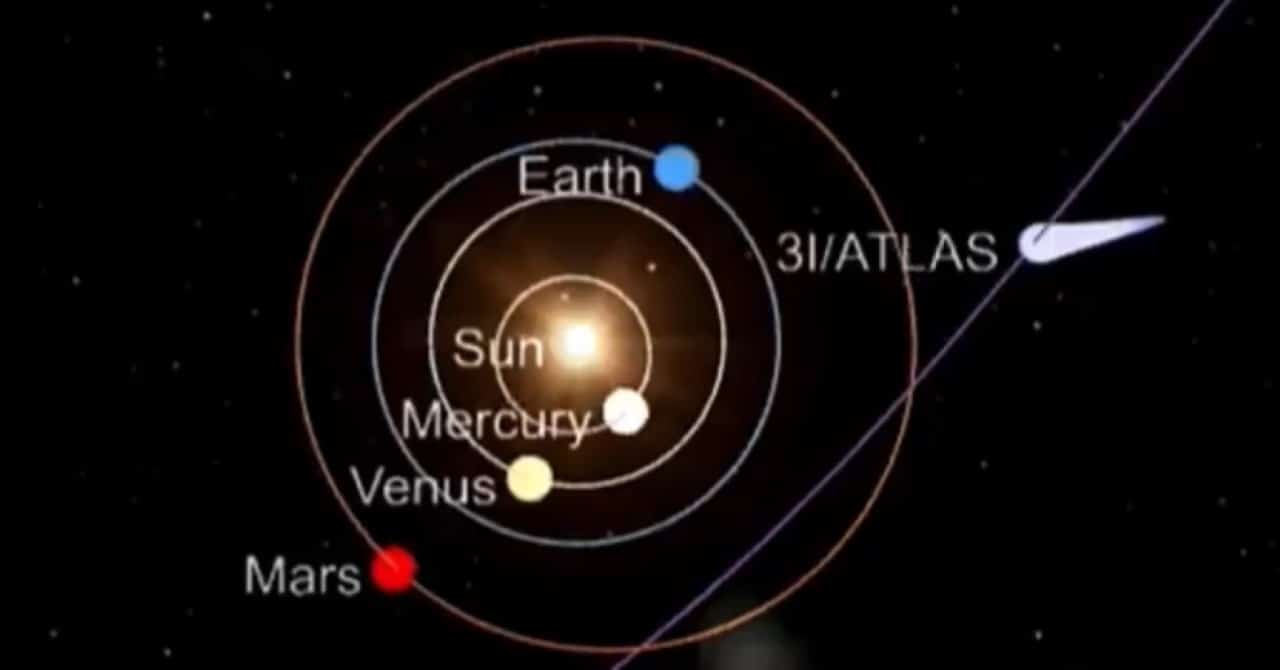
Hyperbolic Trajetória confirms origin external to our system
Precise tracking of 3I/Atlas’s orbit allowed astronomers to rule out any gravitational link to Sol. The hyperbolic route indicated that the object traveled for millions of years before crossing our space boundary. Equipamentos spacecraft recorded speed and entry angle with minimal margin of error. The data confirms the nature of an interstellar visitor to the rocky, icy body.
Recent Simulações point out that the comet’s starting point may be located in a binary star system. Outra viable hypothesis suggests formation in a young star cluster. Nesses environments, violent gravitational interactions often eject matter into deep space with extreme force. Mapping this entry route helps experts identify cosmic corridors where other similar objects could arrive in the future.
The rapid passage required an immediate response from observatories around the world. The joint effort ensured the capture of images at different wavelengths before definitive removal. The compilation of this visual and spectroscopic collection forms the database that supports current scientific publications on the orbital dynamics of external bodies.
Análise of gases indicates abundance of organic molecules
Spectroscopic reading of the dust and gases released by 3I/Atlas revealed a peculiar chemical signature. The material has similarities with local comets, but carries different proportions of silicates and volatile elements. The difference indicates that the formation occurred under pressure and temperature conditions very different from those found at the origin of our system. The instruments measured the density of the coma with high precision during the period of greatest brightness.
Reanalyses conducted throughout 2026 identified a greater quantity of complex organic molecules than initial estimates. The discovery fuels the debate about the role of comets as transporters of building blocks of life between different planetary systems. Astrobiology considers this transfer of material a key factor in understanding the distribution of essential elements throughout the observable universe.
The study of the proportion of ice and the structure of the ejected dust provided the thermal history of the interstellar object. Astrophysicists concluded that the comet faced severe heating and cooling cycles throughout its millennia-long journey. The preservation of volatile compounds inside the core demonstrates the thermal insulation capacity of the outer layers of compacted dust.
Core’s Fragmentação Exposes Cosmic Visitor’s Inner Layers
The breakup of 3I/Atlas into multiple pieces occurred in April 2020 and changed the course of space investigations. The disintegration dimmed the brightness expected for amateur observers. Para the scientific community, the event exposed virgin material that had never undergone surface sublimation. The break allowed direct analysis of the celestial body’s internal structure without the need for robotic drilling.
The telescopes began to track each fragment individually after separation from the main block. Cada piece formed its own tail of gas and dust when interacting with solar radiation. The separation speed and disintegration pattern provided accurate data on the cohesive strength of the material. The thermal stress caused by the solar approach exceeded the structural strength of the rotating core.
Detailed observation of the event generated fundamental conclusions about the mechanics of comets:
- Chemical stratification reveals different concentrations of elements at each depth of the rock core.
- The mechanical resistance of interstellar bodies presents significant variations in relation to locally formed objects.
- The rupture pattern serves as a basis for predicting the behavior of future visitors under strong thermal radiation.
Computer models calibrated with this information can anticipate risks of fragmentation in other missions. The safety of future operations planning to collect comet samples directly depends on this structural prediction capability.
Avanços technology prepares agencies for future detections
The experience gained from monitoring 3I/Atlas accelerated the updating of protocols in international space agencies. The need for quick responses has driven the development of more efficient orbital identification algorithms. Early warning systems now operate with greater sensitivity to detect anomalies in the trajectory of distant celestial bodies. Autonomous tracking technology has gained priority in astronomical research budgets.
Next-generation Telescópios has received improvements focused on capturing low-bright, fast-moving targets. The terrestrial and space infrastructure works in an integrated way to cross data in real time. The main objective is to ensure that the next interstellar visitor is detected months before its closest approach to Terra or Sol. Extra time is vital for targeting specific measurement equipment.
Nasa and its international partners strategize for robotic deep space interception missions. Launching flyby probes requires precise calculations and extremely short windows of opportunity. Current technological readiness increases the chances of success in any attempt at physical contact or extreme proximity to an object of external origin.
Impacto of discoveries in understanding planetary formation
The data extracted from 3I/Atlas works as a direct window into the dynamics of alien protoplanetary disks. The comet’s chemical composition reflects the materials available for world-building in its home system. Direct comparison between these elements and those found in our neighborhood validates theoretical models of star formation. The diversity of chemical processes in the universe becomes evident through spectroscopy.
The presence of water and organic matter in a body formed so far away reinforces the premise that the basic ingredients for life are common in the galaxy. The comet acts as a time capsule that preserves the exact conditions of the environment where it was born. Humanity can access fragments of another star system without the need for interstellar travel that is unfeasible with current technology.
The continuous processing of collected information ensures that the 3I/Atlas legacy remains active in research centers. The search for new objects with hyperbolic trajectories continues to mobilize observatories on all continents. The decoding of cosmic secrets advances with each new spectral analysis published by the researchers involved in the project.





