
Artemis II mission reaches record distance and photographs eclipse on the far side of the Moon

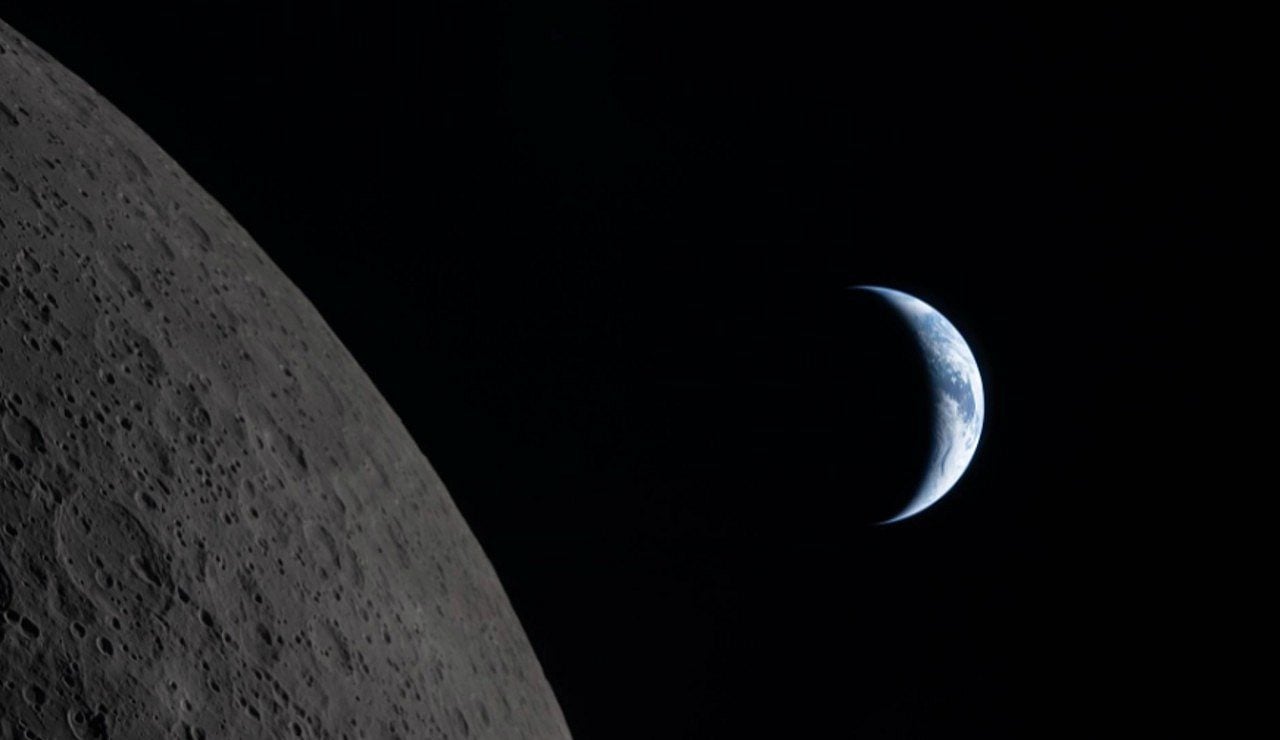
The crew of the Artemis II mission completed a lunar flyby on April 6, recording unprecedented images of the far side of the natural satellite. The Orion capsule reached a maximum approach of 6,547 kilometers to the lunar surface during the maneuver. The event marked the first time that humans observed this specific region directly with their own eyes. The operation is part of the practical testing phase of deep space navigation systems.
The four astronauts on board reached the milestone of 406,700 kilometers away from Terra. The number surpasses the historical record set by the Apollo 13 mission in 1970. The team worked in shifts over seven hours of continuous observation. The effort resulted in the capture of approximately 10,000 detailed photographs of lunar geology and unique astronomical events. Communications with the control center suffered a scheduled interruption of 40 minutes while the ship transited the hidden face.
For the first time in over 50 years, humans saw the Moon from up-close. 🌕✨ Science is beautiful!
More photos here: https://t.co/Lvypcj6CbL pic.twitter.com/79e2HgN75l
— Canadian Space Agency (@csa_asc) April 7, 2026
Mapeamento geological details basins and ancient lava formations
Astronauts Reid Wiseman, Victor Glover, Christina Koch and Jeremy Hansen applied the training received by the NASA science team. Eles identified specific topographic features during the high-speed passage. The group observed ancient solidified lava flows and areas of massive impact. The Bacia of Hertzsprung stood out in the images as it appeared with its two well-defined concentric rings. The resolution of the new cameras made it possible to map textures that were previously invisible.
Bacia Orientale also entered the crew’s field of vision. The structure represents one of the youngest impact craters present in Lua and was seen in full for the first time by a human team. Visual mapping of these areas provides raw data for analyzing the lunar crust. Scientists use this information to understand the chronology of meteor impacts in the early solar system.
Duas small craters located nearby received names suggested by the crew themselves during the flight. The first formation was named Integrity, in a direct reference to the Orion spacecraft. The second crater was named Carroll, a posthumous tribute to the wife of commander Reid Wiseman. The baptism generated a moment of respectful silence at Centro of Controle of Missão, located in the city of Houston.
Cosmic Alinhamento provides long-lasting solar eclipse
The trajectory of the Orion capsule provided the observation of a total solar eclipse from a perspective outside Terra. The phenomenon lasted about an hour, a period significantly longer than the maximum time of totality recorded on the Earth’s surface. The mass of Lua blocked the light from Sol completely. The occultation revealed the solar corona and magnetic structures visually described as serpentines or thin, glowing hairs.
The crew used specific eye protection equipment to follow the light transition. Blocking direct sunlight allowed clear viewing of other celestial bodies against the dark background of space. Astronauts have spotted planets like Vênus, Marte and Saturno with the naked eye. The field of view also included distant constellations and the strong bluish glow reflected by Terra’s atmosphere.
A portion of the lunar surface remained visible thanks to indirect lighting while Sol was hidden. Sunlight returned gradually at the end of the totality phase of the eclipse. The luminosity transition tested the optical sensors of the ship’s cameras. Continuous recording of the event generated a visual database of the behavior of sunlight in the vacuum of space.
Cápsula Orion records the disappearance of Terra on the horizon
The mission’s photographic equipment captured the exact moment Terra set behind the lunar relief. The event occurred at around 6:41 pm, considering Estados Unidos’s eastern time zone. The main image shows the partially lit blue planet contrasting with the darkness of space. The night side of Terra disappeared into the black background, while the daytime portion displayed sharp atmospheric details.
- The photographs show dense cloud formations covering Austrália and the Oceania region.
- The foreground of the images shows lunar craters with embanked rims and prominent central peaks.
- The visual perspective recreates the famous records of the Apollo era with ultra-high resolution sensors.
- The solar lighting fell at an angle that highlighted the depth of the rock formations.
Crew members reported a sense of isolation as they watched their home planet slowly disappear behind the curvature of Lua. The visual phenomenon reinforced the physical distance between the spacecraft and the control center. The maneuver required absolute precision from the onboard computers to maintain the capsule’s stability during image capture. Telemetry confirmed nominal operation of all gyroscopes.
Análise Data Validates Systems for Exploration Program
The team of astronauts was able to identify the eastern edge of Bacia Polo Sul-Aitken during orbit. The structure is cataloged by astronomers as the largest and oldest impact formation of Lua. The high-definition photographs will help researchers determine the mineralogical composition of the region. Understanding these geological processes underpins the choice of landing sites for the next stages of the space program.
Commander Reid Wiseman transmitted a message of thanks to the engineers and scientists responsible for planning the mission. Ele highlighted the importance of working together for successful data collection. Scientific officer Kelsey Young expressed public recognition for the crew’s dedication. Ela emphasized that the volume of information obtained boosts academic research in institutions around the world.
The seven-hour flyby covered both the visible and hidden sides of Lua. Calculations indicate that about 21% of the hidden side was directly illuminated by Sol at the time of passage. The Artemis II mission fulfills the objective of testing the endurance of the Orion spacecraft with human occupants in extreme conditions. Telemetry data validates the efficiency of life support, thermal control and cosmic radiation protection systems.
The Orion spacecraft follows its return trajectory to Terra after the successful completion of the lunar approach phase. Ground teams have already started downloading the heaviest data packets through the deep space network. The photographs released by the space agency generate the first preliminary analyzes of the topography of the region visited. The technical success of this stage consolidates the operational basis necessary for establishing a sustainable human presence in the lunar environment over the coming decades.





