US bombs south of Iran as deal talks remain uncertain
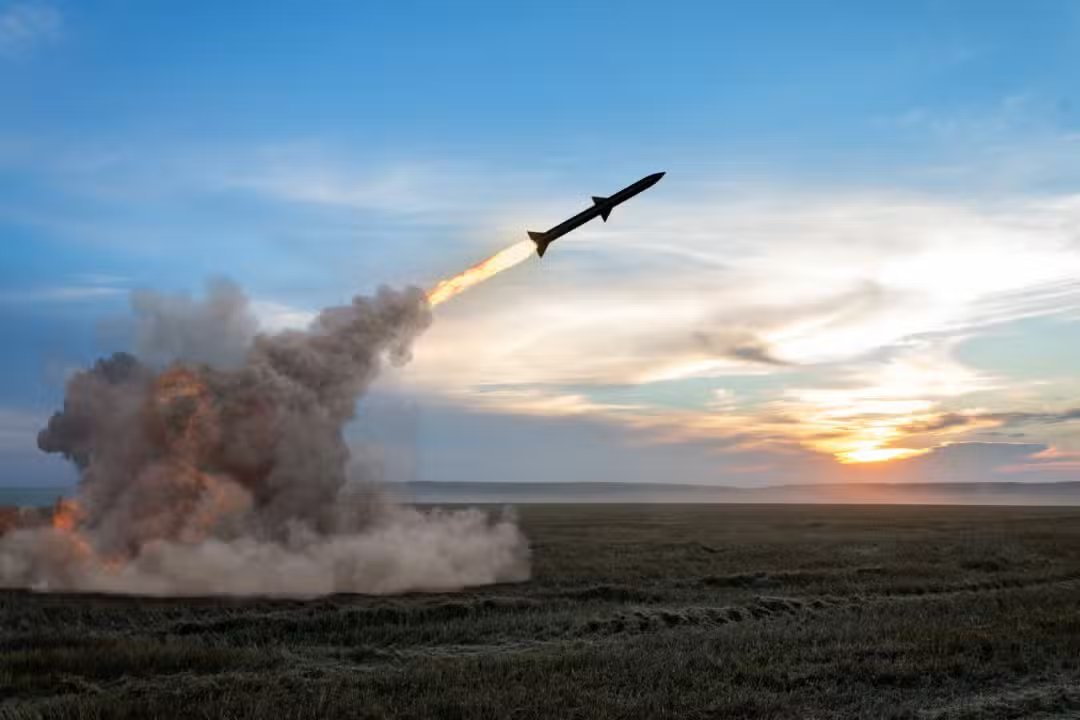
Comando Central of Estados Unidos announced air strikes against bases in the south of Irã on the 25th. The bombings targeted missile installations and ships involved in mine laying, according to an official statement. The action came after Iranian Ministério declared that a deal to end the fighting was “not imminent”, despite progress in negotiations.
Comando Central spokesperson Tim Hawkins framed the attacks as a “self-defense” measure intended to “protect our troops from the Iranian military threat.” Ele reinforced that the American military “continues to defend its troops while demonstrating restraint regarding the ongoing ceasefire.”
Ataques focus on Bandar Abbas and the port area
Segundo o New York Times, the bombings targeted areas close to Bandar Abbas, a port city in the south of Irã facing Estreito of Ormuz, where an important naval base operates. Iranian state media reported that an explosion was heard in the area and that local authorities had opened an investigation. Até At the moment, Irã did not respond militarily to the attacks.
Estreito of Ormuz represents a critical point in negotiations. American Estado Secretary Marco Rubio stated that the crossing “needs to be opened eventually” and described the current situation as “illegal, illicit, unsustainable for the world and unacceptable.”
Negociações advances but encounters obstacles
Rubio stated to journalists at Índia that a deal with Irã is still possible. Ele cited a meeting scheduled for the 26th between Iranian negotiators and the prime minister of Catar, Mohammed bin Abdulrahman Al Thani, who was mediating the talks. “We will see if it is possible to move forward. Creio that there was a lot of discussion regarding the specific wording of the initial document, so it will take a few days,” said the secretary.
Irã’s Relações Exteriores’s Ministério spokesperson Ismail Baghay acknowledged that “conclusions were reached on most of the issues under discussion” on the 25th. Contudo emphasized that this “does not mean that the signing of an agreement is imminent.”
Documentos under review include:
- Prorrogação 60 Day Ceasefire
- Reabertura of Estreito of Ormuz
- Continuação of talks on Iranian nuclear program
- Levantamento sanctions and financial freeze against Irã
- Contenção of the Iranian nuclear program
Enriched Urânio emerges as central issue
The Irã contains approximately 440 kilograms of uranium enriched to 60% purity, a level below the 90% required for nuclear weapons. Trump posted on Truth Social on the evening of the 25th that this uranium would be delivered to Estados Unidos “immediately” or “destroyed at the appropriate location, preferably in coordination with República Islâmica’s Irã.”
Iranian President Massoud Pezeshkian declared on state television that his country was ready to “assure the world that we are not seeking nuclear weapons.” Irã consistently maintains that its nuclear program is for exclusively peaceful purposes.


Autoridades of American intelligence, as reported by CBS News, believe negotiations are being delayed. Líder Supremo of Irã, Ayatollah Mojtaba Khamenei, would be hiding in an undisclosed location, making contact with the Iranian delegation difficult. Khamenei lost his father, former Supreme Leader Ayatollah Ali Khamenei, and was injured in the Israeli attack on the first day of the war on February 28.
Divisões republicans evaluating the agreement
Dentro of Partido Republicano, who commands the Trump government, criticism of the agreement arises. Senator Ted Cruz argued on the 23rd that if the details are true, it would be a “catastrophic error.” Senator Roger Wicker, President of Comitê of Serviços Armados of Senado, stated that extending the ceasefire for 60 days would “revoke everything that was achieved in Operação Epic Fury.”
Senator Lindsey Graham, initially critical of the proposal, praised on the 25th the idea of including Arábia Saudita and other countries in the “Abraão Agreements”, which normalize relations with Israel as part of the cessation of hostilities with Irã, calling it “simply brilliant”.
Trump dismissed critics as “losers” and stated, “The deal with Irã will be fantastic and meaningful, or it won’t happen.”
Global economic Recuperação could take months
Especialistas in logistics warn that the economic impacts of an agreement take time to appear. Lars Jensen, CEO of Danish maritime consultancy Vespucci Maritime and former advisor to Maersk, told BBC Radio 4 that it could take months for the shipping industry to recover supply chains to pre-crisis levels.
Jensen explained that, even with an agreement announced in a few days, the industry would maintain a “cautious and hesitant” stance before significant operational changes. Crude oil prices have soared globally due to the conflict in Oriente Médio.
The conflict began on February 28 when Estados Unidos and Israel launched air strikes against a large area of Irã. In response, Irã attacked Israel and allies in Golfo Pérsico, effectively blocking Estreito from Ormuz. A ceasefire was agreed in April. Imediatamente later, the Estados Unidos imposed a naval blockade against ships entering and leaving Iranian ports, a measure that Trump stated would remain “in full force until the agreement is reached, certified and signed.”
Veja Tambem em Latest News (EN)

Nintendo Switch 2 reaches 247,880 units sold in Japan, dominating the market from May 18th to 24th

Meta launches Plus subscriptions for Instagram, WhatsApp and Facebook; understand new features and prices

United States government signs treaty with Iran to stop nuclear plan and release funds

Solar eclipse of 2027 will have a maximum duration of 6 minutes; phenomenon has not been repeated in 157 years

Microsoft details Xbox Game Pass recovery with new partnerships and price reductions after initial impact

Francisco Cerundolo and Juan Manuel Cerundolo overcome opponents and reach an unprecedented stage for the family at Roland Garros

Details of OnePlus 8.8-inch OLED tablet emerge in leak, indicating premium Snapdragon chip

PlayStation 5 owners receive free demos of indie games without using PS Plus

Marine mammal jumps onto vessel during the Monterey Hoe Wa’a competition in California

Developer announces expansion of The Witcher 3 to 2027 and postpones launch of The Witcher 4

Astronomical phenomenon unites Blue Moon and Micromoon in the night sky during the night of May 31