NASA reveals new chemical data from interstellar comet 3I/Atlas as it passes through the solar system

Agência Espacial Americana (NASA) has released new detailed reports on the interstellar comet 3I/Atlas during the year 2026. The celestial body attracts the attention of global astronomers due to its origin outside the solar system. Pesquisadores uses state-of-the-art telescopes to map the physical structure of the object. The close passage to Sol allowed the collection of unprecedented information about the formation of distant planetary systems. The scientific mobilization involves several international agencies focused on unraveling the mysteries of this cosmic traveler.
Recent chemical analyzes point to significant differences between 3I/Atlas and comets native to our cosmic neighborhood. The visitor carries singular proportions of primordial elements. Essa distinction confirms the hypothesis that the object formed in a molecular cloud with its own thermal and dynamic characteristics. Cientistas consider observation a direct opportunity to study the matter of another star without the need to send interstellar probes. The astronomical event marks a turning point in modern astrophysics.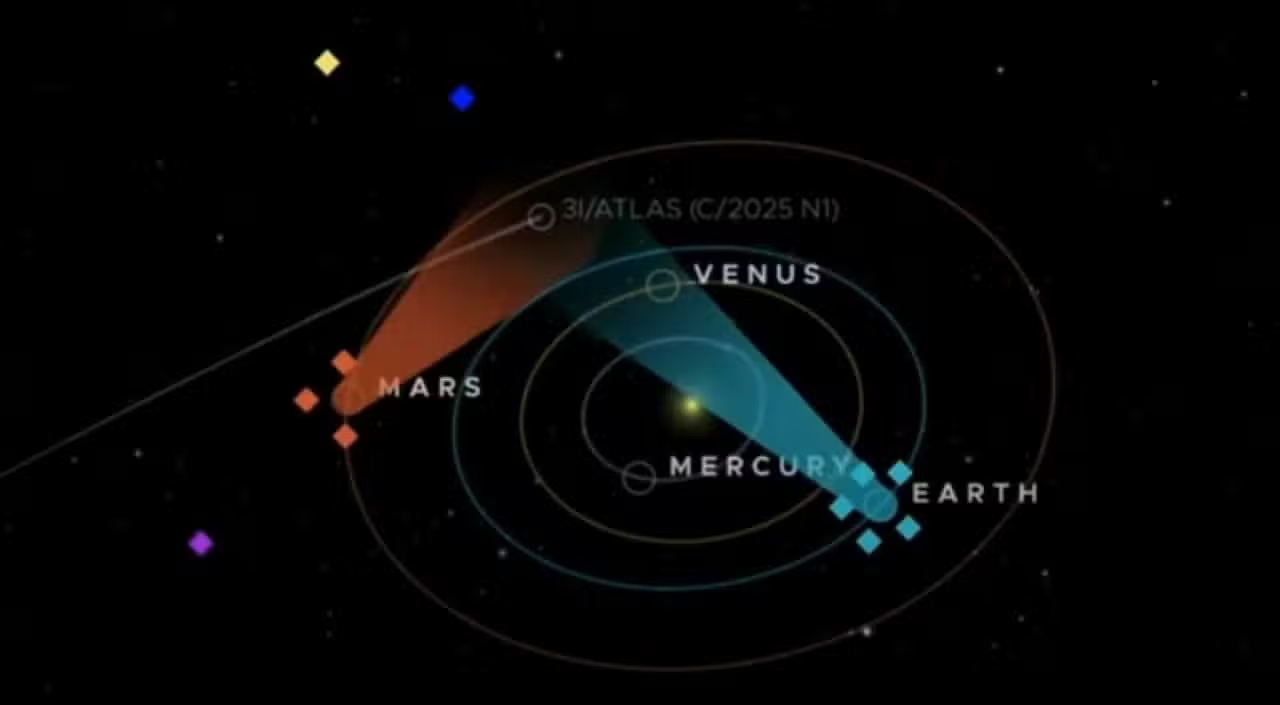
Hyperbolic Trajetória and continuous monitoring since discovery
The Asteroid Terrestrial-impact Last Alert System (Atlas) warning system recorded the first detection of the comet in the year 2019. The hyperbolic orbit of the celestial body immediately indicated its external provenance. Apenas, a restricted group of interstellar objects, has this confirmation documented in the history of astronomy. The speed of displacement and the lack of gravitational connection with Sol attest that 3I/Atlas has been traveling through the cosmic vacuum for millions, or possibly billions, of years. The absence of an elliptical orbit proves its alien origin.
The dynamic behavior of the comet required adaptations in tracking methodologies. In 2020, the object’s core underwent a spectacular fragmentation process. The event generated multiple smaller chunks and forced experts to recalculate the routes for each segment. Observations conducted in 2026 focus on the interaction of these fragments with solar radiation. The release of gases and dust forms a complex coma around the main core. Variações sudden bursts of brightness keep monitoring teams on constant alert.
Instrumentos high technology applied in data collection
NASA coordinates a network of space and ground-based equipment to extract as much data as possible during the comet’s passage. Telescópio Espacial Hubble captured high-resolution images that documented the initial core breakage. Atualmente, Telescópio Espacial James Webb operates at full capacity in object analysis. The equipment’s infrared sensors identify complex organic molecules that escape from the frozen surface. Identification of rare isotopes provides clues about the exact region of the galaxy where the body originated.
Space missions receive direct support from facilities located on the Earth’s surface. The Chile desert is home to two of the most important complexes for this research. The Atacama Large Millimeter/submillimeter Array (ALMA) and Very Large Telescope (VLT) measure the comet’s radio wave emissions. The combination of different wavelengths creates a three-dimensional profile of the cosmic visitor. The multiwave approach reveals everything from the surface texture to the density of the surrounding gas cloud.
- Telescópio Espacial Hubble performs high-resolution visual recording of the physical structure and fragmentation of the nucleus.
- Telescópio Espacial James Webb performs infrared spectroscopic mapping of volatile gases and organic compounds.
- Complexo ALMA in Chile monitors submillimeter wave emission to analyze coma density.
- Observatório VLT provides complementary data on the fragments’ orbital dynamics and interaction with the solar wind.
Technological integration between these platforms allows for a complete 3I/Atlas scan. International Agências share raw data in real time to speed up information processing. The joint effort eliminates observation gaps caused by Terra’s rotation or adverse weather conditions at terrestrial sites. The accuracy of current instruments surpasses all measurements made on previous comets. Global synergy ensures that no change in the comet’s structure goes unnoticed by scientists.



Composição distinct chemistry and analysis of organic compounds
Reports from 2026 detail the presence of an exotic mix of water ices, carbon dioxide and methane. 3I/Atlas presents concentrations of silicates that differ from the pattern found on celestial bodies in our solar system. The detection of heavy elements suggests an extremely cold formation environment. Young protoplanetary Nuvenss located in other regions of the galaxy have chemical signatures similar to those found on the comet. The preservation of these materials turns the object into an astrophysical time capsule.
Astrophysicists actively debate the identification of cyanide and dicarbon in the coma structure. Estes compounds function as markers of chemical processes that occur in low-temperature, high-energy scenarios. The unusual abundance of these substances indicates molecular synthesis routes different from those known to current science. The presence of complex prebiotic molecules raises questions about the distribution of organic materials throughout the universe. Especialistas looks at whether these building blocks could seed life on habitable planets.
The study of the comet’s internal chemistry works like a natural laboratory analysis. The material preserved inside the core survived cosmic radiation during the long interstellar journey. Cada new molecule cataloged by spectrometers helps to put together the scenario of the object’s mother star. The metallicity of 3I/Atlas points to a stellar system with planetary formation dynamics different from that which gave rise to Terra. The volatility of the components reacts unpredictably to the heat of our Sol.
Implicações astrophysics on the formation of stellar systems
The comet’s ejection from its original system was likely due to violent gravitational interactions. Giant Planetas or the close passage of other stars may have hurled 3I/Atlas into deep space. The straight trajectory through the interstellar medium kept its primordial characteristics intact until the approach with our Sol. The data collected in 2026 serves as the basis for new mathematical models of stellar dynamics. Understanding these mechanisms explains how matter travels between different star clusters.
Continuous monitoring of the comet’s departure ends the most intense phase of the research. The hyperbolic speed guarantees that the object will cross the boundaries of the solar system in the next few years and will not return. Space agencies archive the terabytes of information captured for future analysis. The legacy of 3I/Atlas redefines the parameters of the search for new interstellar visitors and improves astronomical observation protocols. The historical passage consolidates the use of infrared telescopes in detecting celestial bodies of external origin.
Veja Tambem em Latest News (EN)

Court validates US$7.85 million settlement against Sony for monopoly on PlayStation Store

Microsoft system applies discount of up to 50% on Xbox Series X for engaged players

Microsoft digital system reduces Xbox Series X price by up to 50% for selected profiles

Microsoft algorithm reduces Xbox Series X value by up to 50% on old consoles panel

Avi Loeb discusses Project Galileo, UFOs, extraterrestrial intelligence, the transformation of humanity and the impacts of technological advances and cosmic discoveries

Salas opens the scoring for River Plate against Blooming in a duel for the South American

Military Police rescue 4-year-old boy abandoned by his mother on Antônio João state highway

New Forbes list points to 22 billionaire celebrities in 2026 with Steven Spielberg in the lead

PlayStation Plus catalog receives Warhammer 40K: Darktide and Destiny 2 ends in June

Author of La Casa de Papel exposes salary crisis for Brazilian screenwriters during Rio2C event

Streaming platforms confirm premieres of Avatar: Fire and Ash and final season of The Bear