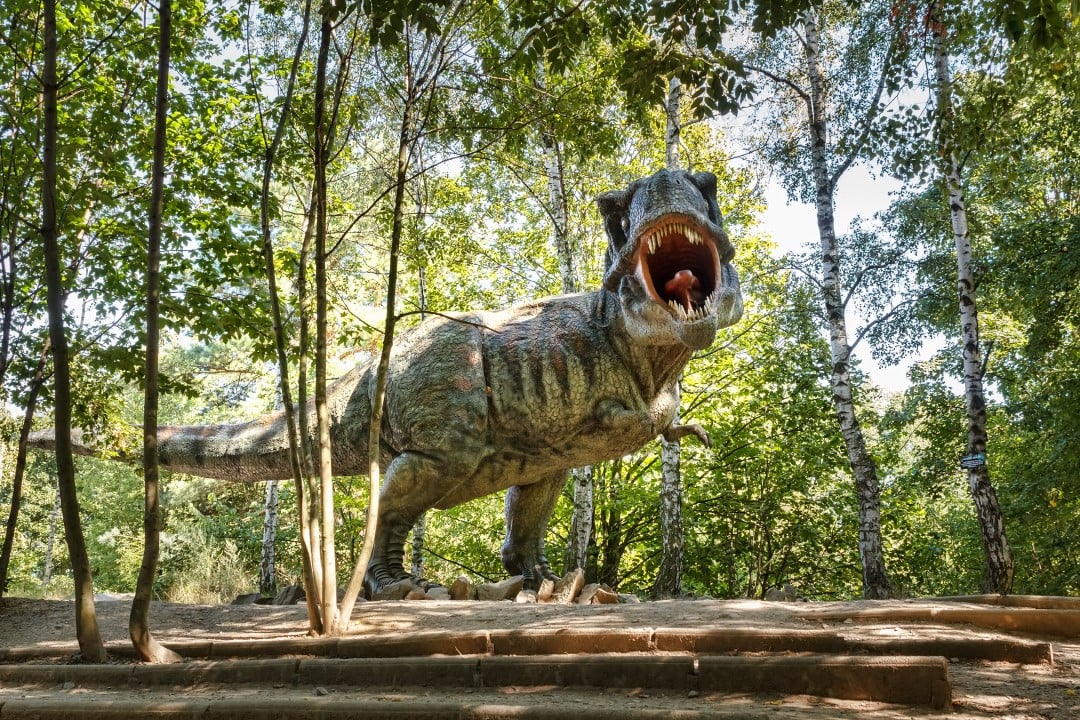
One of the most ferocious animals to pass through Terra had a striking feature: its disproportionately short arms. At around 90 centimeters long, Tiranossauro Rex’s forelimbs were less than a third of the length of its legs, creating an unusual silhouette on a body that could reach more than 12 meters in length in adults.
Scientific Debate of more than 50 years comes to an end
For more than half a century, scientists have debated the exact reason for this peculiar characteristic. Theories varied significantly. Alguns researchers pointed out that the arms were just vestigial, structures with no practical function that shrank throughout evolution. Outros argued that the arms were short to prevent the animal from biting itself during a feeding frenzy, given its known voracity.
Cientistas believe they have reached the end of the debate. A new study published this month in the journal “Proceedings of the Royal Society B” analyzed 85 species of dinosaurs and came to a definitive conclusion: the small arms were an evolutionary compensation caused by the increase in size of another part of the body that consumed more resources, the skull with the crushing jaw.
Study’s Metodologia reveals evolutionary pattern
Para reached this conclusion, researchers measured the forelimb and skull bones of all 85 species, using fossils and data from existing scientific literature. Scientists have developed a new methodology to quantify the strength of the skull, analyzing factors such as overall size, bone fit and bite force. Isso allowed each skull to be arranged on a comparative scale.
Charlie Roger Scherer, PhD student in the Ciências department of Terra of University College London and lead author of the study, explained the evolutionary mechanism involved. “If you’re a dinosaur with a very robust skull, you’ll probably have very small forelimbs. And it doesn’t really matter how big you are — you might weigh 1 ton or 10 tons. If you have a strong skull, you’ll have relatively small arms,” he said.
The evolutionary principle behind biological choices
The fundamental reason lies in how evolution works. “Evolution doesn’t like having everything at the same time”, as Scherer explained, because it tends to prioritize one characteristic over another. Quando a dinosaur needed to focus on using its head as its main weapon to kill large prey, investing evolutionary resources in this specific aspect.
“If you want to focus on using your head to take down large prey, you don’t want to put too much effort into keeping your arms long and clawed, because you probably won’t need them. Então, evolution kind of says, we don’t need the arms anymore, so let’s shrink them and invest more energy in keeping the skull strong,” Scherer detailed.
Tiranossauro Rex leads cranial robustness scale
Não surprisingly, Tiranossauro Rex scored highest on the cranial robustness scale developed by the researchers, followed by Tyrannotitan, another gigantic carnivore that lived in what is now Argentina during Cretáceo Inferior, approximately 30 million years before T. rex.
Além of the tyrannosaurid group that includes T. rex and its direct relatives, researchers found the same correlation between large, strong skulls and small forelimbs in four other main groups of dinosaurs:
- Ceratossaurídeos
- Megalossaurídeos
- Abelissaurídeos
- Carcarodontossaurídeos
Todos these groups were large bipedal carnivores that occupied similar positions at the top of the food chain of their respective periods.
Característica evolutionary was no coincidence
The new analysis suggests that limb reduction was not an isolated coincidence or anomaly, but an evolutionary trait that occurred in different unrelated species over an extensive geological period. Porém, the process of arms reduction was not identical between the species analyzed.
Alguns dinosaurs began evolution by decreasing the size of their fingers, while others prioritized shortening the forearm. Cada lineage found its own evolutionary solution within the general constraint of having to maintain powerful skulls.
Cabeça as primary predation tool
Havia a common factor in all cases. “There’s always one common factor, which is that they all hunt animals that require a little more strength to kill, and that’s why they developed that very strong skull. Tudo was approached head first, so the head became what came into contact with the prey, and that was the easiest way to kill them, rather than jumping or fighting with claws,” Scherer stated.
Contexto temporal Tiranossauro Rex
Tiranossauro Rex lived during the late Cretáceo period, between 68 and 66 million years ago. Esse period represented the last stage of Era Mesozoica, known as the “Era of Dinossauros”, and T. rex was one of the last dinosaurs to inhabit Terra before the mass extinction that ended the era of giant reptiles. Previous Pesquisas pointed out that the ears and the brain were equally crucial to tyrannosaurs’ dominance over their environments.