

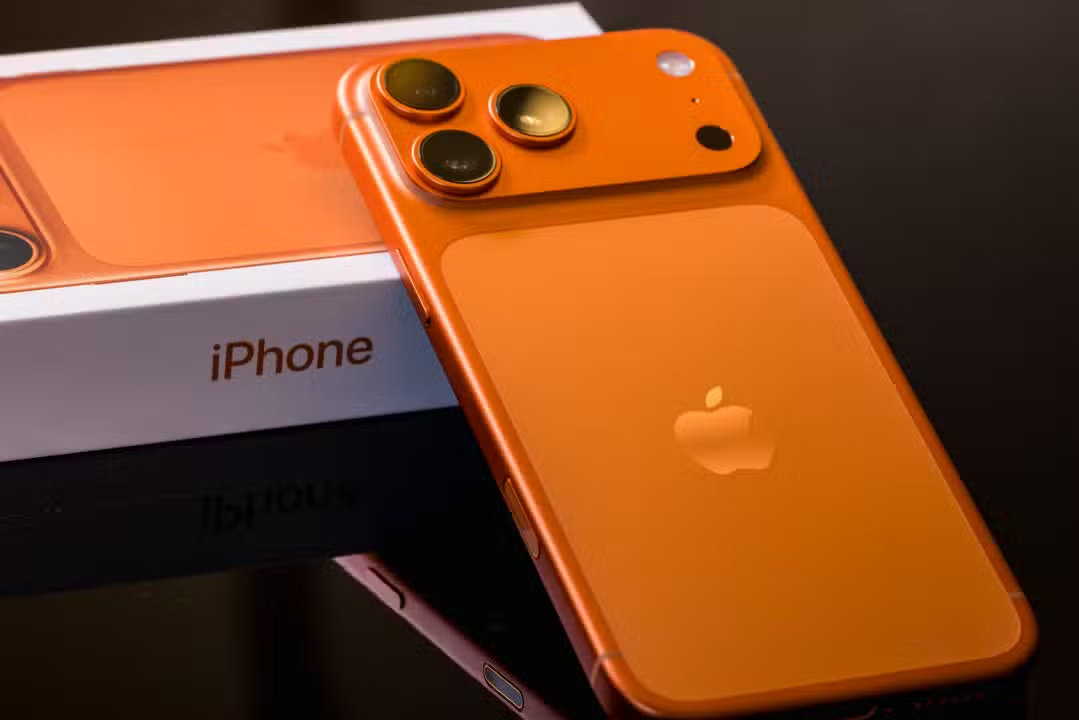
The Apple TV platform carried out an unprecedented operation in sports coverage by broadcasting the clash between LA Galaxy and Houston Dynamo FC with images captured exclusively by iPhone 17 Pro devices. The event took place at Dignity Health Sports Park, located in Carson City, Califórnia, and represented the first time that a major professional game used smartphones as the main live filming equipment.
The initiative arose from a direct partnership with Major League Soccer to test the limits of mobile hardware in a highly technically demanding environment. The devices were strategically distributed throughout the stadium to record everything from the teams warming up to the intense movement during the 90 minutes of ball rolling. The choice of the company’s most recent model took into account the advanced specifications of the optical set, capable of delivering quality compatible with the standards required by television broadcasters.
Especificações iPhone 17 Pro techniques for capturing images
The structured project for the football match required intensive use of the three 48 megapixel Fusion cameras present on the smartphone. Esse photographic system offers operators the equivalent of eight different lenses in a single compact chassis, allowing quick framing variations without the need to physically change equipment. The versatility of the focal lengths guaranteed coverage of open plays in midfield and approximate details in ball disputes.
Além of advanced hardware, the production team employed the Apple Log 2 recording format throughout the broadcast of the sporting event. Esse color profile retains significantly more visual data in shadow areas and high-light spots. The adoption of this technical resource gives image engineers superior flexibility in real-time color treatment, resulting in a visual finish that approaches traditional cinema cameras.
The optical image stabilization integrated into the devices also played a fundamental role in maintaining visual fluidity. Operadores positioned on the sides of the field were able to follow fast runs by LA Galaxy and Houston Dynamo FC athletes without generating excessive vibrations on the spectator’s screen. The cell phone’s internal processor handled encoding the continuous video signal without experiencing overheating failures during hours of uninterrupted operation.
Professional Broadcast Infrastructure Manutenção
Replacing heavy studio cameras with smartphones did not eliminate the complexity of the television operation mounted on the Dignity Health Sports Park. The workflow maintained the backbone of a high-level sports broadcast, with cell phones acting solely as the capture nodes at the edge of the system. The signals generated by the devices traveled instantly to a mobile control center stationed on the outskirts of the arena.
Dentro of this control unit, dozens of professionals performed their usual functions using cutting-edge equipment to ensure delivery of the final product to subscribers. The back-end structure involved the following operational departments:
- TV Direção responsible for cutting cameras and rhythm of the visual narrative.
- Edição live for immediate generation of replays and highlights.
- Captação ambient audio and main narration mixing.
- Integração for expert commentary and real-time tactical analysis.
- Distribuição satellite and fiber optic signal to global servers.
- Equipe technique dedicated to network monitoring and connection stability.
Essa hybrid approach adopted by Apple TV demonstrated that innovation lies in miniaturization from the point of view while preserving the technical rigor of the rear. Image directors were able to apply the same transition and graphic overlay techniques they use in conventional broadcasts. The fluid integration between mobile devices and professional cutting tables validated the format for future applications in sports programming.
Novos angles and the future of sports coverage
The use of the iPhone 17 Pro in Major League Soccer highlights a change in the way directors plan spatial coverage of a sporting event. The small size of the devices allows them to be installed in places where traditional machinery simply does not fit or poses a risk to the physical integrity of athletes. Durante began, the public followed new perspectives generated from unconventional points of view.
The technical team placed units inside the goalposts to record the ball’s trajectory in dangerous shots and goalkeeper saves. Outros devices were positioned in the corridors leading to the pitch, capturing the tension of the players moments before the opening whistle. The warm-up areas and benches also received approximate coverage, offering greater immersion in the competitive environment without interfering with the dynamics of the technical committees.
Especialistas from the audiovisual sector point out that premium smartphones will act as essential complementary tools in the coming seasons, although they will not fully replace long-range lenses. Eventos in massive stadiums still require robust objectives to seek out details on the opposite side of the field with millimeter precision. Contudo, ease of mobility and reduced implementation cost make cell phones viable options for expanding the number of cameras available in a single match.
Histórico testing and expanding technology on Brasil
The milestone reached on the Califórnia is the result of a rigorous testing schedule carried out by the manufacturer over the last few months. In 2025, the company began experimenting using the iPhone 17 Pro to record isolated bids during “Friday Night Baseball”, in a confrontation between Boston Red Sox and Detroit Tigers. The success of this first foray encouraged the project’s expansion into football, culminating in partial testing during the 2025 MLS Cup Final.
Cada stage of this evolutionary process provided crucial data on the behavior of the sensors under different lighting conditions, from natural late afternoon light to nighttime spotlights. Apple engineering used this information to refine image processing algorithms and ensure that the unique 2026 broadcast occurred without interruption. The strategy consolidates the device not just as a consumer product, but as a working instrument for the audiovisual market.
The influence of this technology went beyond North American borders and found practical applications in the national sports scene. The CBF has officially integrated the iPhone 17 Pro into the semi-automatic offside system that operates at Brasileirão 2026. The technological solution, developed together with the company Genius Sports, uses a set of cell phones installed in the stands to track the exact position of the players and the ball in fractions of a second.
Nesse Brazilian context, the devices do not transmit video to the public, but function as high-precision visual sensors that feed the arbitration’s artificial intelligence software. Essa adoption by the highest national football entity reinforces the reliability of the optical components present in the device. The convergence between telecommunications and professional sports indicates that stadium infrastructure will increasingly depend on solutions based on high-performance mobile architecture.