
Celestial alignment generates total solar eclipse visible in Europe and the Arctic in August 2026
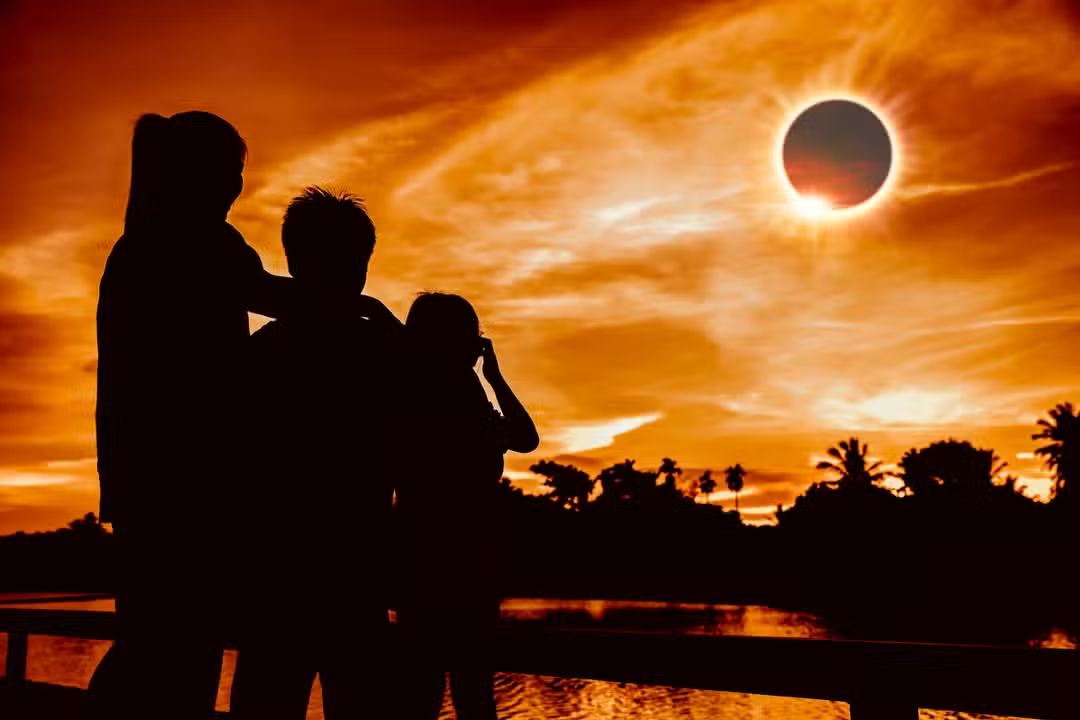
A total solar eclipse turns day into night on August 12, 2026. The perfect alignment between Lua and Sol blocks starlight for approximately two minutes. The phenomenon reaches its full form only in a narrow band of the planet. Cerca of 15 million people inhabit the zone of totality. Outras 980 million observe the event in a partial way.
The lunar shadow begins its journey in the northern hemisphere and crosses different continents. The astronomical event mobilizes scientists in search of the best visibility conditions. The occurrence depends on specific orbital factors. Lua reaches the new phase about two days after perigee. The proximity to Terra increases the apparent diameter of the natural satellite, which guarantees coverage of the solar disk.
Trajetória of the lunar shadow covers polar regions and the European continent
The path of totality begins at Península from Taimyr, at Rússia. The shadow advances quickly across the waters of Oceano Ártico. The path reaches the northeast of Groenlândia shortly thereafter. Islândia receives the phenomenon with the maximum expected duration. Total darkness lasts two minutes and 18 seconds near the northwest Icelandic coast. The exact point of longest duration is in the ocean, about 45 kilometers from the coast.
The band of darkness continues its route through Atlântico Norte. The European continent receives the eclipse through the north of Espanha. Cidades like Coruña, Bilbao, Zaragoza and Valencia lie under the lunar shadow. The phenomenon also affects Palma, in Ilhas Baleares. The event takes place in the late afternoon in these locations. Sol is positioned low on the horizon during totality. Isso requires observation locations with unobstructed views to the west.
Portugal records the entirety in a very restricted area. Apenas the extreme northeast of the continental territory observes complete darkening. Residents of this region can see stars and planets with the naked eye during the day. Atmospheric conditions determine the clarity of this view. The total eclipse ends at sunset at Ilhas Baleares. European summer offers a higher probability of clear skies in Península Ibérica.

Observação of the astronomical event in Brasil occurs partially
Brazilian territory does not enter the path of the totality of the eclipse on August 12, 2026. Observation at Brasil takes place exclusively in partial form. The phenomenon mainly affects some areas of the Nordeste region. The start of solar blocking occurs around 4:15 pm local time. The event lasts approximately 30 minutes on Brazilian soil. Sol is not completely hidden in any national municipality. Concealment percentage varies depending on location.
The partial view covers other large areas of the globe. Grande part of Europa observes the solar disk covered by half or more. The west of África enters the twilight zone in the afternoon. The north of América from Norte also records the passage of Lua in front of Sol. The degree of coverage decreases as the distance from the center band increases. Monitoring requires the use of specialized applications.



Condições techniques and celestial alignment guarantee daytime darkness
The celestial mechanics behind the eclipse involve precise orbital timing. The Lua passes exactly between the Terra and the Sol. The natural satellite needs to be at a suitable distance to cover the star. The recent lunar perigee ensures the required apparent size. The shadow’s trajectory shows unusual behavior on this date. Movement begins from east to west in the polar region before curving south.
The astronomical event provides valuable data for the scientific community. Pesquisadores prepare measuring instruments on land and at sea. Aeronaves participate in monitoring above the clouds. The solar corona gains prominence during the minutes of totality. Essa’s outer layer of Sol’s atmosphere remains invisible on normal days. The intense brightness overshadows the structure. The lunar block allows photographic recording of the region.
Studying the solar corona helps to understand the star’s activity cycle. Scientists analyze coronal mass emissions and solar winds. Atmospheric measurements at Terra make up the scope of the research. The sudden drop in temperature accompanies the sudden darkening. The behavior of different species of animals changes during the phenomenon. Pássaros usually return to their nests early.
Recomendações security requirements require use of certified equipment
Direct observation of Sol causes irreversible damage to the human retina. Astrônomos reinforce the need for strict eye protection. The use of appropriate equipment guarantees safety during the event. The partial phase requires continuous care from observers. Sunlight damages vision even when most of the disk is covered. Common dark Óculos do not provide the necessary filtering.
Experts indicate specific methods to monitor the phenomenon without risk. The list of safe equipment includes direct and indirect options:
- Óculos with international certification and specific solar filters for astronomy.
- Filtros of welder with shade number 14 or higher.
- Projeção from Sol image on a white bulkhead through a dark box.
- Telescópios equipped with solar filters attached to the front objective lens.
The only exception to the use of protection occurs in the totality band. Observers may remove glasses only during brief minutes of complete darkness. The return of sunlight requires immediate replacement of the filters. Moradores from partial eclipse areas should never look at the sky without equipment. Ultraviolet radiation reaches the eyes imperceptibly.
Veja Tambem em Latest News (EN)

Clash of dates between Formula 1 and the World Cup makes Kimi Antonelli declare support for Brazil

Mauricio Pochettino opens talks with Milan to take over team after Massimiliano Allegri’s dismissal

Striker João Pedro guarantees that Cole Palmer would take over the number ten shirt for the Brazilian team

FIA decision prohibits activating the system in straight mode for cars on the Monaco circuit

Napoli agrees to sign Massimiliano Allegri with a two-year contract and millionaire salary

Champions League final pits Paris Saint-Germain and Arsenal in Budapest

Valued at US$9.5 billion, Real Madrid surpasses rivals and leads Forbes ranking in 2026

Young Kimi Antonelli dominates Formula 1 season and father details inspiration in Ayrton Senna

Barcelona invests R$467 million in Anthony Gordon and negotiates with Julián Álvarez for the attack

Goalkeeper Marc ter Stegen negotiates departure from FC Barcelona after losing space in the main squad

Arsène Wenger points out Arsenal’s favoritism against Paris Saint-Germain in the Champions League final
