
Hubble Telescope records nucleus of the Lagoon Nebula and reveals nursery of massive stars

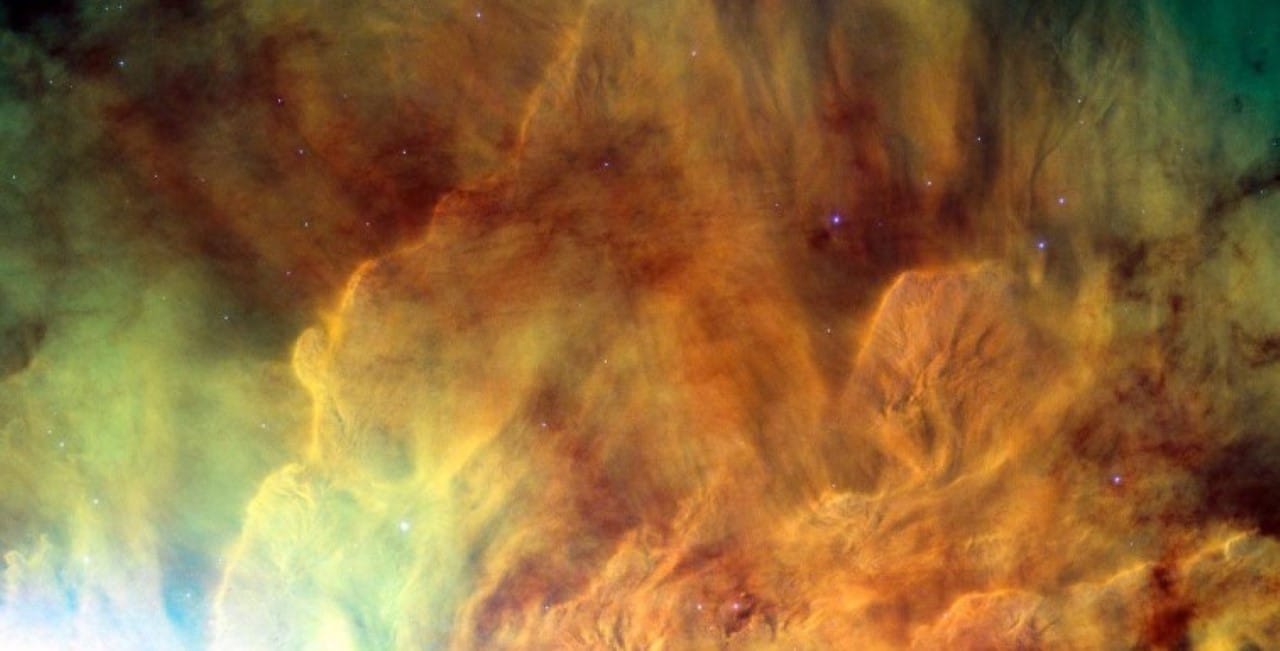
Câmera Avançada to Pesquisas of Telescópio Espacial Hubble recorded high-resolution images of the central region of Nebulosa of Lagoa, scientifically classified as M8. The space observatory captured unprecedented details of the stellar nursery located in the constellation Sagitário. The estimated distance between the cosmic cloud and the planet Terra ranges from 4,000 to 5,000 light years. The photographed area displays the intense activity of young stars that interact directly with the interstellar medium through constant energetic emissions.
The luminous phenomenon occurs because newly formed and massive stars emit high levels of ultraviolet radiation. Essa energy ionizes the surrounding gas and generates its own light emission. The characteristic classifies M8 as an emission nebula. The resulting glow makes the structure visible to the naked eye during clear summer nights in Hemisfério Norte. The photographic record allows astronomers to deepen analyzes of the life cycle of giant molecular clouds and the initial processes of formation of new stellar systems.
Wait for it … ! Wavelength makes a big difference when looking at the Lagoon Nebula. Near-infrared light emitted by distant stars is able to pass through the dense clouds of the nebula to reach Hubble, revealing a very different scene. Credit: NASA, ESA, STScI. pic.twitter.com/t8wAvqpyFj
— Hubble Space Telescope (@HubbleTelescope) August 24, 2023
Radiação ultraviolet and stellar winds shape gas structures
The Nebulosa core of Lagoa exhibits complex physical dynamics driven by the energy of massive stars. The powerful stellar winds generated by these celestial bodies collide with the surrounding material continuously. Essa constant interaction creates deep cavities and extensive columns of gas and cosmic dust over millions of years. The process of space erosion carves spiral shapes that mark the landscape of the central region captured by the orbital equipment.
The intense internal activity directly contrasts with the peaceful “Lagoon” nomenclature attributed to the astronomical object. The dispersion of material around hot stars demonstrates a violent and dynamic phase of stellar evolution. The images captured represent only a tiny fraction of the nebula’s total area, but they provide the data necessary to understand the population density of young stars there. The force of radiation acts as a cleaning mechanism that moves excess material away from the nucleus.
Pesquisadores uses these observations to feed computational astrophysics models. Understanding how giant molecular clouds gravitationally collapse to form new clusters depends on analyzing these areas of intense radiation. The extreme environment of M8 serves as a natural laboratory for science to investigate the dispersion of heavy chemical elements throughout outer space. The observed dynamics help explain the stellar birth rate in our galaxy.
Mapeamento chemist uses false colors to identify elements
The image released by the Telescópio Espacial Hubble team results from the combination of different wavelengths captured by the equipment’s sensors. Scientists apply an artificial coloring technique to highlight the specific chemical composition of the gas and dust cloud. The method facilitates the visual identification of elements that would be imperceptible in a standard visible light photograph. Chromatic separation delivers a detailed map of the distribution of matter in space.
The assignment of false colors follows a rigorous technical standard to map the distribution of ionized gases in the central region of the nebula and guide spectroscopic research:
- The emission lines of the hydrogen element are colored red.
- Nitrogen in an ionized state appears represented by the color green.
- Visible light captured at a wavelength of 550 nanometers is shown in blue.
Essa separation allows astronomers to calculate the temperature, density and relative abundance of each chemical element in the stellar nursery. The presence of dark dust, which blocks the light from stars located in the background, creates a visual contrast with the bright areas of gaseous emission. Overlaying this data reveals where the processes of creation and destruction of cosmic material occur simultaneously. The multiple exposure technique maximizes the scientific return from each orbital observation.
Colossal Dimensões outperforms other forming regions in Via Láctea
Nebulosa of Lagoa covers a considerably larger physical area than other known stellar nurseries in Via Láctea. Astronomical Medições indicate that the major axis of M8 exceeds 100 light-years in length, and can reach up to 140 light-years at its most diffuse ends. Essa’s colossal scale allows for the simultaneous formation of multiple stellar clusters at different stages of development within the same molecular cloud. The vastness of the complex requires multiple observation campaigns for complete mapping.
Para For scientific contextualization purposes, astronomers often compare M8 with Nebulosa of Órion, another famous star-forming complex also visible without the aid of optical instruments. Enquanto to Nebulosa of Órion has a diameter of approximately 24 light years, Nebulosa of Lagoa has a volume tens of times greater. The difference in proportions reinforces the importance of M8 for the study of large-scale galactic evolution. The amount of mass available in Lagoa supports the creation of much more massive stars.
Their location in the night sky also differentiates the two celestial objects for Terra-based observers. Habitantes from midlatitudes in Hemisfério Norte finds Nebulosa from Lagoa in a favorable position for observation during the summer months. In contrast, Nebulosa and Órion dominate the astronomical landscape during the winter period. Seasonal alternation guarantees researchers continuous study targets throughout the entire calendar year for instrument calibration and data collection.
Observatórios terrestrial and space sources complement data on the Sagitário constellation
The work carried out by Telescópio Espacial Hubble is part of a global effort to map the Sagitário constellation. The region hosts a high concentration of interstellar material due to its proximity to the direction of the center of Via Láctea. Complementary Observações driven by equipment installed on the Earth’s surface help to build a broader panorama of the galactic environment where M8 is located. The synergy between different telescopes accelerates discoveries in the field of observational astronomy.
Observatório Vera Rubin provides wide-field images that show Nebulosa of Lagoa positioned next to Nebulosa Trífida. Essa panoramic view contextualizes the gravitational interaction and material exchange between different neighboring molecular cloud complexes. Combining high-resolution space data with wide-field ground-based scans optimizes the accuracy of astrophysical research. Astronomers can trace the origin of the gas flows that fuel the formation of new stars.
Continuing monitoring of these areas rich in star formation ensures constant updating of astronomical catalogs. Radiation emitted by M8’s massive stars will continue to shape the surrounding gas for eons to come, altering the nebula’s physical structure irreversibly. The current photographic record serves as a fundamental time frame so that future generations of scientists can measure the rate of expansion and erosion of interstellar material with mathematical precision.



