
President Putin denies threats to Europe after drone crash in Romania; Moscow suggests Ukrainian origin

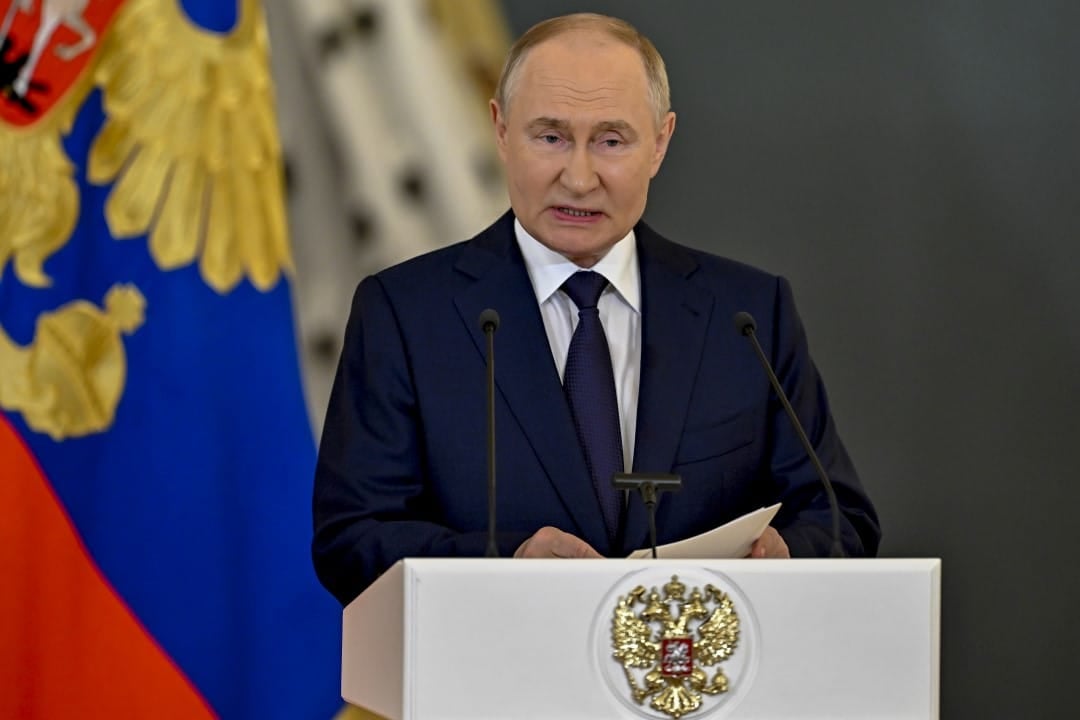
The president of Rússia, Vladimir Putin, stated that the country “never threatened” Europa, in a statement that occurred after the crash of a drone in Romênia’s territory. The Russian leader’s statement sought to discredit European concerns, reiterating that Moscou “is not threatening European countries” and, at the same time, presented a suggestion that the artifact, whose fall raised alarm, could have Ukrainian origins.
Putin’s statement comes at a time of heightened geopolitical tensions, marked by the ongoing conflict in Ucrânia and the growing concern of Organização, Tratado, Atlântico Norte (NATO) member countries about the security of their borders. Romênia, a member of NATO, has an extensive border with Ucrânia, making any aerial incident on its territory a point of particular sensitivity and international surveillance.
Russian Negação and statement context
President Putin’s speech emphasizes the Russian stance of not considering itself a threat to European Estados. Ele used the stage at a recent event to reiterate the position of Moscou, who consistently seeks to shape the narrative around his actions at Europa Oriental. Essa denial aligns with a communications pattern that Rússia adopts in response to international criticism and concerns about its military and strategic presence.
Putin’s insistence on disassociating Rússia from any aggressive intention towards Europa occurs in a period where the proximity of the Ukrainian conflict to NATO borders has generated a series of warnings. Occasional Incidentes, such as the crash of a drone, tend to magnify the perception of risk and intensify the debate on regional security. The Russian president’s statement thus aims to calm these sentiments or, at least, challenge Western interpretations of his country’s actions.
Drone Queda on Romênia intensifies alert
The occurrence of a drone crash in Romanian territory represents an event of great relevance in the current scenario. Embora the specific details about the type of drone, the exact date of the crash and the precise location of the incident have not been widely disclosed by the original source, the very mention of the fact by Putin already underlines the seriousness of the situation. Romênia, as a country bordering Ucrânia and a member of the Western military alliance, is a strategic point.
The presence of any unidentified flying object, especially a drone, in your airspace, and its subsequent crash, naturally triggers a high alert signal. The territorial sovereignty of a NATO country is a fundamental pillar of collective security. Qualquer violation, intentional or accidental, is treated with extreme caution, given the possibility of escalation or miscalculation in a context of hostilities.
Sugestão of Ukrainian origin: Moscou strategy
President Putin not only denied the Russian threat to Europa, but also presented a counter-narrative by suggesting that the weaponry in question, the drone dropped on Romênia, could be of Ukrainian origin. Essa communication tactic serves multiple purposes for Moscou. Primeiramente, it diverts potential responsibility from Rússia to the Ukrainian side, creating a zone of ambiguity regarding the authorship of the incident.
The suggestion that Kiev was the origin of the drone seeks to cast doubt on the Western narrative, which often attributes such events to Russian aggression. Tal’s approach also aims to weaken international solidarity around Ucrânia by insinuating that the country itself could be a source of instability in the region. Essa rhetorical strategy is common in information warfare scenarios, where the attribution of responsibility becomes a geopolitical tool.
Tensões and security in Mar Negro
The Mar Negro region, where Romênia and Ucrânia share borders and strategic interests, has become an epicenter of tensions since the start of the Russian offensive. Mar Negro is a vital trade route and military power projection point for several nations. The crash of a drone on Romanian territory highlights the region’s vulnerability to cross-border incidents.
Airspace security in the area has been a constant concern for NATO, which has strengthened its presence and surveillance capabilities. The alliance seeks to guarantee the territorial integrity of its members and monitor military activities close to its borders. The complexity of the scenario requires a detailed analysis of each incident, in order to avoid misinterpretations or disproportionate reactions that could worsen the regional situation.
Implicações for diplomacy and transatlantic alliance
Putin’s statement and the Romênia drone incident have broad implications for diplomacy and the cohesion of the transatlantic alliance. Russian denial of any threat, in contrast to the risk perception of European countries, creates an abyss in relations. NATO and its members must balance the need to respond to real threats with the caution not to unnecessarily escalate tensions.
The drone incident requires an in-depth investigation to determine its origin and the circumstances of the crash. Transparency in communicating such findings is crucial for credibility and maintaining regional stability. How European countries and NATO react to this statement by Putin and the suggestion of Ukrainian origin will be a test of their unity and their ability to manage crises in a complex environment.
- Proximidade of the conflict in Ucrânia with the border of Romênia is a constant concern.
- Romênia, as a member of NATO, has mutual defense commitments with other allies.
- Incidentes cross-border attacks involving unidentified flying objects raise the alert level.
- Diplomatic and communication channels between countries in the region are essential in times of crisis.
- Monitoring of NATO airspace is intensified to ensure the safety of members.
- Attributing responsibility for such incidents is a key factor in managing regional tensions.
Resposta and regional monitoring
Romanian authorities and NATO partners are actively monitoring the situation, analyzing traces and available information about the drone crash. Determining the origin of the artifact is essential for evaluating next actions and formulating diplomatic and security responses. The top priority is to safeguard the security of the Romanian territory and population, as well as the integrity of the alliance’s airspace.
The cautious stance and search for concrete information characterize the approach of Western countries towards events of this nature. Coordinated communication among NATO members is essential to present a unified front and to prevent the spread of disinformation. The incident at Romênia, coupled with Putin’s rhetoric, keeps Europa in a state of constant vigilance in the face of regional security challenges.





