
Blue Moon astronomical phenomenon occurs on May 31st and marks the thirteenth full phase of the year
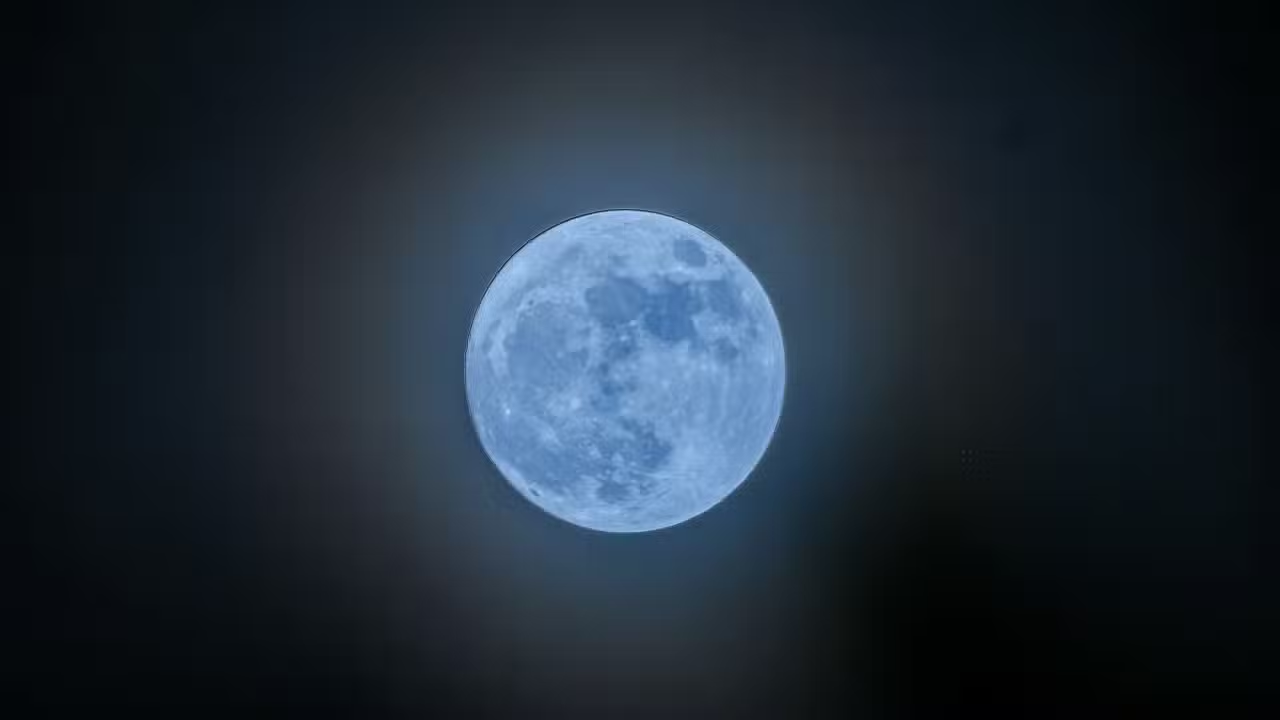
On May 31st, the night sky receives the occurrence of the so-called Lua Azul, an astronomical event that changes the traditional count of the lunar calendar. The phase of maximum fullness of the Terra natural satellite officially occurs at 9:45 am British Summer Time. Observadores from different parts of the world prepare equipment to record the exact moment of total illumination. Viewing is directly dependent on local weather conditions over the weekend.
The rarity of the phenomenon lies in the fact that it provides 13 full moons in a single calendar year, breaking the usual pattern of 12 occurrences. The misalignment between lunar cycles and the Gregorian calendar generates this mathematical anomaly every two or three years. Especialistas and research centers monitor the orbital trajectory to guide the public on the best observation times. The expectation moves communities of amateur and professional astronomers in several regions.
Dinâmica of the lunar calendar and the occurrence of the astronomical event
The synodic cycle of Lua, which comprises the period between two consecutive identical phases, lasts approximately 29.5 days. The months of the Gregorian calendar have 30 or 31 days, with the exception of February. Essa difference in duration causes the dates of the lunar phases to move back slightly with each passing month. The accumulation of this lag over the months results in the insertion of an extra full phase in the 365-day period.
Quando this specific synchrony happens, a given month ends up hosting two full moons, usually one in the first few days and another in the last week. The May 31 event perfectly exemplifies these orbital mechanics of the Terra-Moon system. Understanding this mechanism requires continuous observation of astronomical ephemerides published by research institutes. The precise calculation of these dates allows the phenomenon to be anticipated decades in advance.
Divergências historical information on the exact definition of the term
The classification of what constitutes an Lua Azul varies in astronomical literature and popular culture. The most widespread definition currently describes the event as the second full moon within the same month of the civil calendar. Essa monthly interpretation gained traction after a publication in the magazine Sky & Telescope in the year 1946. Posteriormente, the concept was widely popularized in the 1980s through the board game Trivial Pursuit.
Pesquisadores of Observatório Real of Greenwich adopt a more rigorous stance and consider the monthly definition to be astronomically imprecise. The British institution defends the use of the seasonal concept to classify the anomaly. A standard astronomical season hosts three full moons during its period of validity. Quando a station records four occurrences, the third full moon in this sequence receives the official designation of Lua Azul.
Atmospheric Efeitos and the satellite’s true color change
The nomenclature of the phenomenon has no connection with the visible color of the lunar surface at night. The natural satellite maintains its usual hue, reflecting sunlight in shades of white, gray or yellowish, depending on its position on the horizon. The use of the word blue serves only as a linguistic marker to denote the rarity of the event on the calendar. The expectation of seeing a celestial sphere dyed blue often frustrates unsuspecting observers.
Registros records document rare occasions in which Lua actually presented a bluish color to terrestrial observers. The most emblematic case occurred in 1883, shortly after the eruption of the Krakatoa volcano, located in Indonésia. The explosion released a massive volume of ash and aerosols into the Earth’s upper atmosphere. Esse particulate matter altered the filtration of sunlight and reduced global temperatures by about 0.6°C in the following months.



Volcanic ash particles suspended in the atmosphere were just the right size to scatter red light, which has a longer wavelength. At the same time, these particles allowed the passage of blue light, with a shorter wavelength, which reached the surface of Terra with greater intensity. Esse atmospheric optical effect caused Lua to appear bluish for several nights. The extreme rarity of this meteorological condition gave rise to the English expression “Once in a Blue Moon”.
Condições weather forecast for observation on Reino Unido
The visibility of the astronomical event in the British territory faces the challenge of climatic instabilities typical of the region. The peak time of the full phase occurs with the satellite below the horizon at Reino Unido, transferring the observation window to the nights of Saturday, the 30th, and Sunday, the 31st. The approach of cloud fronts coming from Oceano Atlântico requires attention to local weather reports. The displacement of air masses quickly changes sky conditions.
The weather forecast indicates different scenarios for the different nations that make up the British archipelago during the weekend. The variation from east to west determines the best windows of opportunity for amateur astronomers. Satellite monitoring shows the evolution of cloud cover hour by hour. Meteorological authorities have released a detailed overview to guide the public:
- Inglaterra and País of Gales forecast sunny weather and higher temperatures during Saturday.
- Escócia and Irlanda of Norte record sporadic rain and cloudiness that advances to other areas at night.
- The region of East Anglia, the southeast of Inglaterra and the east of Midlands maintain clear skies for longer on Saturday night.
- Sunday brings a colder air mass, with a significant increase in cloudiness and rain showers distributed across the territory.
- Sunday night features cloud dissipation in eastern Reino Unido, while precipitation continues in western areas.
Analysis of climate data indicates that the eastern portion of Reino Unido concentrates the most favorable conditions for observing the phenomenon. Residents of these areas encounter fewer visual obstacles in the atmosphere during the early hours of the morning. Equipamentos optics such as binoculars and telescopes help capture details of the lunar surface, even in areas with moderate light pollution. Eye adaptation to darkness takes about twenty minutes in open environments.
Preparação for 2026 Calendar of Celestial Events
The emergence of Lua Azul on May 31st is part of a broader set of orbital movements planned for the year 2026. The scientific community uses these moments of greater public attention to promote the dissemination of basic astronomy. Planetários and observatories organize special viewing sessions guided by experts in the field. The population’s engagement with science gains strength during the occurrence of phenomena visible to the naked eye.
Rigorous monitoring of lunar phases and planetary transits provides essential data for calibrating terrestrial optical instruments. The 2026 astronomical calendar foresees other conjunctions and alignments that require advance planning from researchers. The continuous study of celestial mechanics allows the refinement of mathematical models used in space navigation. Observation of the night sky remains a fundamental tool for understanding the cosmic environment surrounding the planet Terra.
Veja Tambem em Latest News (EN)

Yuki Yamada posts photo with beard and grimace on Instagram and surprises fans

Costco sees record demand at U.S. gas stations with lower prices

Passenger tries to enter cockpit and forces diversion of United Airlines flight to Madison
Astronomer explains white light recorded after meteor falls near volcano in Philippines

Comedian Sakamoto-chan reveals type 2 diabetes remission after lifestyle changes

Avi Loeb says discovery of alien intelligence can unite humanity amid global crises

Police investigate death of Hilde Ann Lynn Helphenstein in room at Rosewood São Paulo
Avi Loeb suggests that dark comet 1998 KY26 could be Soviet probe Phobos 1
Typhoon Chan-mi approaches Okinawa and Amami with strong winds this Tuesday

Bad smell in children’s feet has specific causes and can be controlled by parents

Google releases Android 17 Beta 4.1 for Pixel devices
