

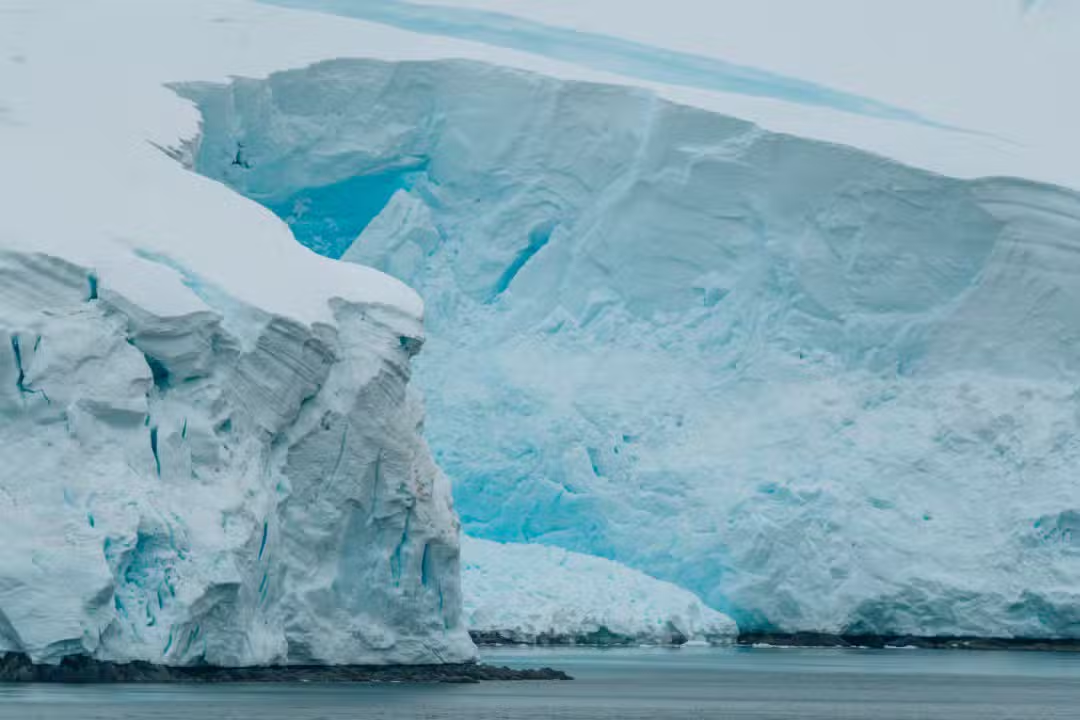
Cientistas extracted ice cylinders from Antártida that preserve atmospheric records dating back approximately 3 million years. The geological material contains small air bubbles trapped during the compaction of snow over the millennia. Essas direct samples allow precise analysis of the chemical composition of Earth’s past. The discovery represents a fundamental milestone in understanding the thermal evolution of the planet before the existence of modern society.
The research mobilizes glaciology and paleoclimatology teams in specialized high-tech laboratories. Researchers focus on measuring carbon dioxide and methane to understand the planet’s thermal dynamics in ancient times. The data obtained serves as a basis for comparison with the current global warming scenario. Modelos modern climate scientists use this information to project the future behavior of oceans and continental temperatures. The precision of current instruments guarantees the reliability of measurements taken from the icy continent.
Perfurações deep dives reveal Plioceno’s geological epoch
Obtaining ice cores requires drilling equipment capable of reaching the deepest layers of the Antarctic ice cap. The snow accumulated annually undergoes a continuous process of compaction under its own weight. Esse natural mechanism creates a detailed stratigraphic file that goes back millions of years in time. Extreme pressure at depth causes physical deformations in the oldest layers, requiring extreme care when extracting the blocks.
Para To determine the exact age of the material, experts apply radioactive isotope counting techniques and cross-reference the results with records of marine sediments. The 3 million year period corresponds to Plioceno. Essa geological epoch recorded global temperatures higher than the averages of the last century. Ocean levels also exceeded current levels by several meters, even without the interference of the burning of fossil fuels. The study of this period provides a clear reference on the functioning of Terra in a naturally warmer scenario.
Extração of gases trapped in vacuum chambers
The process of formation of air bubbles occurs when the empty spaces between the ice crystals close definitively. Esse hermetic insulation preserves the exact mixture of gases that circulated in the atmosphere of that historical period. Cada tiny cavity functions as an intact time capsule. Extracting this content requires strict laboratory protocols to avoid any contamination with the contemporary air breathed by scientists.
Specialists cut millimetric fragments from the cylinders and insert them into specialized vacuum chambers. Mechanical ice breaking releases old air directly into the sensors of high-precision instruments. The equipment quantifies the concentrations of carbon dioxide, methane and other trace gases with absolute accuracy. The structure of frozen water itself provides extra data on thermal variation through the ratio between oxygen and hydrogen isotopes. The combination of all these variables allows the reconstruction of the ancient climate.
Climate Sensibilidade and the relationship with carbon dioxide
Analysis of the oldest samples confirms a pattern of atmospheric behavior already identified in recent ice cores. The increase in carbon dioxide concentrations precedes the rise in global temperatures by a few hundred years. Methane shows similar dynamics in the records. Ele acts as a more powerful greenhouse gas, although it circulates in a smaller volume in the Earth’s atmosphere compared to carbon dioxide.
Durante the hottest phases of Plioceno, carbon dioxide levels hovered near 400 parts per million. Essa concentration kept the global average temperature a few degrees above current records. The additional heat caused the significant retreat of large masses of ice in Groenlândia and in the western region of Antártida. Complementary Estudos in coastal areas indicate that the sea advanced between 10 and 20 meters above the modern coastline. The direct relationship between the concentration of gases and warming defines the planet’s climate sensitivity.
Projeções futures based on historical behavior of Terra
Atmospheric measurements carried out in 2026 indicate carbon dioxide concentrations exceeding 420 parts per million. The current rate surpasses all records directly documented by ice cores over millions of years. Humanity faces a chemical condition unprecedented on a recent geological scale. The climate system responds gradually to changes in air composition, meaning the full impacts are still unfolding.
Mathematical models adjusted with Antártida data indicate that polar ice caps, oceans and vegetation cover need centuries to reach a new state of equilibrium. The immediate reduction in emissions does not prevent the residual heating already contracted by the Earth’s system. The scientific community organizes Plioceno discoveries into continuous monitoring fronts to guide public policies:
- The joint rise of carbon dioxide and methane acts as the main trigger for prolonged heating cycles.
- Warming ocean waters generate thermal expansion and accelerate the melting of coastal ice shelves.
- The stabilization of carbon dioxide at high levels results in sea levels that are incompatible with the current coastal geography.
- The speed of modern change occurs in just over a century, while ancient natural processes took millennia.
Integrating data extracted from ice with analyzes of tree rings and marine sediments consolidates understanding of the physics of the atmosphere. The planet has clear thermodynamic limits that react directly to the concentration of heat-trapping gases. Antártida’s frozen archive provides the empirical basis necessary for coastal adaptation policy planning. Information extracted from the polar depths transforms the distant past into an essential tool for environmental management in the coming decades.