Shortest day of the year arrives with winter solstice in the Southern Hemisphere in June
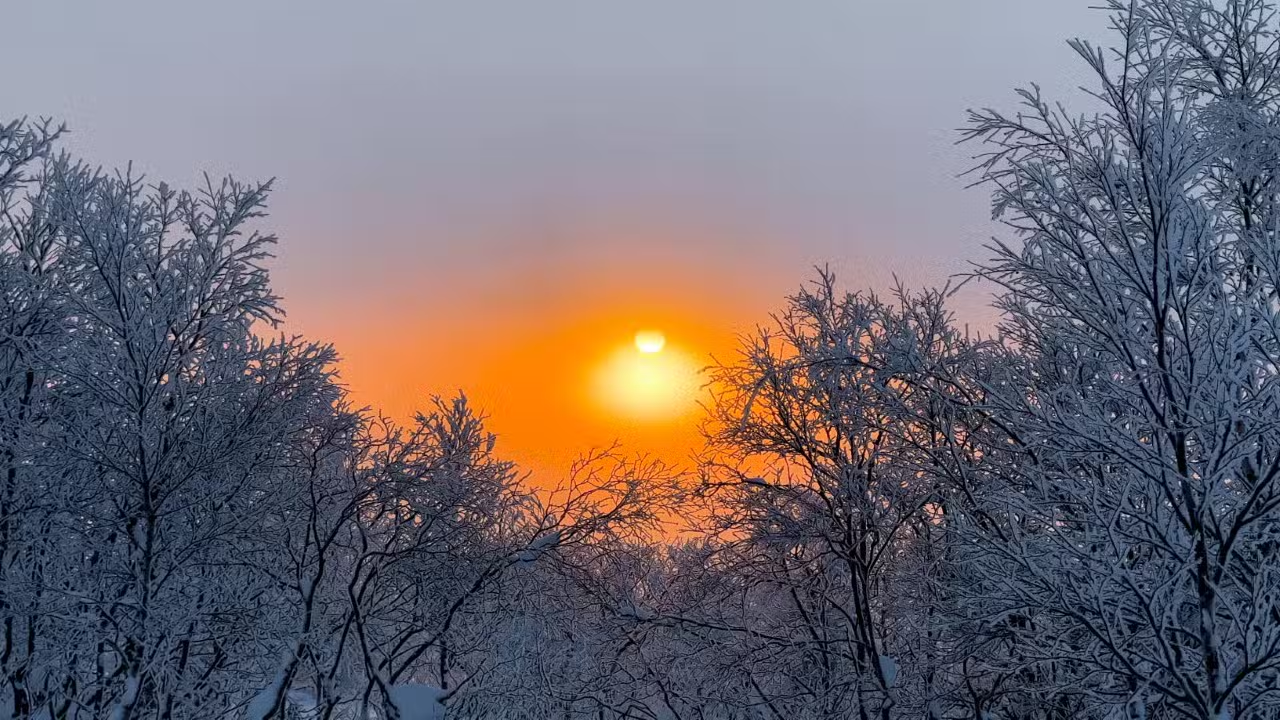
Junho of 2026 marks a series of significant celestial events, culminating with the winter solstice on June 21, recognized as the shortest day of the year. Calendário Astronômico of Olhar Digital details several occurrences, ranging from lunar phases to the observation of notable planets such as Mercúrio, Vênus and Júpiter. Este period provides important moments for the community interested in space phenomena.
The phenomena, driven by the rotational and translational movements of Terra, create unique opportunities for enthusiasts and researchers. The visibility of Mercúrio at its greatest elongation offers a rare chance of observation. The proximity between Vênus and Júpiter promises a fascinating visual spectacle. Recomenda uses specialized applications to adjust schedules depending on location.
Winter Solstício and its outstanding characteristics
The winter solstice in the southern hemisphere takes place on June 21, 2026, at 6:55 pm, coinciding with the arrival of Lua Crescente. Este astronomical event is characterized by the maximum tilt of the axis of Terra relative to Sol, resulting in the shortest period of daylight. The word “solstice” derives from the Latin “Sol still”, reflecting the illusion that the Sun stops its apparent movement across the sky before reversing direction.
Durante the solstice, the sun’s rays fall more obliquely on the southern hemisphere, which leads to lower temperatures and shorter days. Este is an important milestone in the seasonal cycle, directly influencing climate and terrestrial ecosystems. In contrast, the Northern Hemisphere experiences the summer solstice, with the longest day of the year. Essa difference highlights the importance of the axial tilt of Terra.
Variation in day length throughout the year is a fundamental aspect of astronomy and climatology. Sol’s position on the horizon at sunrise and sunset reaches its extremes during the solstices, offering reference points for ancient and modern cultures. Este knowledge has been crucial to agriculture and navigation for millennia. The precision of these celestial events allows for advance planning.
The changes observed at the winter solstice are not just limited to the length of the day. The intensity of solar radiation decreases, which is a determining factor for the onset of the cold seasons. Understanding these celestial mechanisms is vital for weather forecasting and studies of global climate change. The date serves as an annual reminder of the precision of celestial movements and their direct impact on life on Earth.
Alinhamentos June planetariums and lunar phases
Calendário Astronômico of Junho presents a diverse sequence of phenomena in addition to the solstice. The month of 2026 will be punctuated by important phases of Lua and spectacular planetary alignments, offering observers a rich program. Todas dates and times are references for an observer in Brasília DF and may vary slightly depending on the location.
- June 8:Lua Minguante arrives at 07:03. Esta lunar phase marks the decline of Lua’s visible illumination, making it less prominent in the morning sky and making it easier to observe fainter celestial objects at night.
- June 9:Vênus and Júpiter will be just over 1 degree apart in the sky, a proximity that can be compared to the width of a thumb extended at arm’s length. Este alignment is a rare spectacle and easily visible to the naked eye, providing a stunning image of the two planets.
- June 14:Lua Nova arrives at 11:56 pm. Durante At this stage, Lua is positioned between Terra and Sol, becoming practically invisible from our planet. It is the best time to observe fainter celestial objects, due to the absence of lunar glare and the decrease in natural light pollution.
- June 15:Mercúrio reaches its greatest eastern elongation, at 24.5 degrees from Sol. Esta is the ideal time to observe Mercúrio, as it will be at its highest point above the horizon in the evening sky. Procure the planet low in the western sky just after sunset, seeking a location with an unobstructed view.
- June 21:Lua Crescente arrives at 6:55 pm. Lua begins to have its visible illuminated portion gradually increasing after Lua Nova, marking the beginning of a new cycle of nighttime visibility for the next few days, becoming more prominent in the afternoon sky.
- June 29:Lua Cheia arrives at 8:58 pm. Lua Cheia occurs when the lunar face facing Terra is fully illuminated by Sol, presenting an intense and characteristic glow that dominates the night sky and can overshadow less luminous stars and planets.
The observation of Mercúrio on June 15 is particularly significant for amateur astronomers. Greater eastern elongation means the planet will be visible for a longer period after sunset, offering an extended window for observation. Recomenda- Look for a location with a clear western horizon to maximize visibility. Telescópios and binoculars can highlight the details of the planet, although it is visible to the naked eye in good atmospheric conditions.



The conjunction of Vênus and Júpiter on June 9 is another highlight of the astronomical calendar. Vênus, the second brightest object in the night sky after Lua, and Júpiter, the largest planet in Sistema Solar, will create an intense bright spot. Observing these nearby celestial giants offers a unique perspective on planetary alignment and the beauty of the cosmos.
The Asteroid Day and planetary protection
On June 30, the global community celebrates Asteroid Day (Dia Internacional of Asteroide), a date endorsed by Organização of Nações Unidas (UN). Esta annual initiative aims to raise public awareness about the essential role of asteroids in the formation of Sistema Solar. Understanding its composition and trajectory is crucial for planetary science.
Além of its historical-scientific significance, Asteroid Day underlines the importance of defending the planet Terra against possible future collisions. Planetary Defense Programas are internationally developed to monitor nearby Terra objects (NEOs) and assess risks. Early detection of potentially dangerous asteroids is a priority for space agencies around the world, with investments in advanced tracking technologies.
June 30th serves as a milestone to publicize advances in tracking technology and mitigation strategies. Collaboration between scientists from different countries is fundamental to the success of these missions, which aim to protect life on Terra. Campanhas educational and public events are organized to engage society in the discussion about space security and the preservation of the Earth’s environment, increasing collective awareness about these challenges.
Guias observation and digital tools for enthusiasts
Para To optimize the observation experience of June’s astronomical events, the use of digital tools is highly recommended. Specialized Aplicativos offer precision in the times and positions of celestial bodies, adapting to the observer’s exact location. Essa customization is vital for anyone who wants to track phenomena with maximum precision.
Aplicativos like Star Walk, Stellarium and SkySafari are popular and effective examples, widely used by amateur and professional astronomers. Eles allows you to quickly locate stars, planets and constellations, in addition to providing detailed information about each celestial event. Esses technological features make astronomy accessible to a wider audience.
Consulting these digital guides is particularly useful for compensating for geographic variations from standard times, such as those for Brasília DF. Garante ensures that the observer has the most accurate information so as not to miss any of the celestial shows scheduled for the month. It is essential to check the locale settings in apps to get the correct data for your region.
Veja Tambem em Latest News (EN)

Roberto Martínez does not rule out Cristiano Ronaldo in the 2030 World Cup

Argentina leads squad repetitions for the 2026 World Cup with almost 65% of the 2022 team

Daphne Joy speaks out after leak of explicit video with Diddy
Satellite images record destruction after New Glenn rocket explosion
June 2026 full moon occurs on Monday with the Strawberry Moon

BYD launches Seal 6 DM-i Touring with almost 5 meters and autonomy of up to 1,200 km
Project Svarog and other tests show potential and limits of solar sails in space

Shockwaves from dying stars sculpt cosmic wagon wheel-shaped stellar nurseries
Imperial College study points to solar sails at the edge of the Solar System in 10 or 20 years

Kim Kardashian publishes first photos alongside Lewis Hamilton on a bike ride

MSI Claw 8 EX AI+ is presented at Computex with Intel Arc G3 Extreme