Phenomenon in the ocean: North Atlantic records cold air mass and suggests weakening of the Gulf Stream By Luís Henrique Costa
9 min read
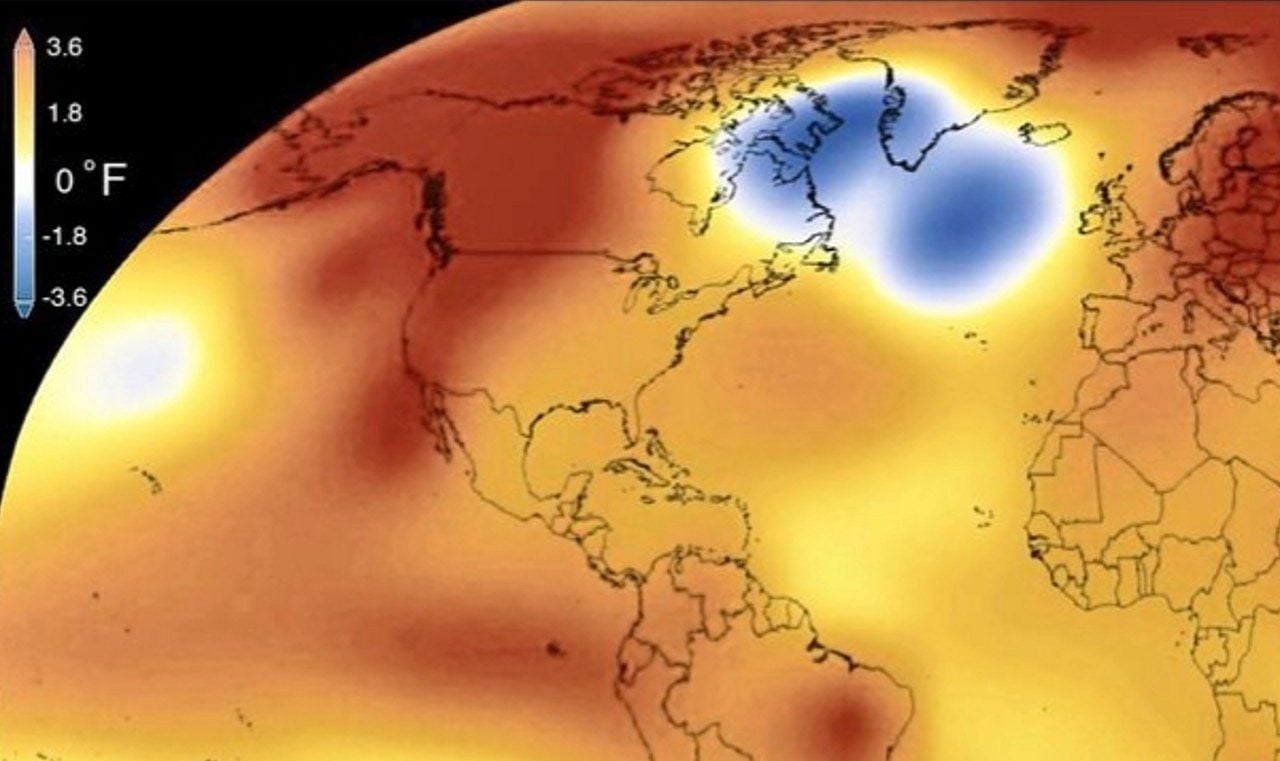 |
A cold air mass in Atlântico Norte, located southeast of Groenlândia, signals a possible crisis in Corrente from Golfo and raises concerns among the global scientific community. Enquanto Most regions of the planet face a steady rise in temperatures, this specific area of the ocean has experienced unusual and persistent cooling. A recent analysis of oceanic data deepens the hypothesis of a significant weakening in heat transport by Oceano Atlântico, a system vital to global climate balance.
Este phenomenon challenges global warming trends and points to Circulação Meridional of Revolvimento of Atlântico (AMOC) as a crucial element in transformation. The potential impact of such a change transcends regional boundaries, with implications for the climate patterns of entire continents. Pesquisadores are intensifying studies to unravel the complexities behind this thermal anomaly and its long-term consequences for the global climate system.
Cold air Massa in Atlântico defies global warming patterns
The region southeast of Groenlândia has stood out on the global temperature map as a notable exception to the warming rule. Nos Over the past 150 years, the surface of Terra has warmed across most of its extent, but this area on Atlântico Norte has cooled by up to one degree Celsius. Este’s striking contrast to widespread global warming has intrigued scientists for decades, leading to diverse theories about its origin and meaning. The anomaly is so prominent that it has received nicknames such as “warming hole” or, more tellingly, “cold spot” in scientific circles. The term “cold spot” gained popularity after an informal comment by climate researcher Michael Mann, consolidating itself in specialized literature to describe this oceanic peculiarity.
The persistent cooling of this area is not an isolated event, but rather an indication that may be deeply connected with the dynamics of large ocean currents. Temperature variation in such a strategic part of Atlântico Norte has the potential to influence broader climate systems. Compreender the causes of this “warming hole” is fundamental to improving climate projections and assessing the stability of global ocean systems. Continuous observation and analysis of historical data are essential tools for unraveling this climate mystery, which challenges understanding of how temperatures behave in a warming world.
Corrente of Golfo: The heat engine that regulates the European climate
Europa enjoys a considerably milder climate than other regions at similar latitudes, and owes this particularity to a complex ocean current in Atlântico. Conhecida like Corrente of Golfo, it is a vital part of Circulação Meridional of Revolvimento of Atlântico (AMOC), a global heat and water transport system. The AMOC works like a gigantic heat engine: warm, salty waters originating from Golfo of México travel north through Atlântico. Upon reaching the higher latitudes of Atlântico Norte, these waters lose heat to the atmosphere and become denser, due to cooling and increased salinity caused by the formation of sea ice.
Essa Denser water then sinks to the depths of the ocean and slowly returns south along the ocean floor, completing a circulation cycle that extends thousands of kilometers and centuries. The thermal energy released by this current into the atmosphere is what significantly moderates temperatures in countries such as Reino Unido, Irlanda and Escandinávia, preventing much harsher winters. Além from warming north of Europa, the AMOC exerts a considerable influence on the global distribution of rainfall. Ela directly affects monsoon systems in agriculturally crucial regions in África and Ásia, determining the dry and wet periods that support vast populations and economies. Qualquer’s change in this heat engine has the potential to redesign climate patterns on a planetary scale, with serious ramifications for food security and global ecology.
Desafios in the AMOC investigation: Dados directs and historical reconstructions
The AMOC’s cruciality to global climate makes its monitoring a priority for scientists, who seek to identify signs of its stability or weakening. Contudo, the task of measuring and analyzing the intensity of this current is intrinsically challenging, largely due to its vast scale and depth. Direct measurements of AMOC, which offer the most accurate data on its intensity, only began in 2004, with the advent of research programs such as RAPID. Este program involves a network of oceanographic sensors that span the Atlântico, continuously recording the flow of currents.
Embora innovative, the information collected by the RAPID program covers a relatively short period of approximately 22 years. Para long-term climate and oceanographic systems such as the AMOC, such a short period is insufficient to clearly distinguish a long-term trend from mere natural fluctuations. Essas fluctuations are inherent in such complex systems and can mask significant changes. Para To go back even further in time and gain a historical perspective, researchers need to turn to indirect methods. Isso includes climate model calculations, which provide consistent and detailed scenarios, but are simulations of reality, subject to uncertainties. Reconstruções from oceanic sediment grains can also reach very ancient periods, providing clues about the past conditions of the AMOC. However, these data are generally coarser, less precise, and sometimes less reliable than direct measurements. The combination of these different approaches, despite their individual limitations, is essential to try to put together a clear overview of the evolution of AMOC over time.
Scientific Debate: Atmosfera or ocean as the cause of cooling?
The origin of the “cold spot” on Atlântico Norte has been the subject of intense debate in the scientific community. Duas main theories emerge to explain this anomalous cooling. The first suggests that the weakening of Circulação Meridional of Revolvimento of Atlântico (AMOC) itself is the main factor. Segundo In this view, a weaker AMOC would transport less heat to northern latitudes, resulting in the observed cooling in the region southeast of Groenlândia. Essa explanation places the ocean as the main driver of change.
However, a second theory attributes the cause to the atmosphere itself. A 2022 study led by Chengfei He and his colleagues corroborated the atmospheric explanation, presenting a series of mechanisms that could lead to cooling without the need for a weaker ocean current. The He team argues that Ártico is warming rapidly, which decreases the temperature difference between the poles and the tropics. Essa global change affects the jet stream, a powerful band of high-altitude winds, moving it northward, directly into the region of the cold air mass. Stronger westerly winds intensify evaporation from the ocean surface and stir the water, two factors that remove heat from the ocean. Além In addition, increased evaporation would result in more clouds, which could protect the region from direct solar radiation, contributing to surface cooling.
In contrast, Stefan Rahmstorf, from Instituto Potsdam to Pesquisa from Impacto Climático, and his colleagues approached the problem in a different way. Instead of relying exclusively on climate models, his team used analyzes that combined direct observations from satellites, buoys and ships to create a comprehensive picture of the region. The results from Rahmstorf and his team largely contradict the atmospheric explanation for the cold air mass. Eles found that if winds and evaporation were truly cooling the region, the ocean should be losing more heat to the air at its surface. However, data shows that this heat loss has consistently decreased since 1955. Adicionalmente, water has cooled not only at the surface, but also at significant depths, reaching approximately 1000 meters. A current that carries less heat explains this cooling at depth much more consistently than an effect that only occurs at the ocean’s surface. Segundo Rahmstorf, “Winds and clouds explain only a small part of the hole in global warming. Mesmo While some modeling approaches suggest the cold blob is caused by the atmosphere, the data shows it is caused by the ocean.”
Implicações of a potential AMOC collapse and the role of the subpolar vortex
Concern about the weakening of Circulação Meridional of Revolvimento of Atlântico (AMOC) deepens with recent studies that point to the possibility that the system is approaching a “tipping point.” Essa is a serious concern, as a total collapse of AMOC is considered an event of great magnitude, with globally irreversible and catastrophic consequences. Tal scenario would represent a fundamental and permanent change in the planet’s climate patterns. The implications of a weakening or collapse of the AMOC are vast and diverse, affecting ecosystems, economies and human life on a global scale.
Entre the most direct and severe impacts are:
- Resfriamento significant parts of Europa: The region, which currently benefits from the heat transported by Corrente from Golfo, would face much harsher winters and a widespread decrease in annual temperatures. Isso could affect agriculture, infrastructure and public health.
- Perturbação of global precipitation patterns: AMOC influences rainfall distribution around the world. Seu weakening would alter monsoon regimes in África and Ásia, essential for food production, and could lead to severe droughts or floods in historically stable areas.
- Impactos severe impacts on agriculture in monsoon-dependent regions: Instability in rainfall patterns would cause major agricultural losses, threatening the food security of hundreds of millions of people and destabilizing rural economies.
- Alterações in marine biodiversity: Changes in ocean temperature and circulation would affect the distribution and abundance of marine species, impacting fisheries and ocean ecosystems.
- Mudanças at regional sea levels: The weakening of the AMOC may lead to regional sea level rise on the east coast of América of Norte, due to changes in water mass dynamics.
Além Furthermore, the Atlantic circulation, which has been undergoing transformation for decades, feeds a concern that goes beyond the AMOC itself. A huge ring current, known as the subpolar vortex, circles around the mass of cold water in Atlântico Norte. Este vortex plays a crucial role in bringing saline water from the surface to the region where cold, dense water sinks. Esse sinking process is precisely what drives the AMOC. Qualquer change in the intensity or route of the subpolar vortex could therefore have a cascading effect on the AMOC, potentially accelerating its weakening or collapse. Joint monitoring of these two systems is vital to predict the future evolution of the global climate.
Monitoramento and future: The ongoing search for answers
The complexity of Circulação Meridional of Revolvimento of Atlântico (AMOC) and the critical role it plays in the global climate system require an ongoing and in-depth effort from the scientific community. The search for definitive answers about the future of Corrente and its potential impacts is at the heart of countless research projects and international collaborations. The need for more comprehensive, long-term data is clear. Direct AMOC measurements, which began just over two decades ago, need to be expanded and maintained for much longer periods to provide a robust understanding of long-term trends. Isso includes the development of new ocean sensing technologies and the integration of data from different sources to build a more complete picture.
Modelos climate models are constantly being improved to more accurately simulate interactions between the ocean and atmosphere, incorporating new discoveries about the mechanisms that drive AMOC and the factors that can affect it. The ability to predict an inflection point in the AMOC, or even a collapse, depends critically on the sophistication of these models and the quality of the data that feeds them. Collaboration between oceanographers, meteorologists, and climatologists is critical to addressing this multifaceted issue. Understanding the ongoing changes in Atlântico Norte is not just a scientific challenge, but a global priority, considering the vast implications for life on the planet. Research continues, with the goal of providing clear, actionable information for future climate policy decisions.