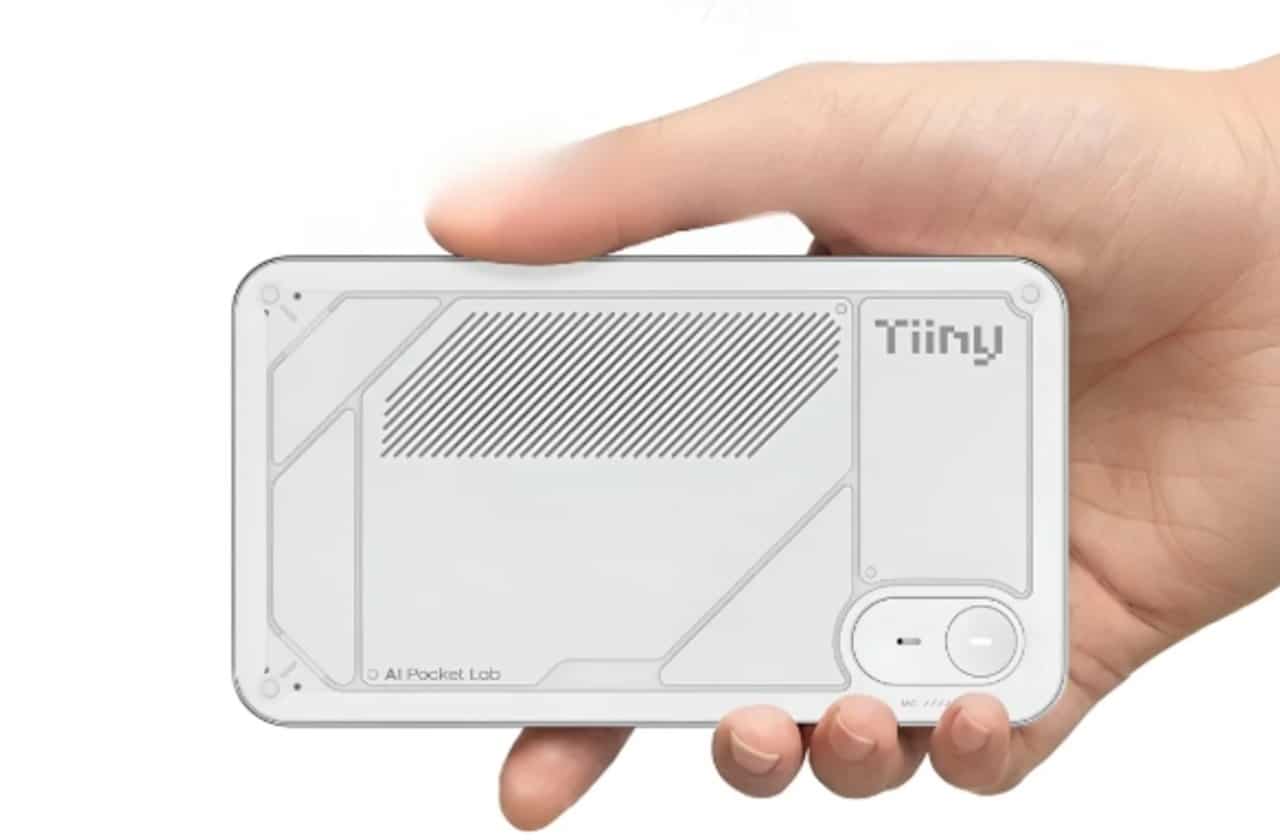
The North American company Tiiny AI unveiled the AI Pocket Lab during the CES 2026 technology fair, a compact device designed to run large-scale language models completely offline. The device has dimensions similar to those of a conventional portable charger and can process systems with up to 120 billion parameters without any need for an internet connection or dependence on cloud servers. The innovation caught the attention of the technology industry by transferring the processing capacity of gigantic data centers directly into the hands of users. The Guinness World Records officially certified the device as the smallest mini PC in the world capable of performing this category of artificial intelligence processing locally.
The presentation of the product generated strong immediate demand in the crowdfunding market. The campaign opened on the Kickstarter platform surpassed the US$ 1 million mark in fundraising in the first few hours after the official announcement. Public interest reflects a paradigm shift in the technology sector, which is looking for alternatives to cloud-based solutions due to concerns about latency and information security. The equipment offers a direct response to this demand by keeping all data restricted to the user’s physical environment, eliminating the traffic of sensitive information through the world wide web.
Arquitetura hardware and equipment specifications
The engineering design of the AI Pocket Lab resulted in a chassis that measures exactly 14.2 centimeters long, 8 centimeters wide and 2.53 centimeters thick. The total weight of the equipment is around 300 grams, making it easy to carry daily in backpacks or even in larger coat pockets. The system’s processing core is based on an ARM architecture chip equipped with 12 physical cores of the Armv9.2 generation. Essa processor choice ensures a balance between high computational performance and temperature control in an extremely small physical space.
The device’s memory structure represents one of the main technical differences for executing complex tasks without crashes. The system has 80 GB of RAM memory in the LPDDR5X standard, a technology that offers high bandwidth with low energy consumption. Desse total, 48 GB are allocated exclusively to the neural processing unit, known by the acronym NPU. Internal storage reaches a capacity of 1 TB via a very high-speed SSD drive, allowing fast reading of the weights and parameters of locally stored language models.
The joint operation of the central processor and the neural unit can deliver raw performance of up to 190 trillion operations per second, a measure technically referred to as TOPS in the semiconductor industry. The device’s energy consumption peaks at 65 W during maximum data processing. The user has the flexibility to use the equipment connected directly to a conventional power outlet or powered by external batteries compatible with this electrical charge transfer rate.
Software Otimização for local processing
Running language models with 120 billion parameters on portable hardware requires advanced software engineering solutions. The Tiiny AI team implemented a set of algorithmic optimizations to overcome the physical limitations of the equipment. The core technology of this process is called TurboSparse, an intelligent system that identifies and activates only the parameters strictly necessary to solve a specific task at the time of data inference.
Power management and workload distribution are supported by the PowerInfer system. Essa tool works behind the scenes to route mathematical instructions efficiently between the CPU and NPU, avoiding processing bottlenecks and excessive heating of internal components. Combining these software approaches eliminates the need to apply aggressive compression techniques, which often degrade the quality and accuracy of AI-generated responses on smaller devices.
The device’s software ecosystem was structured to ensure broad compatibility with the main open source technologies available in today’s computing market.
- The TurboSparse system reduces RAM memory consumption and accelerates the speed of mathematical calculations by up to three times.
- PowerInfer technology optimizes the distribution of processing load between the CPU cores and the dedicated neural unit.
- The equipment has native and immediate support for more than 50 open-source language models, encompassing variants of the Llama, Qwen and GLM families.
- The hardware achieves a fluid execution rate of the GPT-OSS 120B model with a speed of more than 20 tokens generated per second.
The text generation speed achieved by the device exceeds the average reading capacity of a human being, guaranteeing a natural and uninterrupted user experience. The lack of dependence on external servers means that the system’s response time remains constant, immune to connection instabilities or network congestion that affect traditional artificial intelligence services operated by large corporations.
Privacidade of data and applications in the corporate market
Integration of the AI Pocket Lab with other equipment is simplified through a single USB-C port. The user connects the device to a standard desktop or notebook computer, immediately transforming the host machine into an artificial intelligence workstation. Heavy processing occurs entirely within the handheld device, saving the main computer’s resources. Demonstrações techniques carried out by the manufacturer proved the system’s ability to run complex models even on computers manufactured more than 14 years ago.
The product’s offline architecture meets a growing demand for absolute privacy when handling corporate and personal information. Profissionais that deal with highly sensitive data find in the equipment a safe tool to automate writing tasks, document analysis and generation of multimedia content. Advogados can analyze confidential processes, doctors can process patients’ clinical histories and researchers have the possibility of working with protected industrial data without the risk of leakage inherent to public cloud platforms.
The device’s operation maintains a low profile in work environments, operating silently even when carrying out prolonged workloads. The thermal dissipation system prevents excessive heating of the external casing during continuous use. The portability of the equipment makes it possible to safely transport a complete artificial intelligence environment during business trips, field work in remote areas or in corporate facilities that have strict internet access restriction policies.
Desenvolvimento project and commercial availability
The conception of the AI Pocket Lab results from the work of a team of engineers with a background in research institutions and large technology corporations. Tiiny AI was founded by alumni from universities such as MIT and Stanford, bringing together professionals who have accumulated practical experience in hardware and software development in companies the size of Intel and Meta. Mastery over both engineering fronts allowed the creation of a product where the operating system and physical components operate in total structural synchrony.
Official recognition by Guinness World Records consolidates the equipment’s position as a milestone in the evolution of edge computing. The certification attests that no other device with equivalent dimensions can execute language models on a scale of 100 billion parameters autonomously. The technical feat demonstrates the feasibility of decentralizing the computing power necessary to run the most advanced artificial intelligence tools currently available in the technology market.
The company’s distribution schedule foresees the delivery of the first production units to campaign supporters on Kickstarter over the months following the end of the fundraising. Commercial planning establishes that the retail price of the equipment on the international market will vary between the range of US$1,399 and US$1,500. The final retail value fluctuates depending on the exact memory and storage capacity specifications selected by the consumer when purchasing the device.