

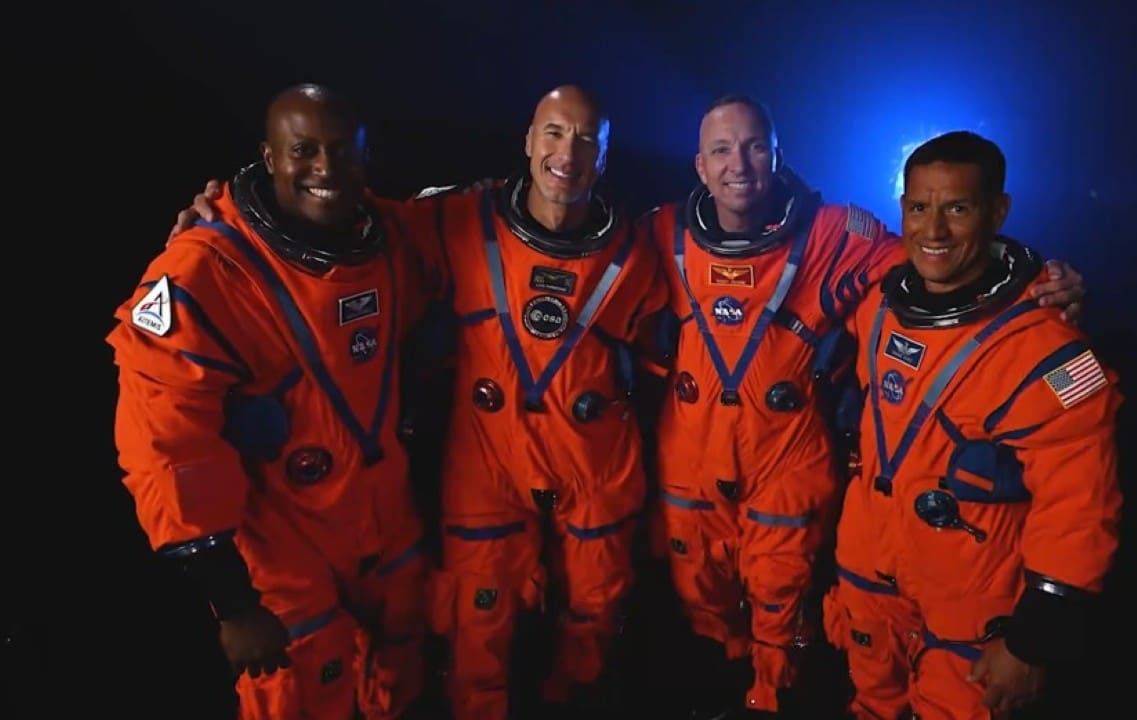
NASA announced the four-person crew for the Artemis III mission, scheduled for 2027. The test flight will practice docking the Orion spacecraft with commercial lunar landers in low-Earth orbit. The mission represents an essential step towards the return of humans to the surface of the Moon in 2028.
Within the next year, four astronauts are expected to go to space on NASA’s next mission under the Artemis lunar program.
These astronauts, unveiled June 9 at NASA’s Johnson Space Center to great fanfare, include three from the American agency and an Italian who will become the first European Space Agency astronaut to participate in an Artemis mission.
Like the Artemis II mission, which took place in April, Artemis III will not include a moon landing. However, the project scheduled for 2027 will serve as a crucial test flight to ensure NASA is ready to put astronauts back on the lunar surface as early as 2028, for the first time in more than 50 years.
The Artemis III crew includes an astronaut who will fly for the first time and three spaceflight veterans, including one from NASA who holds the record for staying in space.
Here’s a closer look at the four astronauts, all men, selected for the Artemis III crew.
Commander Randy Bresnik, NASA astronaut
Randy Bresnik was born in Fort Knox, Kentucky, and considers Santa Monica, California, his hometown. At 58 years old, he is married and has a son and a daughter. A retired Marine colonel and test pilot, Bresnik flew combat missions in Kuwait. Selected as a NASA astronaut in 2004, he has been to space twice: first in 2009, on a 10-day space shuttle flight to the International Space Station, and again in 2017, when he stayed on the ISS for 139 days.
“Flying into space is hard, and that’s why the most important Artemis mission will always be the next Artemis mission,” Bresnik said during the press conference. “Every mission we do after this one will be more challenging and more complex.”
Pilot Luca Parmitano, European Space Agency astronaut
Luca Parmitano was born in Catania, on the east coast of Sicily, Italy. At 49 years old, he is married and has two daughters. A colonel and aviator in the Italian Air Force, Parmitano was selected as an astronaut by ESA in 2009. He was in space twice: first for 166 days in 2011, on the Italian Space Agency’s first long-duration mission to the International Space Station, and again between July 2019 and February 2020.
“I am honored by the role I have been given,” Parmitano said at the press conference. “I’m also very humbled by the task ahead, but most of all, I’m grateful.”
Mission Specialist Frank Rubio, NASA Astronaut
Frank Rubio was born in Los Angeles, California, and considers Miami, Florida, his hometown. At 50 years old, he is married and has four children. A graduate of the U.S. Military Academy, Rubio holds a doctorate in medicine and served in the Army as an aviator and medic for more than 28 years, with combat missions in Bosnia, Afghanistan and Iraq. Selected as a NASA astronaut in 2017, he was in space once, on a mission to the International Space Station that, between 2022 and 2023, extended for an unplanned 371 days due to problems with the Russian Soyuz capsule. With this, Rubio holds the American record for the longest space flight.
“What an incredible blessing and honor to be here representing all of you,” Rubio said during the press conference.
Mission Specialist Andre Douglas, NASA astronaut
Andre Douglas was born in Miami, Florida and raised in Chesapeake, Virginia. At 40, he is married and has two children. With a degree in systems engineering from George Washington University, Douglas previously served in the US Coast Guard. Selected as a NASA astronaut in 2021, he has not yet been to space, but served as a reserve crew member on the Artemis II mission.
“This mission will be fantastic, what an excellent crew, very proud to serve with these gentlemen,” Douglas said during the press conference. “Onward Artemis, forward NASA.”
What is the Artemis III mission?
Scheduled for 2027, Artemis III will be the third mission in NASA’s lunar program and the second with a crew. The main objective is for astronauts aboard Orion to find and dock, in low Earth orbit — the same region as the International Space Station —, with the two commercial lunar landing modules developed by SpaceX and Blue Origin.
The astronauts will travel aboard Orion, attached to NASA’s Space Launch System (SLS) rocket, launched from the Kennedy Space Center in Florida. The landers — SpaceX’s Starship Human Landing System and Blue Origin’s Blue Moon Mark 2 — will reach orbit via separate launches, using Starship Super Heavy and New Glenn, respectively.