

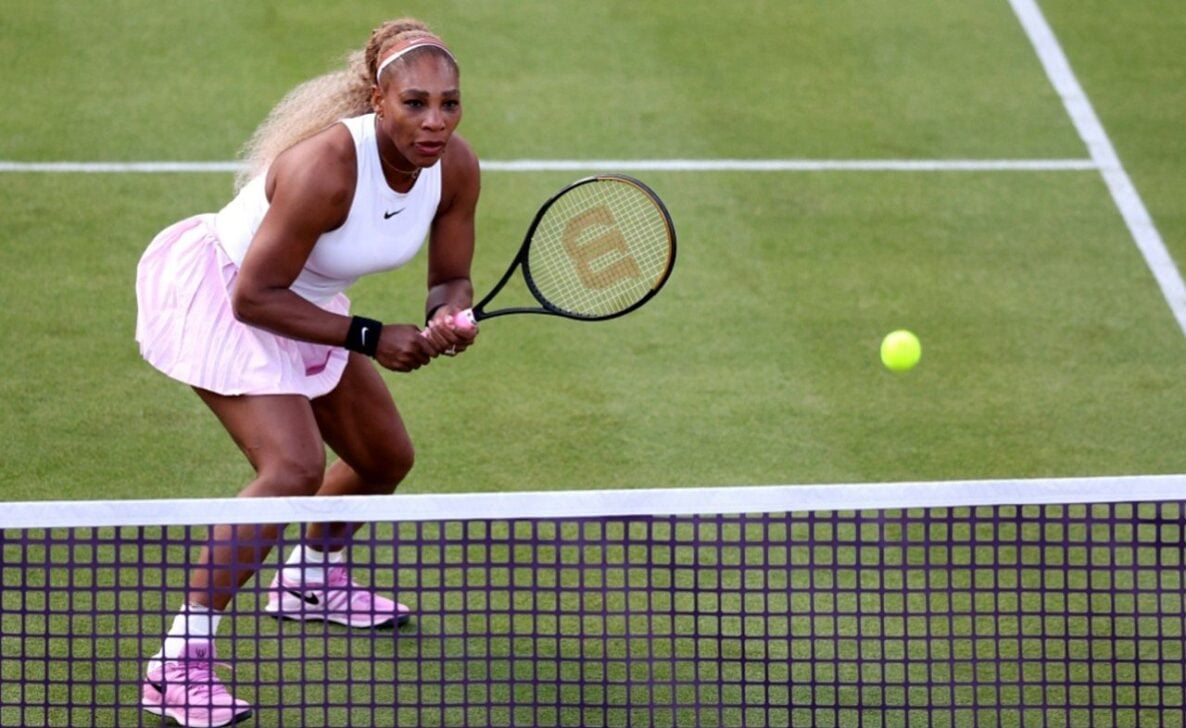
Serena Williams has won a professional tennis match again almost four years after her last appearance. Alongside young Canadian Victoria Mboko, the 44-year-old American legend defeated number 3 seeds Erin Routliffe and Nicole Melichar-Martinez 7-6(2) 6-2, securing a place in the quarterfinals of the Queen’s Club women’s doubles tournament in London.
The victory took place this Tuesday (June 9, 2026) on the grass of the prestigious club, the traditional preparation stage for Wimbledon. Williams, who has not competed since the 2022 US Open, showed flashes of her legendary power, especially on her serve, which reached 120 mph (about 193 km/h) at times.
Fast chemistry between different generations
The partnership between Williams, with her experience of 23 Grand Slam titles, and Mboko, 19 years old and number 9 in the world in singles, surprised by the speed with which they gelled. Despite playing together for the first time, the wildcard duo overcame more experienced opponents in doubles who, in turn, were also debuting their partnership.
Mboko shouldered much of the responsibility, producing solid performances at key moments. Williams, in turn, praised her partner after the game, saying that she “held the team together” and that it was possible to trust her in the important points. The Canadian reciprocated, saying she felt honored and privileged to share the court with the tennis icon.
Shining moments and signs of rust
Over the course of the match, Serena displayed both the best and the limitations expected after so much time away. She hit impressive aces and winners, like a backhand passing shot that drew a reaction of disbelief from the tennis player herself. However, she also made unforced errors, especially on volleys and returns at the beginning, and admitted to being nervous minutes before entering the court.
The serve, Williams’ historic weapon, was one of the positive highlights. It started slower, below 100 mph, but evolved throughout the opening set until reaching speeds reminiscent of its best phase. This suggests that, even with less mobility, it can still be competitive if the service maintains its level.
The opponents seemed affected by the occasion and the presence of one of the sport’s biggest stars. Routliffe and Melichar-Martinez committed double faults and missed simple volleys, which made it easier for the American-Canadian duo, who closed the first set in a tie-break and dominated the second.
In the end, Williams was self-critical at the press conference. He gave a C- rating for his own performance, highlighting moments in which the duo did not play at the expected level, but also celebrating the room for evolution. Mboko agreed, saying it was good to see the potential for improvement and the motivation to grow.
The 44-year-old tennis player joked about grass being an especially challenging surface for her return after four years. Mboko responded lightly, asking his partner not to be so hard on herself. The relaxed tone contrasted with the competitive intensity evident throughout the match, where Williams screamed in frustration at a mistake and celebrated with excitement at decisive points.
What changes for Williams’ future
The victory encourages the fans, but does not guarantee that the return will be simple. Singles tennis requires much more displacement and physical intensity than doubles. When pressed to run, Williams showed she still needs to adjust her timing. Her sister Venus, who returned after a 16-month absence in 2025 at the age of 45, won the first game, but then faced a series of defeats, illustrating the difficulties of readapting at an advanced age.
Experts point out that the biggest challenge for veteran athletes is not recovering their technical peak, but maintaining consistency over multiple matches. Williams made it clear he’s not just back for a casual experience. Mboko summed up the duo’s spirit: “Let’s go for more.”
Williams’ presence drew a large crowd to the Andy Murray Arena and generated anticipation about possible appearances at Wimbledon. The Queen’s tournament serves as ideal preparation on grass, the surface on which Serena achieved some of her greatest triumphs. She has another commitment confirmed in doubles at the Berlin Tennis Open next week.
Intergenerational partnership also gains attention. While Mboko represents the future of Canadian and world tennis, Williams brings the legacy of someone who transformed the sport. The natural chemistry observed on the court suggests that the pair can go far in the tournament and, who knows, inspire new generations.
Williams and Mboko will play again in the quarterfinals this Thursday. Regardless of the next result, the first step of the return has already been taken with victory and, above all, with a demonstration that the passion for the competition remains intact.