
James Webb’s discovery of the GHZ2 galaxy could redefine how black holes were born in the early universe

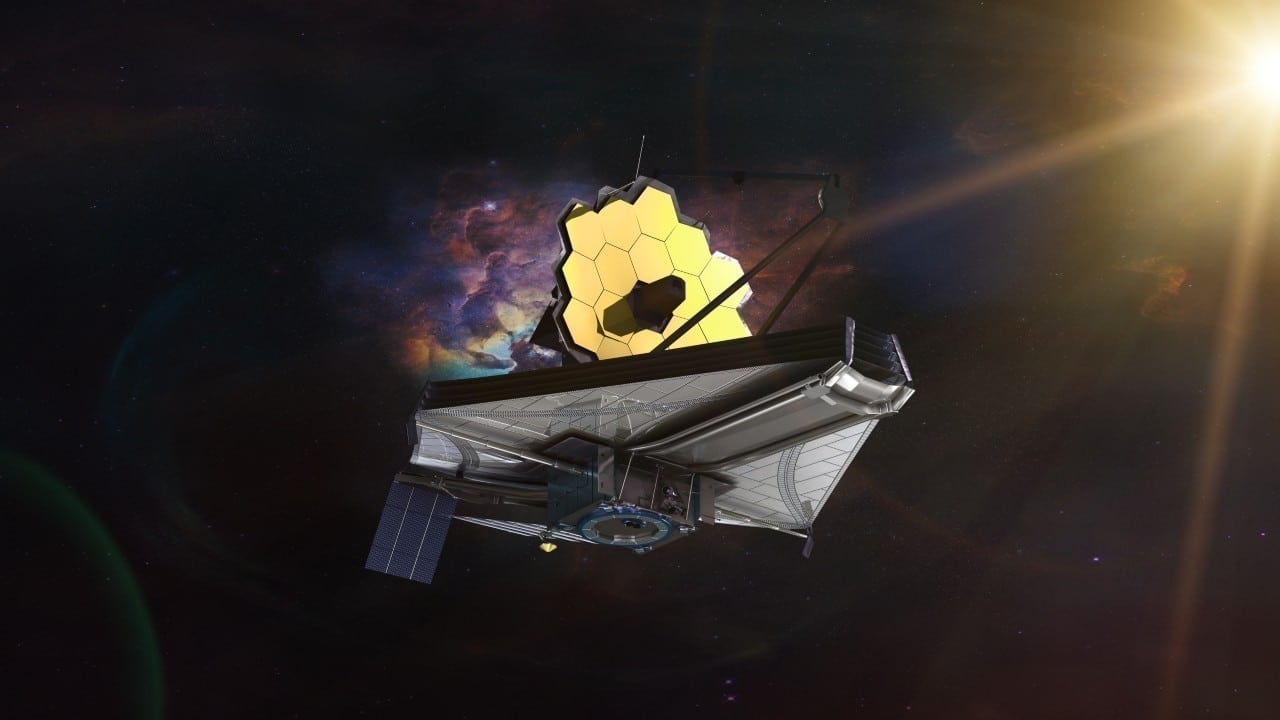
Scientists, using the James Webb Space Telescope, have detected signs of an intensely active supermassive black hole inside the distant galaxy GHZ2. This phenomenon was captured at a time when the cosmos was just 350 million years old since the Big Bang, raising questions about current theories regarding the initial formation of black holes.
Identification of a possible black hole in an extremely remote galaxy
The GHZ2 galaxy was first identified in 2022 through Webb observations, standing out among numerous other galaxies located at vast distances. The light emitted by this celestial object took approximately 13.4 billion years to reach our planet, allowing researchers to study it in a primordial period of the universe.
The feature that made GHZ2 unique was not its faint luminosity, but rather a peculiar glow manifested in specific wavelengths of infrared light. Such tones, which act as atomic markers in GHZ2, signaled the presence of a highly energetic process occurring in its galactic center.
Recent analyzes suggest that GHZ2 may be home to the most distant supermassive black hole ever detected. This discovery elevates what was previously a mere nebulous point to a fundamental object of study to understand the physical laws that governed the universe in its beginnings.
The research developed by the team, made available on the preprint server arXiv on November 4 and awaiting validation from other scientists, is based on information collected by two key pieces of equipment at Webb: the Near Infrared Spectrograph (NIRSpec) and the Mid-Infrared Instrument (MIRI). The combination of these instruments makes it possible to decompose the light coming from the galaxy into a detailed spectrum, facilitating a detailed analysis.
The analysis of light: insights from emission lines
The brightness emitted by galaxies is not homogeneous. The occurrence of intense peaks of luminosity at precise wavelengths is observed, phenomena known as emission lines. They manifest when atoms or ions receive energy and subsequently radiate it in the form of light.
At GHZ2, these bright spots reach remarkable intensity, and many are classified as “high ionization lines” by researchers. Such spectral manifestations point to the presence of gas that has been exposed to radiation with a very high energy content.
The spectral pattern of GHZ2 demonstrates high-energy emission that would be unlikely to be generated by conventional young stars, suggesting the existence of an unusual power source in its core.
A detail that immediately caught attention was a prominent C IV line, originated by triply ionized carbon, that is, carbon atoms devoid of three electrons. The creation of this energetic state requires a vast amount of very high-energy photons.
Although high-mass, high-temperature stars are capable of ionizing gases, there is a maximum threshold for this capacity. The strength of the C IV line in GHZ2 exceeds what traditional models of galaxies in the process of star formation can fully justify. On the other hand, an active galactic nucleus (AGN), which consists of gas spiraling and being sucked into a supermassive black hole, is a natural source for this more intense mode of radiation.
Evidence of a hybrid system: stars and an additional energy source
The researchers created complex models, combining the luminosity of typical stars with the radiation expected from an AGN. These models underwent successive refinements to identify the composition that most closely matched the information obtained by Webb.
The scientists’ conclusion was that many of the properties observed in the visible and near-infrared spectrum could be satisfactorily attributed to an intense star formation process. However, the carbon line and other indicators of high ionization persisted in needing an explanation that involved a supplementary, more powerful energy source.
Such a scenario strongly suggests the existence of a “composite” galaxy, a cosmic arrangement where a collective of young stars coexist and a feeding black hole emits light simultaneously.
- Intense star formation activity is responsible for the majority of low- and medium-energy emission lines.
- The high ionization lines, particularly C IV, reinforce the hypothesis of the existence of an active black hole.
- It is likely that GHZ2 contains both a vigorous starburst process and an AGN at its center.
Despite the evidence, the situation is not completely straightforward. GHZ2 does not exhibit certain classic features of AGNs often observed in closer galaxies, such as specific line ratios and some mid-infrared features. This absence leaves room for other explanations.
One of the possibilities considered is that the GHZ2 galaxy could house ephemeral stars with extraordinarily large masses, hundreds or thousands of times greater than that of the Sun, and which would be able to generate more powerful radiation than that of conventional stars. Another theory proposes that the original stellar composition of the galaxy operated differently from the stars present in contemporary galaxies, which would alter the expected profile of the emission lines.
The challenges of such a massive black hole in a young universe
If GHZ2 indeed hosts a supermassive black hole at such an early period in the existence of the cosmos, a complex question emerges for scientists: how could it reach such magnitude in such a restricted time frame?
A black hole starts with small dimensions and expands its mass by absorbing gas, dust, stars, or through union with other black holes. However, at a stage where the universe was a mere 350 million years old, the period available for the development of an object with millions of times the solar mass would be extremely limited.



