
David Hockney, artist who left a mark on British pop art with his vibrant landscapes and portraits, dies aged 88

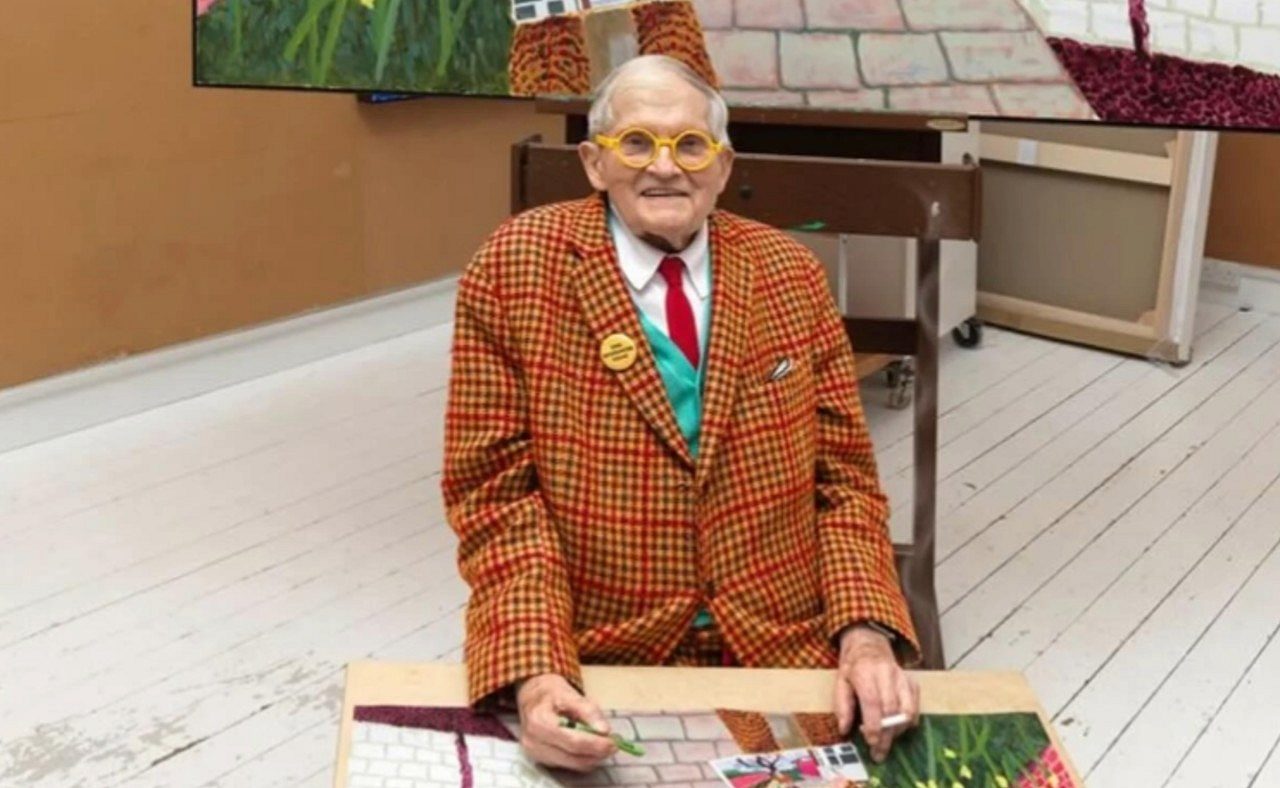
Acclaimed painter David Hockney, a central figure in the global artistic scene, passed away this Thursday (12), aged 88. Known for his lush landscapes, immersive portraits and iconic swimming pool paintings, the Brit has cemented his place as one of the giants of contemporary art.
His depictions of everyday scenes, often rendered in a bright acrylic color palette, earned him the title of one of the forerunners of British Pop Art. However, Hockney never aligned himself with this movement or any other, emphasizing that his vast work was based purely on constant observation. He believed that true art emerged from “looking, always looking”.
In an interview given in 2019 at the Louisiana Museum of Modern Art, in Denmark, Hockney reflected on his philosophy. “The world is very, very beautiful if you look at it, but most people don’t do it much, do they?” he asked. He added: “They just watch the ground in front of them so they can walk, but they don’t really look at things, incredibly well, with intensity… I do.”
Confirmation of the death of the artist, who left peacefully at his home on Thursday, was made by his press secretary, Erica Bolton.
Work “Peter Getting out of Nick’s Pool” and the recognition of David Hockney
One of David Hockney’s first major recognitions came in 1967, when his work “Peter Getting out of Nick’s Pool” won first place at the prestigious John Moores Liverpool Exhibition, solidifying his position on the art scene.
Born in West Yorkshire, England, from humble beginnings, Hockney quickly transformed himself into a vibrant force in the art world, initially taking London by storm. He then set out with the ambition of being the “Piranesi of Los Angeles”, in allusion to the 18th century engraver who documented the Italy of his time. Later, the artist devoted himself to English and French landscapes, with his restless intellect and self-confidence directing him towards color-saturated figurative works, distancing him from the abstract expressionism or pop art that dominated the scene among many of his contemporaries.
Hockney refined his singular aesthetic through travel and an insatiable appetite for experimentation, including the use of new technology. For more than six decades, he explored various media, painting with oils, acrylics and watercolors, making drawings, creating engravings and developing work on fax machines and copiers, as well as iPads and iPhones, showing remarkable adaptability and curiosity in relation to media.
His versatility extended to the design of sets for plays and operas. Using an iPad, Hockney created a hawthorn flower pattern for a stained glass window in Westminster Abbey, a tribute to the reign of Queen Elizabeth II.
David Hockney’s work for Queen Elizabeth II at Westminster Abbey
One of Hockney’s notable contributions was the design of a stained glass window for Westminster Abbey, known as “The Queen’s Window”, a tribute to the reign of Queen Elizabeth II.
With an irreverent and determined personality, Hockney never shied away from small or large controversies. A tobacco enthusiast since the age of 16, he sparked controversy during the Covid-19 pandemic by publicly speculating whether smokers might be immune to the virus. Although he was an avid reader, his spelling was poor, immortalizing the word “tea” as “tae” in a 1961 painting. He flouted art school rules and did not hide his homosexuality at a time when many did. When hearing loss led him to wear hearing aids in middle age, he credited the condition with sharpening his perception of the world around him, enriching his art.
Blockbuster exhibitions featuring Hockney’s most popular works attracted record numbers of visitors to museums. In 2018, his painting “Portrait of an Artist, (Pool with Two Figures)” sold for US$90.3 million, setting at the time the highest price ever paid at auction for a work by a living artist. Hockney took the title from Jeff Koons, who regained it the following year when his “Rabbit” sculpture sold for $91 million.
He was also widely recognized for his portraits, often of couples, including his friends, writer Christopher Isherwood and artist Don Bachardy.
Famous portrait ‘Mr and Mrs Clark and Percy’ on display
The famous portrait ‘Mr and Mrs Clark and Percy’ was one of the works highlighted at Tate Britain, London, as part of an exhibition covering 500 years of British art.
Among other themes explored by Hockney were his dachshunds, Stanley and Boodgie; friends like textile designer Celia Birtwell and curator Henry Geldzahler; and family members, including their parents. The artist also documented his own image and physique from youth to old age, with candid depictions of aging.
Since he began using Polaroid cameras in the 1960s, Hockney has maintained an intense relationship with photography, capturing thousands of images and using some in collages and other creations. He also worked with 35mm cameras and digital devices, but always argued that photography could not capture nature in the same way as painting.
Born in Bradford, England, in 1937, Hockney demonstrated a fascination with painting and the mechanics of moving the brush from pot to canvas from a young age. In interviews, he recalled how, as a child, he was mesmerized by watching his father use fresh paint to renovate old bicycles. Attracted by art classes at school, he stated that, at the age of 11, he had already decided that he would be an artist.
In 1959, he moved to London to study at the Royal College of Art. In the midst of a cosmopolitan circle of teachers and students, he experimented with abstract expressionism, then in vogue, but did not adapt to it.
At the Royal College of Art, Hockney distinguished himself as a superlative draughtsman, absorbing classical training in his own way. When the institution awarded him its gold medal, Hockney accepted the honor wearing a gold lamé coat.
During his student years he devoted himself to engraving, in part because the Royal College of Art covered the costs of his materials. In group exhibitions, Hockney’s paintings have won awards and the attention of curators and collectors. After graduation, he set up a studio in Notting Hill, London, which at the time was a neighborhood in stark contrast to the trendy area it has become today. In a productive frenzy, he completed paintings for his first successful solo exhibition in December 1963 in London.
David Hockney in his studio: images from 1967
An image from 1967 depicts David Hockney in his studio, surrounded by some of his works, capturing a moment in his artistic production at the height of his career.
The following year marked a turning point in his life. Attracted by the climate and the promise of new friendships and experiences, Hockney visited California. He arrived without a driver’s license, according to Christopher Simon Sykes’ biography of the artist, and barely passed the test after a brief lesson in a friend’s truck. He enjoyed driving and, over the years, progressed from the $1,000 Ford Falcon, in which he initially cruised the highways, to luxury vehicles.
Hockney immortalized on his canvases the palm trees, modern homes and swimming pools of Los Angeles and Santa Monica, falling in love with a region where he would reside intermittently for more than five decades.
His many projects for theater and opera began with the sets for a revival of Alfred Jarry’s “Ubu Rei” in 1966 at the Royal Court Theater in London.
A transatlantic celebrity since the 1960s, Hockney cut a dandy figure with irreverent touches such as loose bow ties, scarves, caps and pocket squares. Large, round glasses, often with heavy black frames, were another of his trademarks. In 1961, an advertisement for Lady Clairol hair dye inspired him to transform his naturally dark hair into platinum blonde.
Hockney’s multidisciplinary approach: from stage to photographic collage
Hockney’s multifaceted approach to art ranged from designing opera sets to creating complex collages from photographs, demonstrating his vast exploration of different mediums and techniques.
Hockney was prone to long sessions in the studio, especially as his romantic life became more intense. The separation from his partner, Peter Schlesinger, in the early 1970s spurred an extremely productive period that resulted in paintings such as “Portrait of an Artist, (Pool with Two Figures)”.
As exhibitions, books, and retrospectives cemented his fame, Hockney increasingly relied on travel—to Paris and elsewhere—to be able to work uninterrupted, before friends and other commitments crowded his schedule.
In his final years, his artistic focus shifted from California back to Europe, motivated by a renewed interest in painting outdoors. Nature, and trees in particular, became his obsession. Hockney returned to England in 1997 for his first extended stay in decades, devoting hours to driving, admiring and painting the Yorkshire landscape. He returned in 2004, spending a summer creating watercolors of the landscape, and continued to depict the following seasons in oil.



