
Space rock found in the Sahara proves the existence of an extinct planet in the Solar System

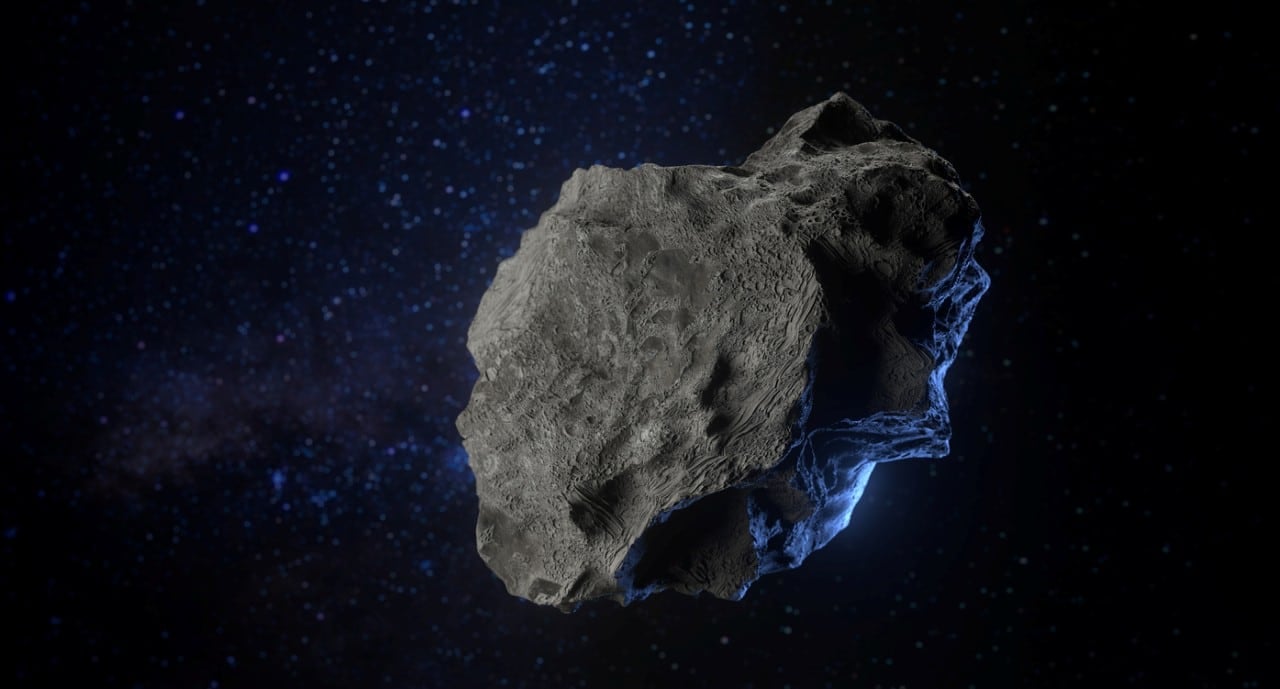
A small rock fragment recovered from the vast expanses of the Sahara Desert is rewriting the history of the formation of our corner of the universe. Researchers have identified compelling evidence of an ancient celestial body that orbited the Sun during the early days of the planetary system, but which ended up being completely annihilated. The main hypothesis suggests that this primitive world suffered a large-scale cataclysmic collision, an event quite frequent during the chaotic phase of structuring of the cosmos. This stunning discovery offers an unprecedented window into understanding the violent dynamics that shaped Earth’s neighborhood.
The object responsible for this revelation goes by the technical name of NWA 12774, a space rock that weighs approximately 454 grams and was recovered in 2019. Far from being an ordinary pebble, the material carries chemical signatures that challenge previous theories about the evolution of the first rocky planets. By analyzing the intimate composition of this space fossil, scientists realized that it did not fit into traditional models of asteroid formation, requiring a new investigative approach.
The geological rarity hidden in the sands of the African desert
Experts classified the sample as an angrite, an extremely unusual category of volcanic meteorite that is among the oldest ever documented by science. To give you an idea of its chronological importance, this rock solidified just a few million years after the birth of the Solar System itself, which dates back an impressive 4.56 billion years in the past. It is a true time capsule that survived unimaginable eons wandering through the void before falling to our planet.
The exclusivity of this material becomes even more evident when we look at the global astronomical cataloging numbers. The global collection of documented space rocks shows how precious the fragment studied by geoscience teams is:
- There are more than 80 thousand meteorites officially registered and stored in research institutions around the globe.
- Of this colossal amount, less than 70 specimens belong to the rare class of angritos.
- The atypical chemical composition of these specific samples indicates evolutionary paths completely different from those taken by known planets.
Until the emergence of this new analysis, the scientific community mostly believed that the angrites were fragments resulting from the destruction of a medium-sized asteroid, around 200 kilometers in diameter. This prevailing view limited understanding of the size and complexity of the celestial bodies that inhabited our cosmic neighborhood in its early days, treating these rocks as mere shards of smaller space boulders.
Chemical clues point to an environment of crushing pressure
The perspective on the origin of these rocks has changed radically thanks to a recent study conducted by geoscientist Aaron Bell, linked to the University of Colorado, in the United States. The research team applied advanced detailed analysis techniques and was able to identify the presence of aluminum-rich clinopyroxene within the sample. This specific mineral works as a natural barometer, as its crystallization requires very particular and extremely intense environmental conditions.
To understand the exact origin of the mineral, scientists needed to recreate in the laboratory the exact conditions under which the meteorite was forged billions of years ago. Test results demonstrated that the material could only have grown under crushing pressures of at least 17.5 kilobars. This technical data was the turning point that overturned the small asteroid theory, since a celestial body of reduced dimensions would never be able to generate such an internal gravitational force.
The magnitude of this pressure becomes easier to understand when compared to known extremes on our own planet. The value discovered by the researchers exceeds by more than 17 times the pressure recorded at the bottom of the Mariana Trench, the deepest and most inhospitable place in all of Earth’s oceans. The research, which gained prominence in the pages of the prestigious scientific journal Earth and Planetary Science Letters, found that only a celestial body of gigantic proportions could harbor such conditions in its internal layers.
Estimated dimensions of the ancient celestial body that disappeared from the map
Based on pressure data and the mineral’s crystalline structure, scientists were able to calculate the approximate size of the lost world that gave rise to the meteorite. Estimates indicate that the angrite formed in the surface layers of a protoplanet that was at least 1,800 kilometers in diameter. This initial measurement would already place it at a size slightly larger than our Moon, configuring an object of considerable mass in primitive space.
The research team’s superior projections suggest that the celestial body could be even more imposing, although it would not match the size of today’s consolidated planets. Calculations indicate that the protoplanet could measure up to 3,200 kilometers from end to end, which would make it slightly smaller than Mars. Regardless of the exact size, the certainty is that it was a complex world, with volcanic activity and geological differentiation, which ended up being wiped off the cosmic map.
The disappearance of this protoplanet perfectly illustrates the brutality of the Solar System in its infancy, when gravity was still organizing orbits and titanic collisions were routine events. The colossal shock that pulverized this world scattered its debris across deep space, and some of these fragments traveled for billions of years until they crossed Earth’s orbit and fell onto the scorching sands of the African continent.
The impact of this discovery on the future of astronomical exploration
The study leader expressed fascination with the revelations provided by such a small and apparently simple rock. In an official statement, Aaron Bell highlighted how incredible it is to see that a world of such vast proportions existed in the past and disappeared without leaving an evident trace in our neighborhood. The researcher highlighted that humanity only knows about the existence of this protoplanet because a tiny fraction of its debris managed to survive the space journey and land safely on our planet.
The research sets an exciting precedent for reviewing materials that have already been in the scientific community’s possession for decades. The authors of the study make a point of remembering that an immense amount of meteorites remains stored on the shelves and vaults of university laboratories around the world, awaiting more modern analyses. The application of new scanning and pressure simulation technologies could transform these forgotten stones into fundamental keys to unlocking other astronomical mysteries.
The future of planetary geology gains new momentum in light of these advanced laboratory research methodologies. Future analysis of these dusty collections has the real potential to reveal the existence of other lost worlds that orbited the Sun during the early stages of our system’s formation. Each reevaluated meteorite holds the promise of telling the story of a planet that did not survive the gravitational dance, helping to piece together the complex puzzle of our own cosmic origin.





