Interstellar comet 3I/Atlas reaches a speed of 57 km/s and crosses the Solar System on a route of no return
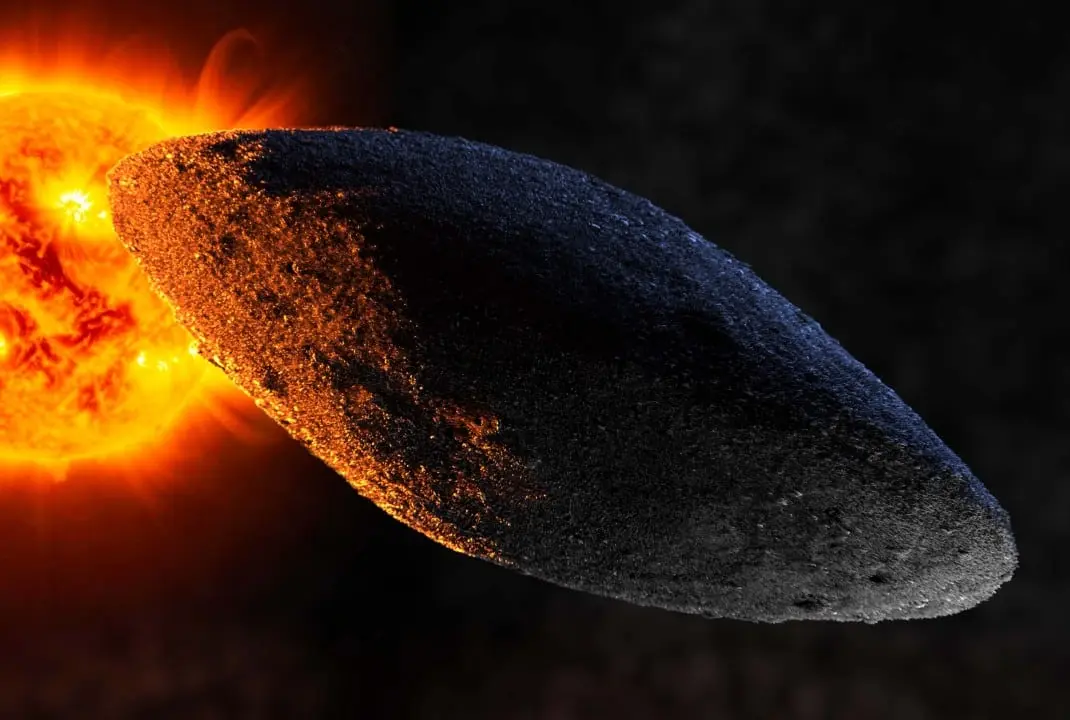
The celestial body classified as 3I/Atlas advances through our cosmic space at an impressive speed of 57 kilometers per second. This visitor travels in an open curve format, a mathematical feature that guarantees its direct passage without the attraction force of our main star being able to trap it in a fixed orbit. Researchers who monitor the skies have already attested, using high-precision equipment, that the space rock was born far beyond our neighboring borders.
The recent astronomical finding places the traveler as the third visitor from outside ever documented by science, following in the historical footsteps of the asteroid ‘Oumuamua, detected in 2017, and the comet Borisov, cataloged in 2019. The initial displacement rate far surpasses the barrier necessary to escape any local gravitational field, transforming the encounter into a kind of cosmic slingshot that only changes the direction of the flight. Although the magnetic and physical influence of our star-king reaches distances of up to 3.8 light years, this invisible force completely fails in its attempt to stop the passage of the errant body.
- 3I/Atlas travel speed: 57 km/s;
- Trademark set by pioneer ‘Oumuamua: 26 km/s;
- Maximum speed of predecessor Borisov: 33 km/s.
How deep space travelers are born and expelled
Rock or ice structures with this profile used to revolve around distant suns before undergoing a violent expulsion process. Extreme events, such as the explosion of a massive star at the end of its life or an intense gravitational clash with giant planets, act as the trigger that hurls these fragments into the dark void between star systems.
The solitary journey lasts millions of years in absolute darkness until the rock crosses the path of an inhabited planetary neighborhood, like ours. Research centers use powerful lenses to map flight angles that do not close a circle around our sun, definitive proof that the material carries an alien passport.
Understanding the math behind the route of no return
The concept of hyperbolic path means, in practice, that the object has kinetic energy much greater than the retention force of the environment at any point on the map. The visitor enters our territory, suffers a slight detour due to solar mass and leaves forever, eliminating any chance of becoming a permanent neighbor.
The gravitational pull of the center of our system manages to bend the flight line, but fails to reduce the rock’s momentum to a level that allows capture. Monitoring teams continue to track telemetry data as the structure of ice and dust plunges back into the unexplored depths of the galaxy.
Mathematical projections point out exactly when the closest approach to Earth will occur, a fleeting event that will last just a few weeks on the astronomical calendar. High-capacity simulators run virtual scenarios to understand how the gravitational pull will dictate the traveler’s new direction.
Crucial differences from local celestial bodies
The pieces of dirty ice that were born in our cosmic backyard usually reach tens of kilometers per second only when they reach perihelion, the hottest point closest to the star. The galactic outsiders, on the other hand, maintain the frenetic pace they inherited from the chaotic environment where they were originally ejected.
This contrast in dynamic behavior serves as a stamp of external origin for the newly discovered body. Spectroscopy equipment dissects the light reflected by the surface to catalog the exact chemical recipe, looking for proportions of minerals that do not exist in our planetary formation table.
The mystery of the speed gain in previous visits
The first known outsider, ‘Oumuamua, intrigued the scientific community by recording an unexplained acceleration gain during his visit in 2017. The release of pockets of hydrogen trapped inside the rock ended up offering the most logical explanation for the extra push, ruling out fanciful theories.
The extreme heat generated by the stellar proximity works like a natural engine, melting the ice inside and creating jets of gas that push the structure forward. Other ideas raised at the time to explain the phenomenon ended up losing strength due to an absolute lack of concrete data to support the theses.
The physical consequences of meeting our sun
The grazing through the center of the system bends the intruder’s line of travel at an angle already calculated by the mathematicians on duty. Ground-based laboratories keep their eyes glued to telescopes to refine output coordinates second by second.
The energy of the movement easily wins the tug of war against the attraction force of our star. After crossing the final frontier, the space rock resumes its vocation as a cosmic nomad, traveling in a straight line through eternity.
What the chemical signature reveals about the visitor
Preliminary surveys show that the rock carries the same basic building blocks of the universe, but mixed in a totally different recipe from that found in our asteroids. This laboratory reading hammers home the classification of the body as a true mineral alien.
Optical sensors capture the rainbow of light emitted by the comet’s tail to compare it with the database of terrestrial and lunar materials. The verdict of the numbers proves that the fast-moving block of ice has no degree of kinship with the dust cloud that formed the Earth.